
Pulp Fiction, 1865 · page 215 of 400
The Argosy — page 215: what you’re looking at
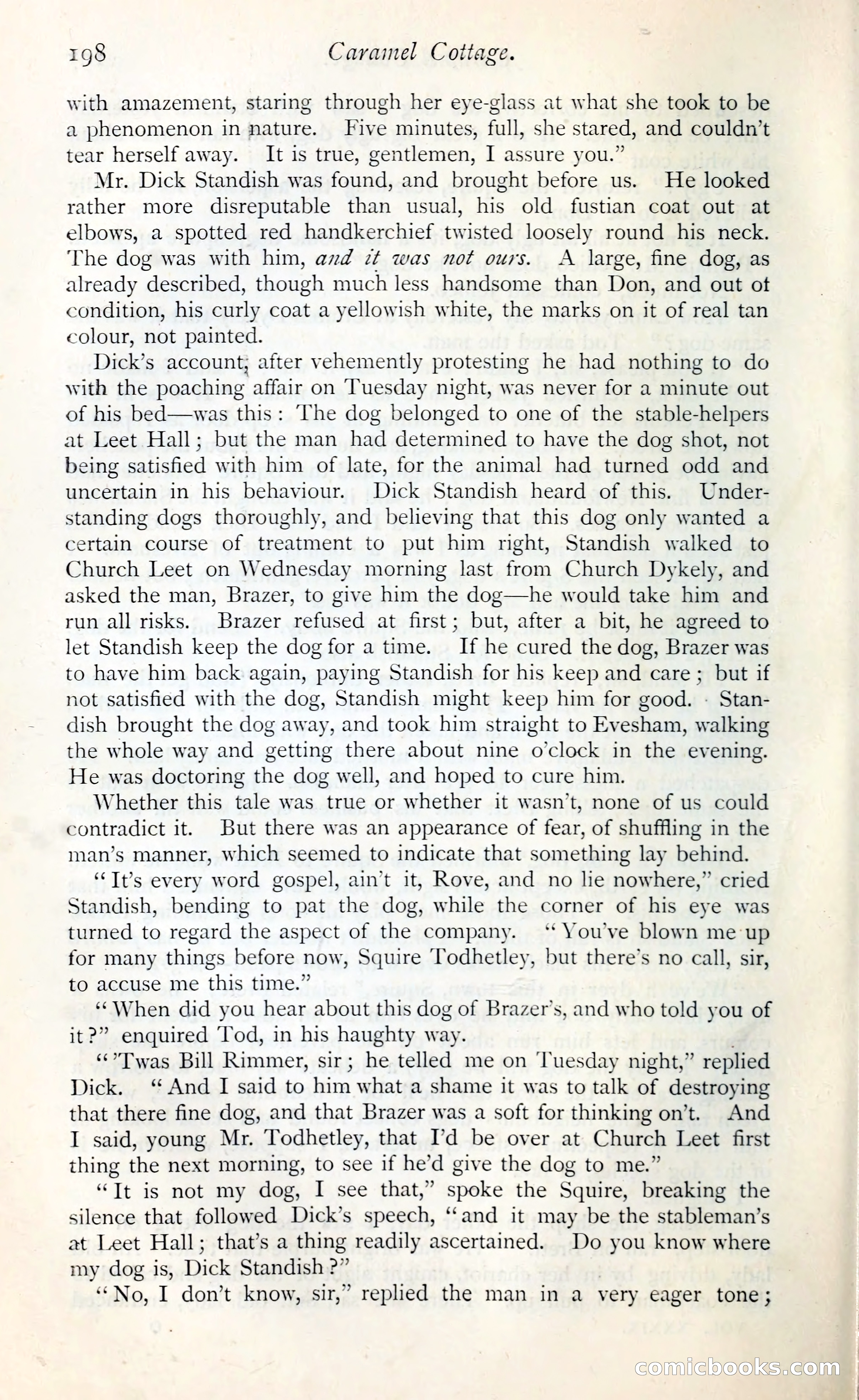
A restored page from Pulp Fiction, 1865. Page through the whole issue in the reader above.
📄 Transcribed text from this page (OCR, searchable)
Machine-transcribed from the original scan — historical spelling and the odd misread are preserved.
198 Caramel Cottage. with amazement, staring through her eye-glass at what she took to be a phenomenon in nature. Five minutes, full, she stared, and couldn't tear herself away. It is true, gentlemen, I assure you.” | Mr. Dick Standish was found, and brought before us. He looked rather more disreputable than usual, his old fustian coat out at elbows, a spotted red handkerchief twisted loosely round his neck. The dog was with him, avd zt was not ours. <A large, fine dog, as already described, though much less handsome than Don, and out ot condition, his curly coat a yellowish white, the marks on it of real tan colour, not painted. Dick’s account, after vehemently protesting he had nothing to do with the poaching affair on Tuesday night, was never for a minute out of his bed—was this: The dog belonged to one of the stable-helpers at Leet Hall; but the man had determined to have the dog shot, not being satisfied with him of late, for the animal had turned odd and uncertain in his behaviour. Dick Standish heard of this. Under- standing dogs thoroughly, and believing that this dog only wanted a certain course of treatment to put him right, Standish walked to Church Leet on Wednesday morning last from Church Dykely, and asked the man, Brazer, to give him the dog—he would take him and run all risks. Brazer refused at first; but, after a bit, he agreed to let Standish keep the dog for a time. If he cured the dog, Brazer was to have him back again, paying Standish for his keep and care ; but if not satisfied with the dog, Standish might keep him for good. - Stan- dish brought the dog away, and took him straight to Evesham, walking the whole way and getting there about nine o’clock in the evening. He was doctoring the dog well, and hoped to cure him. Whether this tale was true or whether it wasn’t, none of us could contradict it. But there was an appearance of fear, of shuffling in the man’s manner, which seemed to indicate that something lay behind. ‘It’s every word gospel, ain’t it, Rove, and no lie nowhere,” cried Standish, bending to pat the dog, while the corner of his eye was turned to regard the aspect of the company. ‘ You've blown me-up for many things before now, Squire Todhetley, but there’s no call, sir, to accuse me this time.” ‘‘When did you hear about this dog of Brazer’s, and who told you of it?” enquired Tod, in his haughty way. | “°Twas Bill Rimmer, sir; he telled me on Tuesday night,” replied Dick. ‘And I said to him what a shame it was to talk of destroying that there fine dog, and that Brazer was a soft for thinking on’t. And I said, young Mr. Todhetley, that I'd be over at Church Leet first thing the next morning, to see if he’d give the dog to me.” “Tt is not my dog, I see that,” spoke the Squire, breaking the silence that followed Dick’s speech, ‘‘and it may be the stableman’s at Leet Hall; that’s a thing readily ascertained. Do you know where my dog is, Dick Standish ?” ‘“No, I don’t know, sir,” replied the man in a very eager tone; GOMIGIOOKS