
Pulp Fiction, 1865 · page 214 of 400
The Argosy — page 214: what you’re looking at
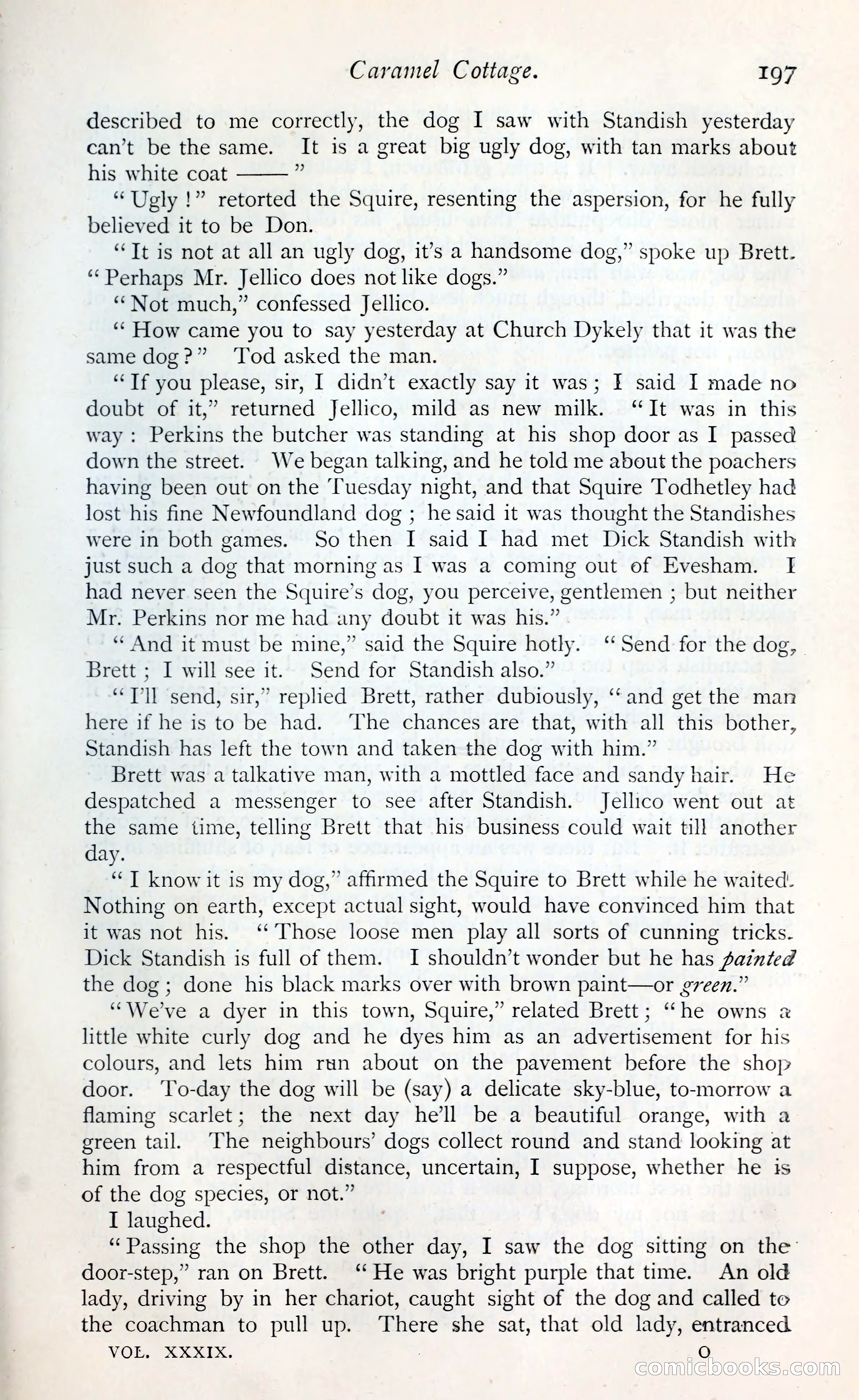
A restored page from Pulp Fiction, 1865. Page through the whole issue in the reader above.
📄 Transcribed text from this page (OCR, searchable)
Machine-transcribed from the original scan — historical spelling and the odd misread are preserved.
Caramel Cottage. 197 described to me correctly, the dog I saw with Standish yesterday can’t be the same. It is a great big ugly dog, with tan marks about his white coat - “Ugly !” retorted the Squire, resenting the aspersion, for he fully believed it to be Don. “Tt is not at all an ugly dog, it’s a handsome dog,” spoke up Brett- ‘““Perhaps Mr. Jellico does not like dogs.” “Not much,” confessed Jellico. ‘‘ How came you to say yesterday at Church Dykely that it was the same dog?” ‘Tod asked the man. ‘“‘If you please, sir, I didn’t exactly say it was; I said I made no doubt of it,” returned Jellico, mild as new milk. “It was in this way : Perkins the butcher was standing at his shop door as I passed down the street. We began talking, and he told me about the poachers having been out on the Tuesday night, and that Squire Todhetley had lost his fine Newfoundland dog ; hesaid it was thought the Standishes were in both games. So then I said I had met Dick Standish with just such a dog that morning as I was a coming out of Evesham. If had never seen the Squire’s dog, you perceive, gentlemen ; but neither Mr. Perkins nor me had any doubt it was his.” “And it must be mine,” said the Squire hotly. ‘‘Send for the dog, Brett ; I will see it. Send for Standish also.” ‘““T’ll send, sir,” rephed Brett, rather dubiously, ‘and get the man here if he is to be had. ‘The chances are that, with all this bother, Standish has left the town and taken the dog with him.” Brett was a talkative man, with a mottled face and sandy hair. He despatched a messenger to see after Standish. Jellico went out at the same time, telling Brett that his business could wait till another day. “IT know it is my dog,” affirmed the Squire to Brett while he waited. Nothing on earth, except actual sight, would have convinced him that it was not his. ‘‘ Those loose men play all sorts of cunning tricks. Dick Standish is full of them. I shouldn’t wonder but he has painted the dog; done his black marks over with brown paint—or green.” “We've a dyer in this town, Squire,” related Brett; “he owns a little white curly dog and he dyes him as an advertisement for his colours, and lets him run about on the pavement before the shop door. ‘To-day the dog will be (say) a delicate sky-blue, to-morrow a flaming scarlet; the next day he'll be a beautiful orange, with a green tail. The neighbours’ dogs collect round and stand looking at him from a respectful distance, uncertain, I suppose, whether he is of the dog species, or not.” I laughed. “Passing the shop the other day, I saw the dog sitting on the’ door-step,” ran on Brett. ‘‘ He was bright purple that time. An old lady, driving by in her chariot, caught sight of the dog and called to the coachman to pull up. There she sat, that old lady, entranced VOL. XXXIX. | an O ECORNICLOOKS.EO