
Pulp Fiction, 1865 · page 154 of 400
The Argosy — page 154: what you’re looking at
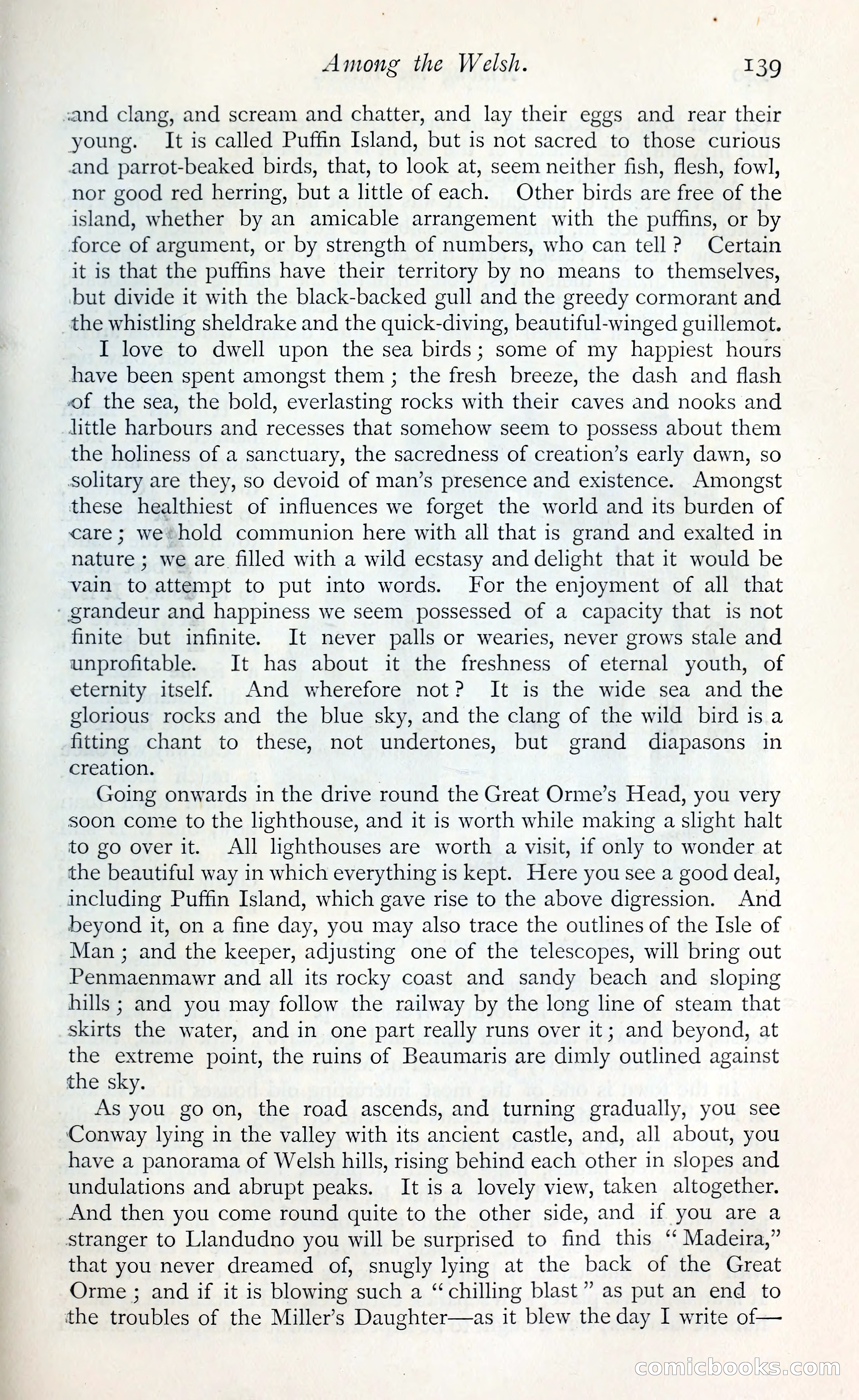
A restored page from Pulp Fiction, 1865. Page through the whole issue in the reader above.
📄 Transcribed text from this page (OCR, searchable)
Machine-transcribed from the original scan — historical spelling and the odd misread are preserved.
Among the Welsh. 139 sand clang, and scream and chatter, and lay their eggs and rear their young. It is called Puffin Island, but is not sacred to those curious and parrot-beaked birds, that, to look at, seem neither fish, flesh, fowl, nor good red herring, but a little of each. Other birds are free of the island, whether by an amicable arrangement with the puffins, or by force of argument, or by strength of numbers, who can tell? Certain it is that the puffins have their territory by no means to themselves, but divide it with the black-backed gull and the greedy cormorant and the whistling sheldrake and the quick-diving, beautiful-winged guillemot. I love to dwell upon the sea birds; some of my happiest hours have been spent amongst them ; the fresh breeze, the dash and flash of the sea, the bold, everlasting rocks with their caves and nooks and hittle harbours and recesses that somehow seem to possess about them the holiness of a sanctuary, the sacredness of creation’s early dawn, so solitary are they, so devoid of man’s presence and existence. Amongst these healthiest of influences we forget the world and its burden of care; wethold communion here with all that is grand and exalted in nature ; we are filled with a wild ecstasy and delight that it would be vain to attempt to put into words. For the enjoyment of all that ' grandeur and happiness we seem possessed of a capacity that is not finite but infinite. It never palls or wearies, never grows stale and unprofitable. It has about it the freshness of eternal youth, of eternity itself. And wherefore not? It is the wide sea and the glorious rocks and the blue sky, and the clang of the wild bird is a fitting chant to these, not undertones, but grand diapasons in creation. Going onwards in the drive round the Great Orme’s Head, you very soon come to the lighthouse, and it is worth while making a shght halt to go over it. All lighthouses are worth a visit, if only to wonder at the beautiful way in which everything is kept. Here you see a good deal, including Puffin Island, which gave rise to the above digression. And beyond it, on a fine day, you may also trace the outlines of the Isle of Man ; and the keeper, adjusting one of the telescopes, will bring out Penmaenmawr and all its rocky coast and sandy beach and sloping hills; and you may follow the railway by the long line of steam that skirts the water, and in one part really runs over it; and beyond, at the extreme point, the ruins of Beaumaris are dimly outlined against the sky. As you goon, the road ascends, and turning gradually, you see Conway lying in the valley with its ancient castle, and, all about, you have a panorama of Welsh hills, rising behind each other in slopes and undulations and abrupt peaks. It is a lovely view, taken altogether. And then you come round quite to the other side, and if you are a stranger to Llandudno you will be surprised to find this ‘ Madeira,” that you never dreamed of, snugly lying at the back of the Great Orme ; and if it is blowing such a “chilling blast’ as put an end to the troubles of the Miller’s Daughter—as it blew the day I write of— GomilGaooks ) (CO)