
Pulp Fiction, 1865 · page 153 of 400
The Argosy — page 153: what you’re looking at
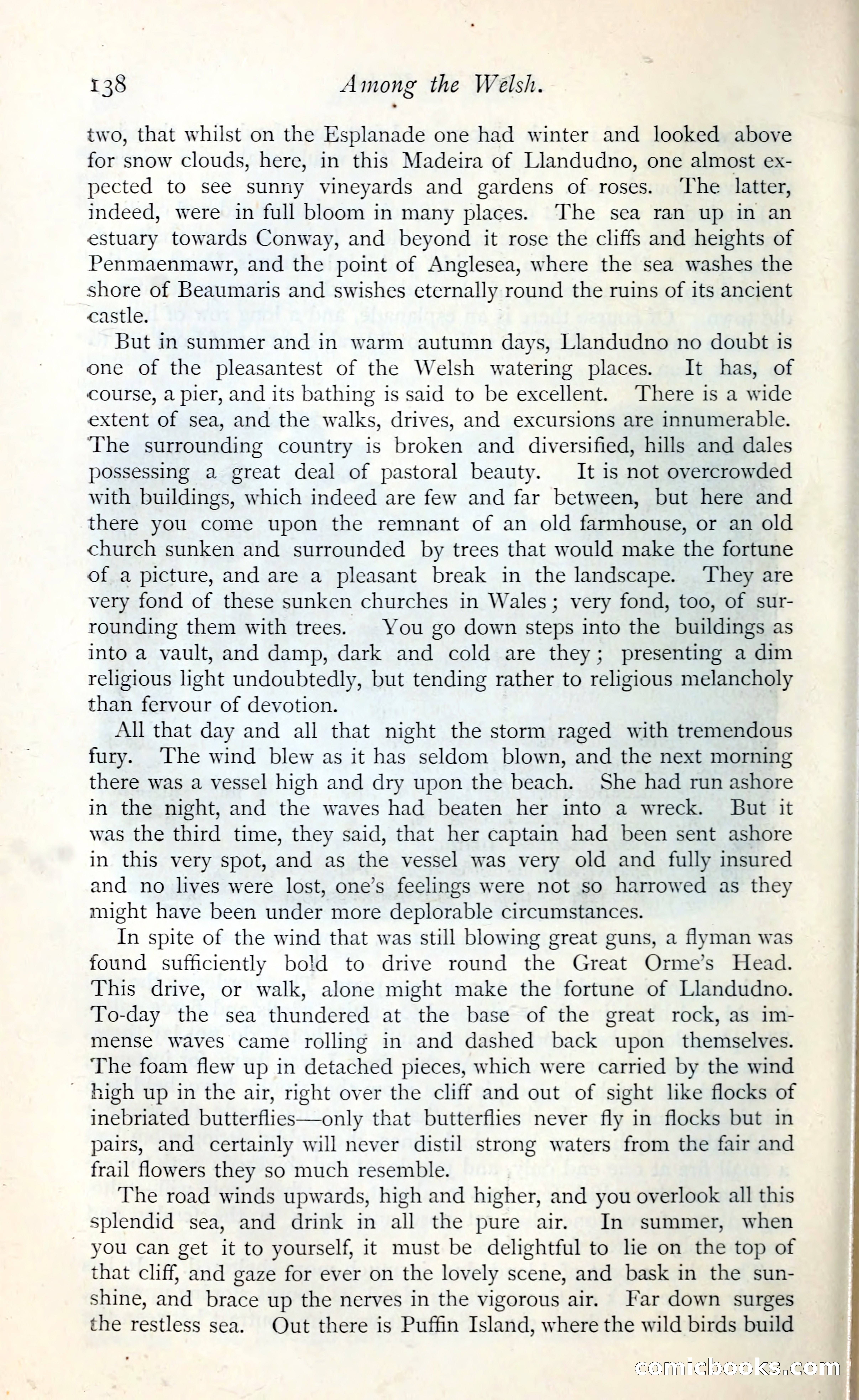
A restored page from Pulp Fiction, 1865. Page through the whole issue in the reader above.
📄 Transcribed text from this page (OCR, searchable)
Machine-transcribed from the original scan — historical spelling and the odd misread are preserved.
138 Among the Welsh. two, that whilst on the Esplanade one had winter and looked above for snow clouds, here, in this Madeira of Llandudno, one almost ex- pected to see sunny vineyards and gardens of roses. ‘The latter, indeed, were in full bloom in many places. ‘The sea ran up in an estuary towards Conway, and beyond it rose the cliffs and heights of Penmaenmawr, and the point of Anglesea, where the sea washes the shore of Beaumaris and swishes eternally round the ruins of its ancient castle. But in summer and in warm autumn days, Llandudno no doubt is one of the pleasantest of the Welsh watering places. It has, of course, a pier, and its bathing is said to be excellent. There is a wide extent of sea, and the walks, drives, and excursions are innumerable. ‘The surrounding country is broken and diversified, hills and dales possessing a great deal of pastoral beauty. It is not overcrowded with buildings, which indeed are few and far between, but here and there you come upon the remnant of an old farmhouse, or an old church sunken and surrounded by trees that would make the fortune of a picture, and are a pleasant break in the landscape. ‘They are very fond of these sunken churches in Wales; very fond, too, of sur- rounding them with trees. | You go down steps into the buildings as into a vault, and damp, dark and cold are they; presenting a dim religious light undoubtedly, but tending rather to religious melancholy than fervour of devotion. All that day and all that night the storm raged with tremendous fury. The wind blew as it has seldom blown, and the next morning there was a vessel high and dry upon the beach. She had run ashore in the night, and the waves had beaten her into a wreck. But it was the third time, they said, that her captain had been sent ashore in this very spot, and as the vessel was very old and fully insured and no lives were lost, one’s feelings were not so harrowed as they might have been under more deplorable circumstances. In spite of the wind that was still blowing great guns, a flyman was found sufficiently bold to drive round the Great Orme’s Head. This drive, or walk, alone might make the fortune of Llandudno. To-day the sea thundered at the base of the great rock, as im- mense waves came rolling in and dashed back upon themselves. The foam flew up in detached pieces, which were carried by the wind high up in the air, right over the cliff and out of sight lke flocks of inebriated butterflies—only that butterflies never fly in flocks but in pairs, and certainly will never distil strong waters from the fair and frail flowers they so much resemble. The road winds upwards, high and higher, and you overlook all this splendid sea, and drink in all the pure air. In summer, when - you can get it to yourself, it must be delightful to lie on the top of that cliff, and gaze for ever on the lovely scene, and bask in the sun- shine, and brace up the nerves in the vigorous air. Far down surges the restless sea. Out there is Puffin Island, where the wild birds build ECORNICLIOM KS ,(e()