
Pulp Fiction, 1865 · page 72 of 399
The Argosy — page 72: what you’re looking at
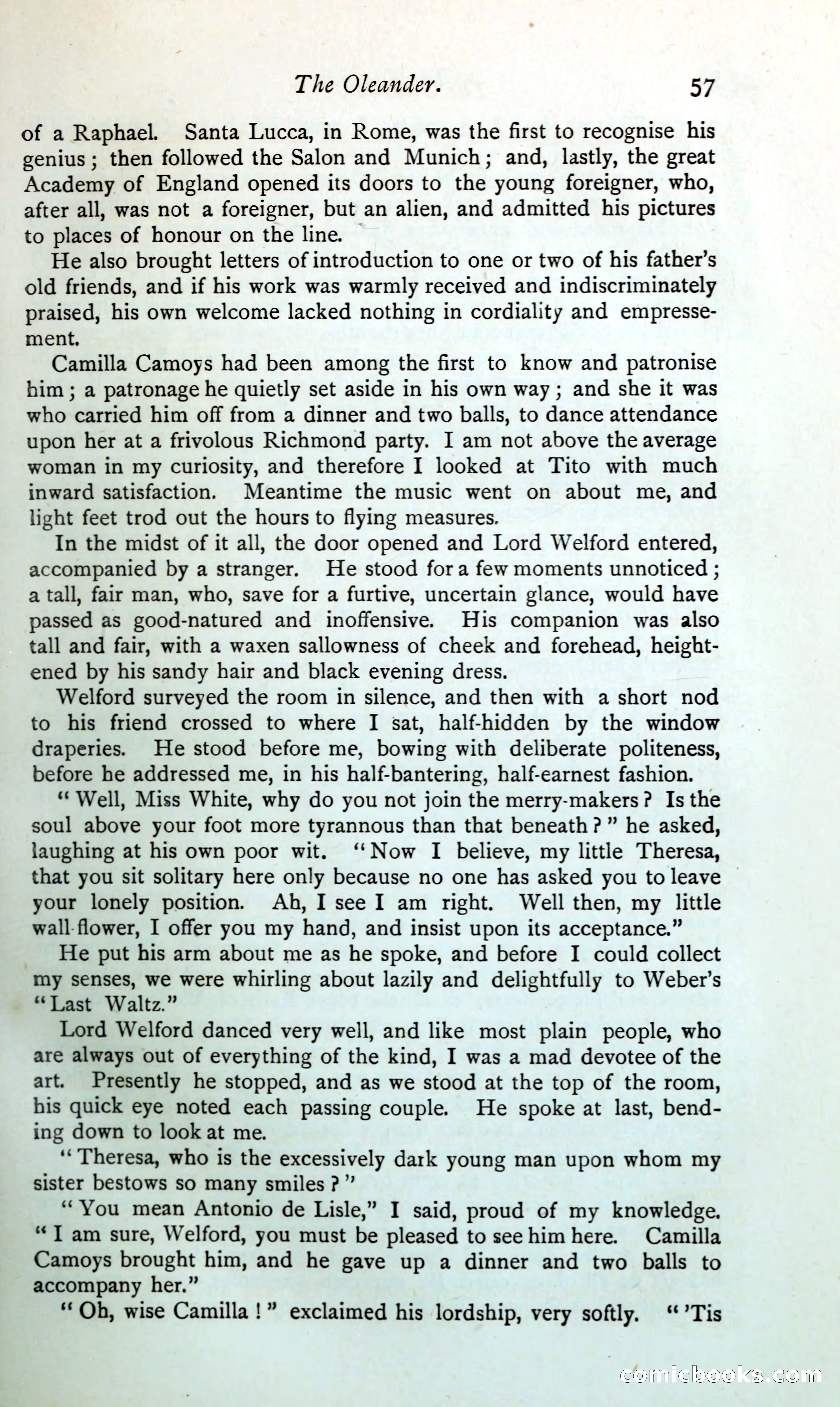
A restored page from Pulp Fiction, 1865. Page through the whole issue in the reader above.
📄 Transcribed text from this page (OCR, searchable)
Machine-transcribed from the original scan — historical spelling and the odd misread are preserved.
The Oleander. 57 of a Raphael. Santa Lucca, in Rome, was the first to recognise his genius ; then followed the Salon and Munich; and, lastly, the great Academy of England opened its doors to the young foreigner, who, after all, was not a foreigner, but an alien, and admitted his pictures to places of honour on the line. — He also brought letters of introduction to one or two of his father’s old friends, and if his work was warmly received and indiscriminately praised, his own welcome lacked nothing in cordiality and empresse- ment. Camilla Camoys had been among the first to know and patronise him ; a patronage he quietly set aside in his own way; and she it was who carried him off from a dinner and two balls, to dance attendance upon her at a frivolous Richmond party. I am not above the average woman in my curiosity, and therefore I looked at Tito with much inward satisfaction. Meantime the music went on about me, and light feet trod out the hours to flying measures. In the midst of it all, the door opened and Lord Welford entered, accompanied by a stranger. He stood fora few moments unnoticed ; a tall, fair man, who, save for a furtive, uncertain glance, would have passed as good-natured and inoffensive. His companion was also tall and fair, with a waxen sallowness of cheek and forehead, height- ened by his sandy hair and black evening dress. Welford surveyed the room in silence, and then with a short nod to his friend crossed to where I sat, half-hidden by the window draperies. He stood before me, bowing with deliberate politeness, before he addressed me, in his half-bantering, half-earnest fashion. “Well, Miss White, why do you not join the merry-makers? Is the soul above your foot more tyrannous than that beneath?” he asked, laughing at his own poor wit. ‘‘Now I believe, my little Theresa, that you sit solitary here only because no one has asked you to leave your lonely position. Ah, I see I am right. Well then, my little wall-flower, I offer you my hand, and insist upon its acceptance.” He put his arm about me as he spoke, and before I could collect my senses, we were whirling about lazily and delightfully to Weber’s “Last Waltz.” Lord Welford danced very well, and like most plain people, who are always out of everything of the kind, I was a mad devotee of the art. Presently he stopped, and as we stood at the top of the room, his quick eye noted each passing couple. He spoke at last, bend- ing down to look at me. ‘Theresa, who is the excessively dark young man upon whom my sister bestows so many smiles ? ” ‘You mean Antonio de Lisle,” I said, proud of my knowledge. “] am sure, Welford, you must be pleased to seehim here. Camilla Camoys brought him, and he gave up a dinner and two balls to accompany her.” ‘Oh, wise Camilla!” exclaimed his lordship, very softly. ‘“ ’Tis Gomichboo (E©) m