
Pulp Fiction, 1865 · page 71 of 399
The Argosy — page 71: what you’re looking at
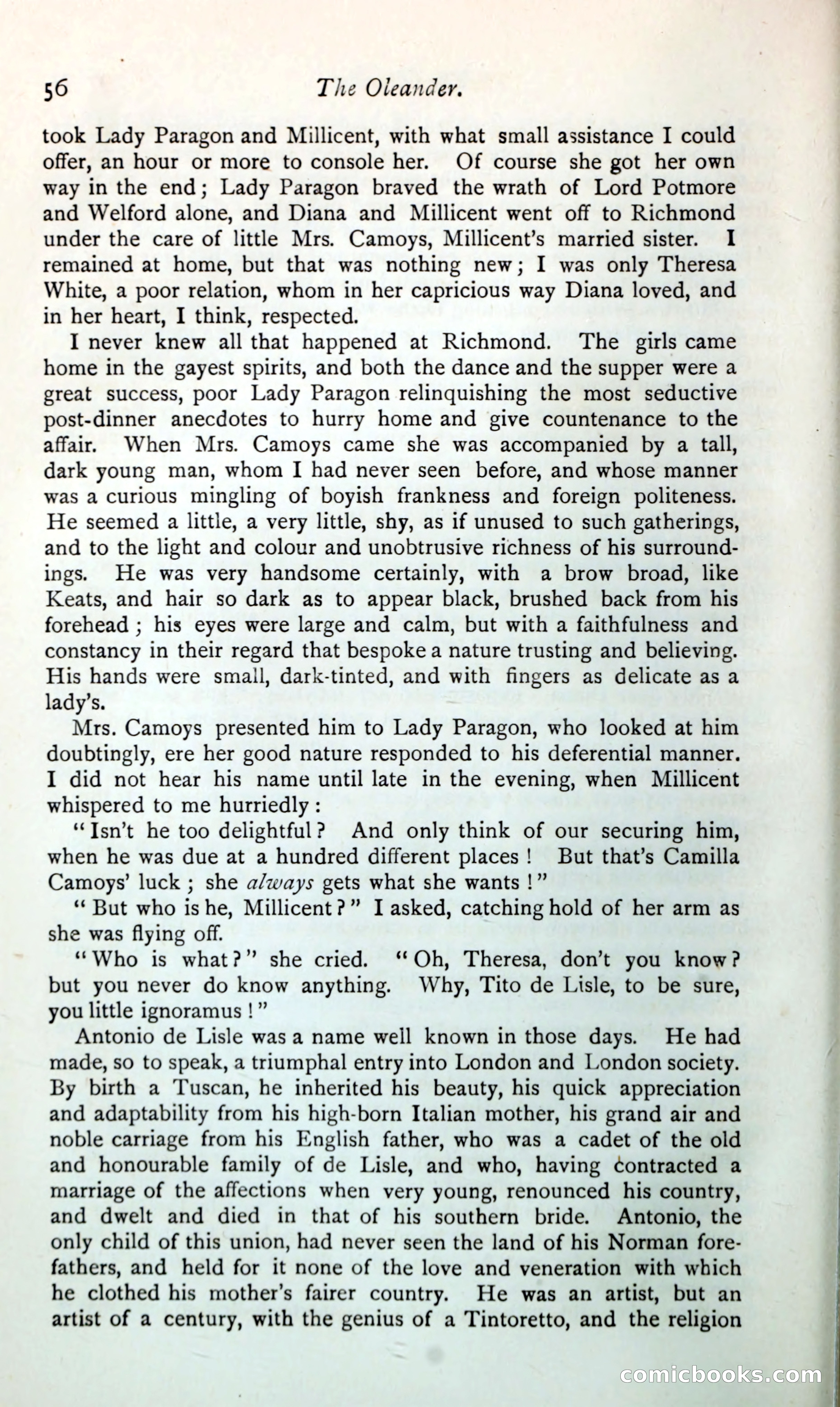
A restored page from Pulp Fiction, 1865. Page through the whole issue in the reader above.
📄 Transcribed text from this page (OCR, searchable)
Machine-transcribed from the original scan — historical spelling and the odd misread are preserved.
56 The Oleander. took Lady Paragon and Millicent, with what small assistance I could offer, an hour or more to console her. Of course she got her own way in the end; Lady Paragon braved the wrath of Lord Potmore and Welford alone, and Diana and Millicent went off to Richmond under the care of little Mrs. Camoys, Millicent’s married sister. I remained at home, but that was nothing new; I was only Theresa White, a poor relation, whom in her capricious way Diana loved, and in her heart, I think, respected. I never knew all that happened at Richmond. The girls came home in the gayest spirits, and both the dance and the supper were a great success, poor Lady Paragon relinquishing the most seductive post-dinner anecdotes to hurry home and give countenance to the affair. When Mrs. Camoys came she was accompanied by a tall, dark young man, whom I had never seen before, and whose manner was a curious mingling of boyish frankness and foreign politeness. He seemed a little, a very little, shy, as if unused to such gatherings, and to the light and colour and unobtrusive richness of his surround- ings. He was very handsome certainly, with a brow broad, like Keats, and hair so dark as to appear black, brushed back from his forehead ; his eyes were large and calm, but with a faithfulness and constancy in their regard that bespoke a nature trusting and believing. His hands were small, dark-tinted, and with fingers as delicate as a lady’s. Mrs. Camoys presented him to Lady Paragon, who looked at him doubtingly, ere her good nature responded to his deferential manner. I did not hear his name until late in the evening, when Millicent whispered to me hurriedly : ‘“Isn’t he too delightful? And only think of our securing him, when he was due at a hundred different places! But that’s Camilla Camoys’ luck ; she a/ways gets what she wants !” ‘‘ But who is he, Millicent?” I asked, catching hold of her arm as she was flying off. ‘Who is what?” she cried. ‘‘Oh, Theresa, don’t you know? but you never do know anything. Why, Tito de Lisle, to be sure, you little ignoramus !” Antonio de Lisle was a name well known in those days. He had made, so to speak, a triumphal entry into London and London society. By birth a Tuscan, he inherited his beauty, his quick appreciation and adaptability from his high-born Italian mother, his grand air and noble carriage from his English father, who was a cadet of the old and honourable family of de Lisle, and who, having contracted a marriage of the affections when very young, renounced his country, and dwelt and died in that of his southern bride. Antonio, the only child of this union, had never seen the land of his Norman fore- fathers, and held for it none of the love and veneration with which he clothed his mother’s fairer country. He was an artist, but an artist of a century, with the genius of a Tintoretto, and the religion Gomichoo (E(0)