
Pulp Fiction, 1865 · page 69 of 399
The Argosy — page 69: what you’re looking at
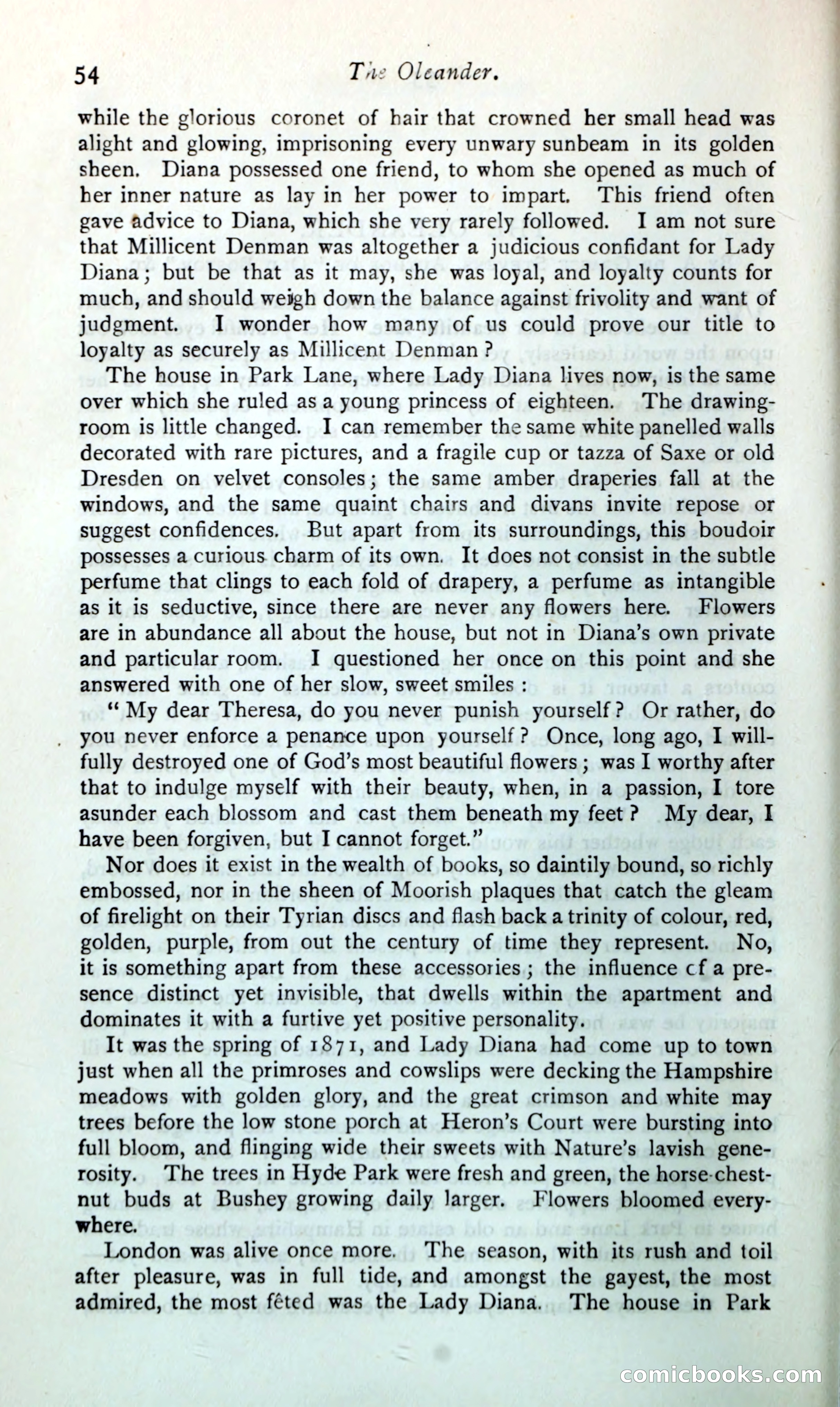
A restored page from Pulp Fiction, 1865. Page through the whole issue in the reader above.
📄 Transcribed text from this page (OCR, searchable)
Machine-transcribed from the original scan — historical spelling and the odd misread are preserved.
54 Tne Oleander. while the glorious coronet of hair that crowned her small head was alight and glowing, imprisoning every unwary sunbeam in its golden sheen, Diana possessed one friend, to whom she opened as much of her inner nature as lay in her power to impart. This friend often gave advice to Diana, which she very rarely followed. I am not sure that Millicent Denman was altogether a judicious confidant for Lady Diana; but be that as it may, she was loyal, and loyalty counts for much, and should weigh down the balance against frivolity and want of judgment. I wonder how many of us could prove our title to loyalty as securely as Millicent Denman? The house in Park Lane, where Lady Diana lives now, is the same over which she ruled as a young princess of eighteen. The drawing- room is little changed. I can remember the same white panelled walls decorated with rare pictures, and a fragile cup or tazza of Saxe or old Dresden on velvet consoles; the same amber draperies fall at the windows, and the same quaint chairs and divans invite repose or suggest confidences. But apart from its surroundings, this boudoir possesses a curious charm of its own. It does not consist in the subtle perfume that clings to each fold of drapery, a perfume as intangible as it 1s seductive, since there are never any flowers here. Flowers are in abundance all about the house, but not in Diana’s own private and particular room. I questioned her once on this point and she answered with one of her slow, sweet smiles : ‘My dear Theresa, do you never punish yourself? Or rather, do you never enforce a penance upon yourself? Once, long ago, I will- fully destroyed one of God’s most beautiful flowers ; was I worthy after that to indulge myself with their beauty, when, in a passion, I tore asunder each blossom and cast them beneath my feet? My dear, I have been forgiven, but I cannot forget.” Nor does it exist in the wealth of books, so daintily bound, so richly embossed, nor in the sheen of Moorish plaques that catch the gleam of firelight on their Tyrian discs and flash back a trinity of colour, red, golden, purple, from out the century of time they represent. No, it is something apart from these accessories; the influence cf a pre- sence distinct yet invisible, that dwells within the apartment and dominates it with a furtive yet positive personality. It was the spring of 1871, and Lady Diana had come up to town just when all the primroses and cowslips were decking the Hampshire meadows with golden glory, and the great crimson and white may trees before the low stone porch at Heron’s Court were bursting into full bloom, and flinging wide their sweets with Nature’s lavish gene- rosity. The trees in Hyde Park were fresh and green, the horse-chest- nut buds at Bushey growing daily larger. Flowers bloomed every- where. London was alive once more. ‘The season, with its rush and toil after pleasure, was in full tide, and amongst the gayest, the most admired, the most féted was the Lady Diana. The house in Park GEomicbooks.co