
Pulp Fiction, 1865 · page 68 of 399
The Argosy — page 68: what you’re looking at
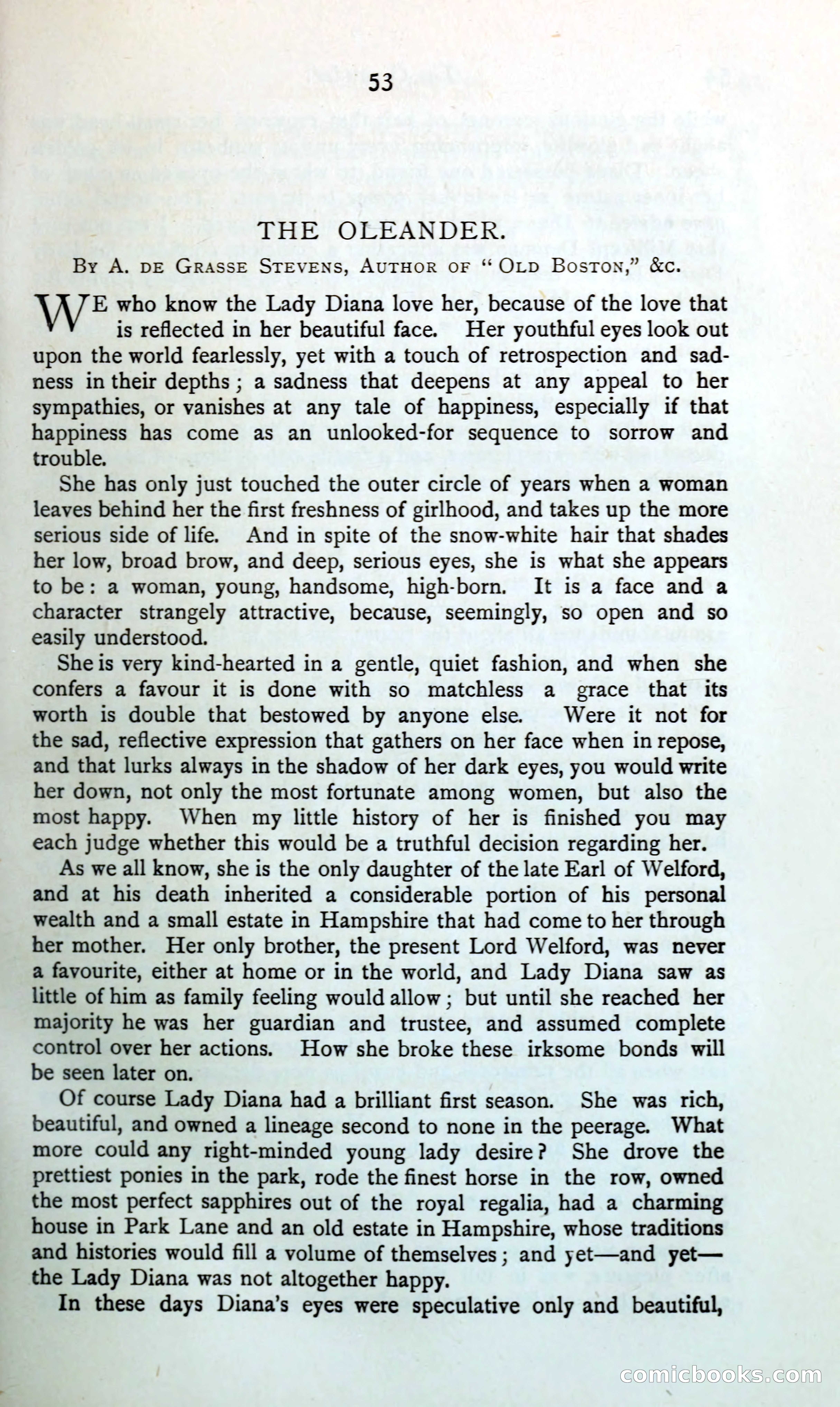
A restored page from Pulp Fiction, 1865. Page through the whole issue in the reader above.
📄 Transcribed text from this page (OCR, searchable)
Machine-transcribed from the original scan — historical spelling and the odd misread are preserved.
33 THE OLEANDER. By A. DE GRASSE STEVENS, AUTHOR OF * OLD Boston,” &c. WE who know the Lady Diana love her, because of the love that is reflected in her beautiful face. Her youthful eyes look out upon the world fearlessly, yet with a touch of retrospection and sad- ness in their depths ; a sadness that deepens at any appeal to her sympathies, or vanishes at any tale of happiness, especially if that happiness has come as an unlooked-for sequence to sorrow and trouble. She has only just touched the outer circle of years when a woman leaves behind her the first freshness of girlhood, and takes up the more serious side of life. And in spite of the snow-white hair that shades her low, broad brow, and deep, serious eyes, she is what she appears to be: a woman, young, handsome, high-born. It is a face and a character strangely attractive, because, seemingly, so open and so easily understood. She is very kind-hearted in a gentle, quiet fashion, and when she confers a favour it is done with so matchless a grace that its worth is double that bestowed by anyone else. Were it not for the sad, reflective expression that gathers on her face when in repose, and that lurks always in the shadow of her dark eyes, you would write her down, not only the most fortunate among women, but also the most happy. When my little history of her is finished you may each judge whether this would be a truthful decision regarding her. As we all know, she is the only daughter of the late Earl of Welford, and at his death inherited a considerable portion of his personal wealth and a small estate in Hampshire that had come to her through her mother. Her only brother, the present Lord Welford, was never a favourite, either at home or in the world, and Lady Diana saw as little of him as family feeling would allow; but until she reached her majority he was her guardian and trustee, and assumed complete control over her actions. How she broke these irksome bonds will be seen later on. Of course Lady Diana had a brilliant first season. She was rich, beautiful, and owned a lineage second to none in the peerage. What more could any right-minded young lady desire? She drove the prettiest ponies in the park, rode the finest horse in the row, owned the most perfect sapphires out of the royal regalia, had a charming house in Park Lane and an old estate in Hampshire, whose traditions and histories would fill a volume of themselves ; and yet—and yet— the Lady Diana was not altogether happy. In these days Diana’s eyes were speculative only and beautiful, Gomichboo (E(@) m