
Pulp Fiction, 1865 · page 49 of 399
The Argosy — page 49: what you’re looking at
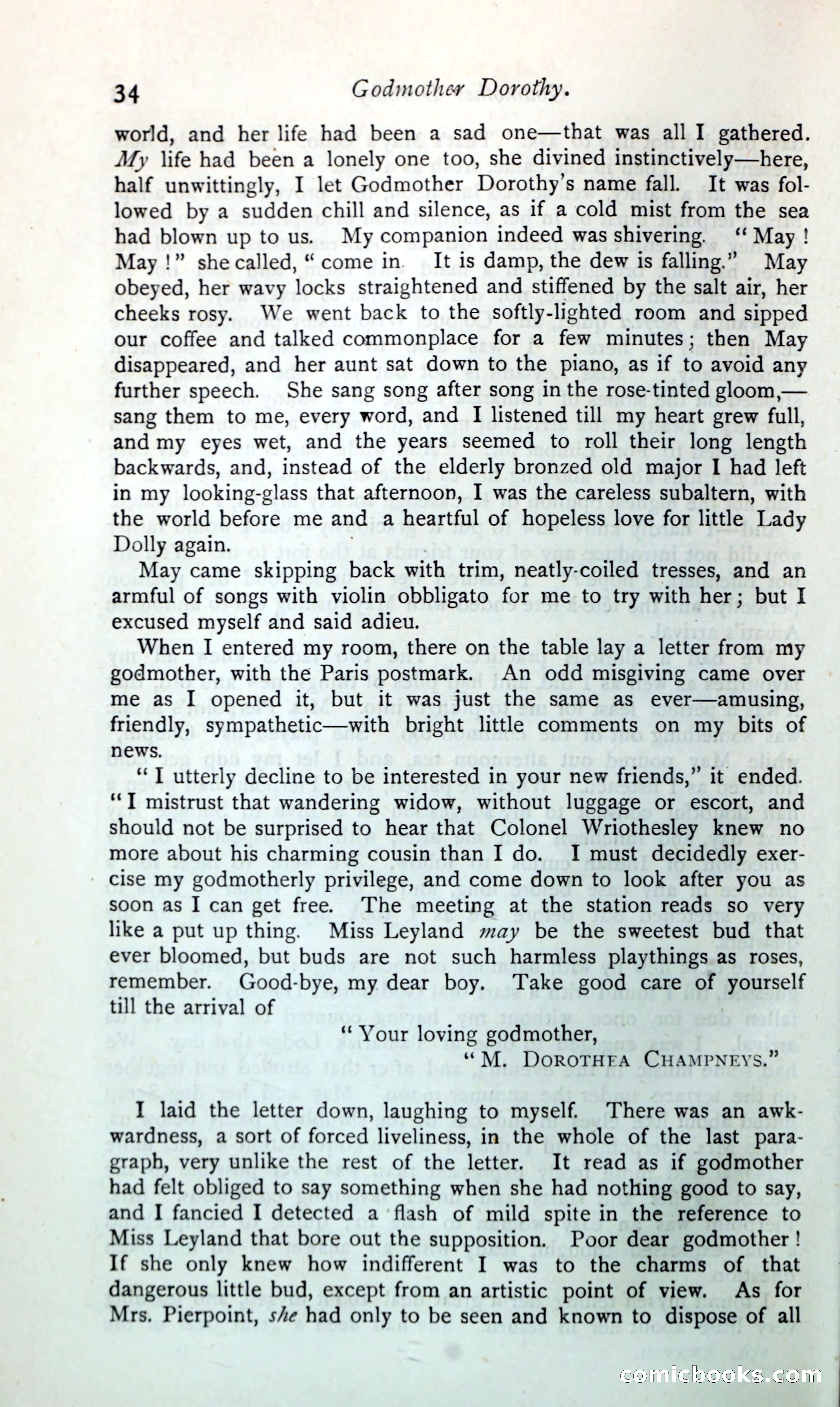
A restored page from Pulp Fiction, 1865. Page through the whole issue in the reader above.
📄 Transcribed text from this page (OCR, searchable)
Machine-transcribed from the original scan — historical spelling and the odd misread are preserved.
34 Godmother Dorothy. world, and her life had been a sad one—that was all I gathered. My life had been a lonely one too, she divined instinctively—here, half unwittingly, I let Godmother Dorothy’s name fall. It was fol- lowed by a sudden chill and silence, as if a cold mist from the sea had blown up to us. My companion indeed was shivering. ‘ May! May!” shecalled, “come in. It is damp, the dew is falling.” May obeyed, her wavy locks straightened and stiffened by the salt air, her cheeks rosy. We went back to the softly- lighted room and sipped our coffee and talked commonplace for a few minutes; then May disappeared, and her aunt sat down to the piano, as if to avoid any further speech. She sang song after song in the rose-tinted gloom,— sang them to me, every word, and I listened till my heart grew full, and my eyes wet, and the years seemed to roll their long length backwards, and, instead of the elderly bronzed old major I had left in my looking-glass that afternoon, I was the careless subaltern, with the world before me and a heartful of hopeless love for little Lady Dolly again. May came skipping back with trim, neatly-coiled tresses, and an armful of songs with violin obbligato for me to try with her; but I excused myself and said adieu. When I entered my room, there on the table lay a letter from my godmother, with the Paris postmark. An odd misgiving came over me as I opened it, but it was just the same as ever—amusing, friendly, sympathetic—with bright little comments on my bits of news. ‘‘T utterly decline to be interested in your new friends,” it ended. ‘‘T mistrust that wandering widow, without luggage or escort, and should not be surprised to hear that Colonel Wriothesley knew no more about his charming cousin than I do. I must decidedly exer- cise my godmotherly privilege, and come down to look after you as soon as I can get free. The meeting at the station reads so very like a put up thing. Miss Leyland may be the sweetest bud that ever bloomed, but buds are not such harmless playthings as roses, remember. Good-bye, my dear boy. Take good care of yourself till the arrival of . Your loving godmother, “M. DoROTHEA CHAMPNEYS.” I laid the letter down, laughing to myself. There was an awk- wardness, a sort of forced liveliness, in the whole of the last para- graph, very unlike the rest of the letter. It read as if godmother had felt obliged to say something when she had nothing good to say, and I fancied I detected a flash of mild spite in the reference to Miss Leyland that bore out the supposition. Poor dear godmother ! If she only knew how indifferent I was to the charms of that dangerous little bud, except from an artistic point of view. As for Mrs. Pierpoint, she had only to be seen and known to dispose of all Gomicbooks.com