
Pulp Fiction, 1865 · page 87 of 400
The Argosy — page 87: what you’re looking at
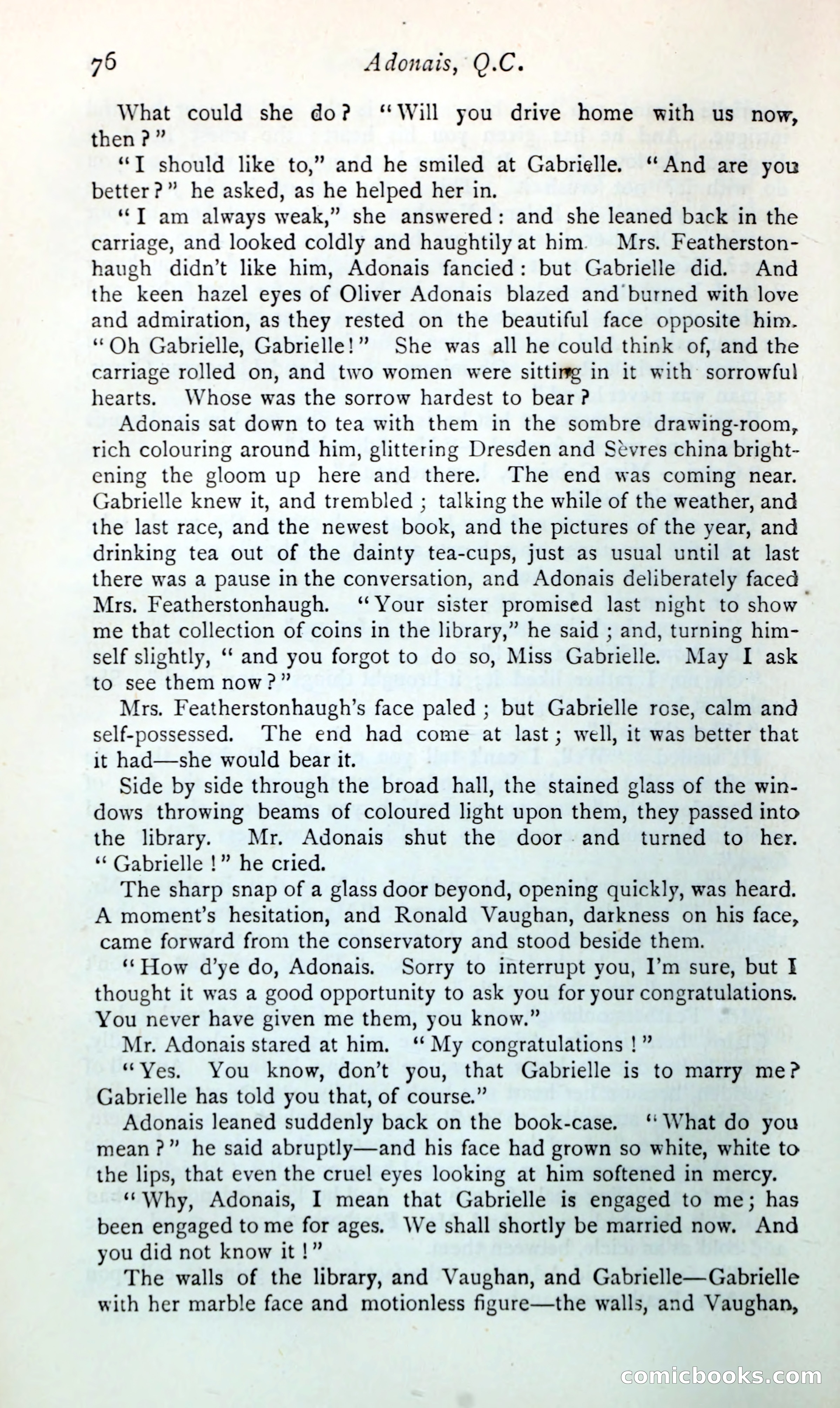
A restored page from Pulp Fiction, 1865. Page through the whole issue in the reader above.
📄 Transcribed text from this page (OCR, searchable)
Machine-transcribed from the original scan — historical spelling and the odd misread are preserved.
76 Adonais, Q.C. What could she do? “Will you drive home with us now, then?” “IT should like to,” and he smiled at Gabrielle. ‘And are you better?” he asked, as he helped her in. ‘“T am always weak,” she answered: and she leaned back in the carriage, and looked coldly and haughtily at him. Mrs. Featherston- haugh didn’t like him, Adonais fancied: but Gabrielle did. And the keen hazel eyes of Oliver Adonais blazed and burned with love and admiration, as they rested on the beautiful face opposite him. ‘Oh Gabrielle, Gabrielle!” She was all he could think of, and the carriage rolled on, and two women were sitting in it with sorrowful hearts. Whose was the sorrow hardest to bear P Adonais sat down to tea with them in the sombre drawing-room, rich colouring around him, glittering Dresden and Sévres china bright- ening the gloom up here and there. The end was coming near. Gabrielle knew it, and trembled ; talking the while of the weather, and the last race, and the newest book, and the pictures of the year, and drinking tea out of the dainty tea-cups, just as usual until at last there was a pause in the conversation, and Adonais deliberately faced Mrs. Featherstonhaugh. ‘Your sister promised last night to show me that collection of coins in the library,” he said ; and, turning him- self slightly, “‘ and you forgot to do so, Miss Gabrielle. May I ask to see them now?” | Mrs. Featherstonhaugh’s face paled ; but Gabrielle rose, calm and self-possessed. ‘The end had come at last; well, it was better that it had—she would bear it. Side by side through the broad hall, the stained glass of the win- dows throwing beams of coloured light upon them, they passed into the library. Mr. Adonais shut the door-and turned to her. ‘‘ Gabrielle !” he cried. The sharp snap of a glass door beyond, opening quickly, was heard. A moment’s hesitation, and Ronald Vaughan, darkness on his face, came forward from the conservatory and stood beside them. ‘How d’ye do, Adonais. Sorry to interrupt you, I’m sure, but I thought it was a good opportunity to ask you for your congratulations. You never have given me them, you know.” Mr. Adonais stared at him. ‘‘ My congratulations !” “Yes. You know, don’t you, that Gabrielle is to marry me? Gabrielle has told you that, of course.” Adonais leaned suddenly back on the book-case. ‘‘ What do you mean ?” he said abruptly—and his face had grown so white, white to the lips, that even the cruel eyes looking at him softened in mercy. ‘‘Why, Adonais, I mean that Gabrielle is engaged to me; has been engaged to me for ages. We shall shortly be married now. And you did not know it!” The walls of the library, and Vaughan, and Gabrielle—Gabrielle with her marble face and motionless figure—the walls, and Vaughan, Gomichbooks.co m