
Pulp Fiction, 1865 · page 385 of 400
The Argosy — page 385: what you’re looking at
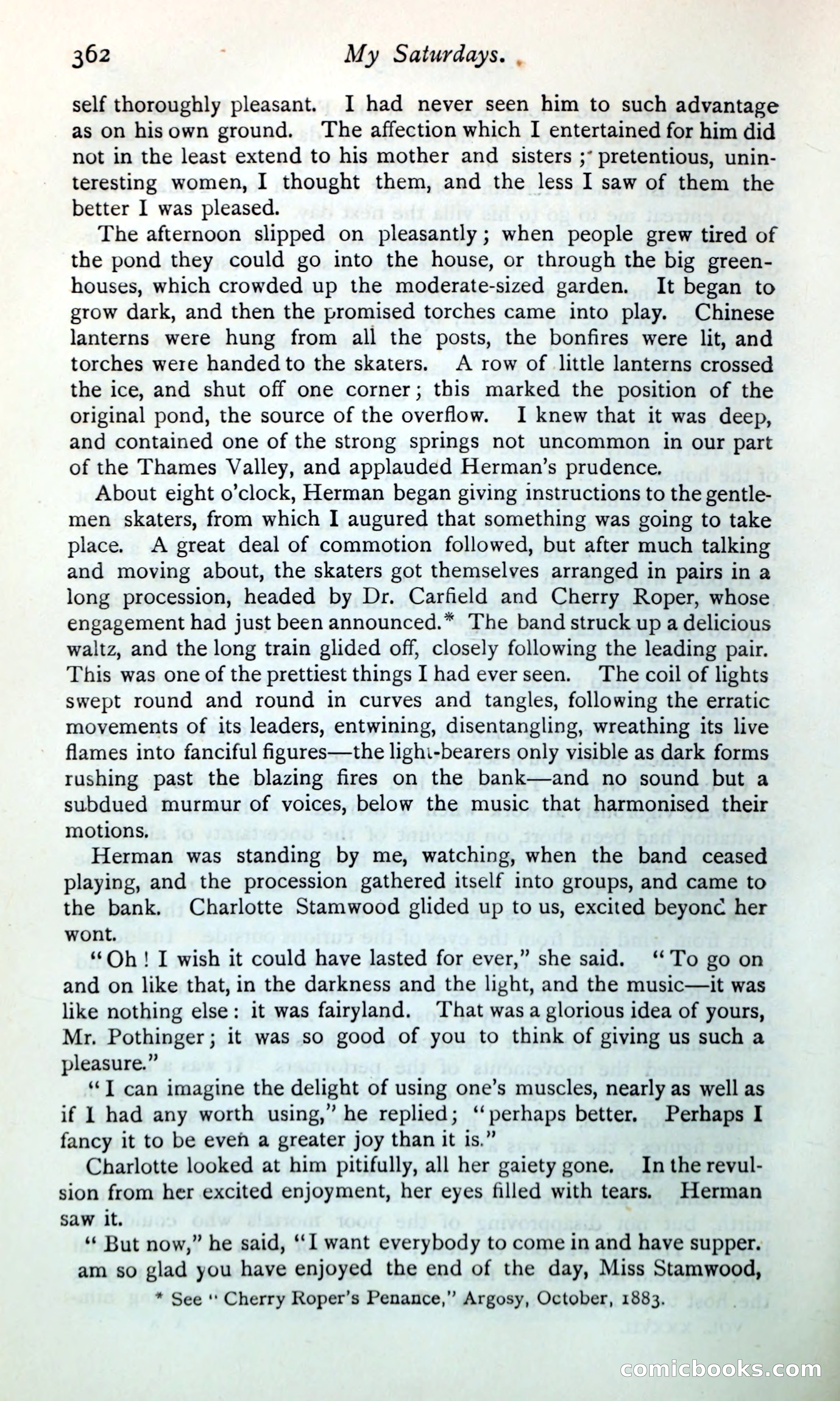
A restored page from Pulp Fiction, 1865. Page through the whole issue in the reader above.
📄 Transcribed text from this page (OCR, searchable)
Machine-transcribed from the original scan — historical spelling and the odd misread are preserved.
362 ' My Saturdays. , self thoroughly pleasant. I had never seen him to such advantage as on hisown ground. The affection which I entertained for him did not in the least extend to his mother and sisters ;” pretentious, unin- teresting women, I thought them, and the less I saw of them the better I was pleased. The afternoon slipped on pleasantly ; when people grew tired of the pond they could go into the house, or through the big green- houses, which crowded up the moderate-sized garden. It began to grow dark, and then the promised torches came into play. Chinese lanterns were hung from all the posts, the bonfires were lit, and torches were handed to the skaters. A row of little lanterns crossed the ice, and shut off one corner; this marked the position of the original pond, the source of the overflow. I knew that it was deep, and contained one of the strong springs not uncommon in our part of the Thames Valley, and applauded Herman’s prudence. About eight o’clock, Herman began giving instructions to the gentle- men skaters, from which I augured that something was going to take place. A great deal of commotion followed, but after much talking and moving about, the skaters got themselves arranged in pairs in a long procession, headed by Dr. Carfield and Cherry Roper, whose engagement had just been announced.* The band struck up a delicious waltz, and the long train glided off, closely following the leading pair. This was one of the prettiest things [had everseen. The coil of lights swept round and round in curves and tangles, following the erratic movements of its leaders, entwining, disentangling, wreathing its live flames into fanciful figures—the lighi-bearers only visible as dark forms rushing past the blazing fires on the bank—and no sound but a subdued murmur of voices, below the music that harmonised their motions, Herman was standing by me, watching, when the band ceased playing, and the procession gathered itself into groups, and came to the bank. Charlotte Stamwood glided up to us, excited beyonc her wont. ‘‘Oh! I wish it could have lasted for ever,” she said. ‘‘To go on and on like that, in the darkness and the light, and the music—it was like nothing else: it was fairyland. ‘That was a glorious idea of yours, Mr. Pothinger; it was so good of you to think of giving us such a pleasure.” ‘‘T can imagine the delight of using one’s muscles, nearly as well as if 1 had any worth using,” he replied; ‘‘perhaps better. Perhaps I fancy it to be even a greater joy than it is.” Charlotte looked at him pitifully, all her gaiety gone, In the revul- sion from her excited enjoyment, her eyes filled with tears. Herman Saw it. ‘* But now,” he said, “I want everybody to come in and have supper. am so glad you have enjoyed the end of the day, Miss Stamwood, * See ‘' Cherry Roper’s Penance,” Argosy, October, 1883. Gomicbooks (elo) m