
Pulp Fiction, 1865 · page 382 of 400
The Argosy — page 382: what you’re looking at
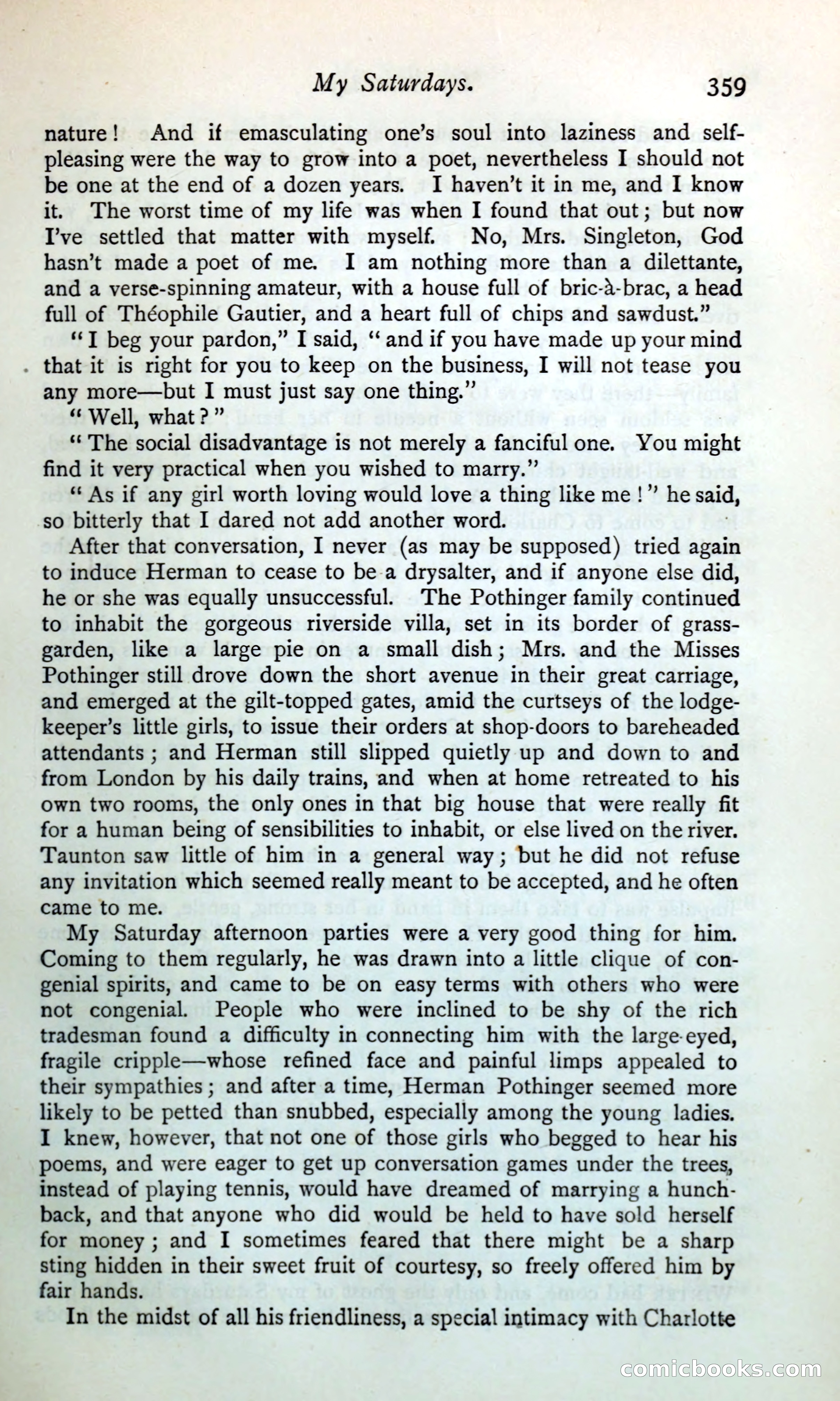
A restored page from Pulp Fiction, 1865. Page through the whole issue in the reader above.
📄 Transcribed text from this page (OCR, searchable)
Machine-transcribed from the original scan — historical spelling and the odd misread are preserved.
My Saturdays. 359 nature! And if emasculating one’s soul into laziness and self- pleasing were the way to grow into a poet, nevertheless I should not be one at the end of a dozen years. I haven’t it in me, and I know it. The worst time of my life was when I found that out; but now I’ve settled that matter with myself. No, Mrs. Singleton, God hasn’t made a poet of me. I am nothing more than a dilettante, and a verse-spinning amateur, with a house full of bric-A-brac, a head full of Théophile Gautier, and a heart full of chips and sawdust.” **T beg your pardon,” I said, ‘‘ and if you have made up your mind . that it is right for you to keep on the business, I will not tease you any more—but I must just say one thing.” “ Well, what?” *‘ The social disadvantage is not merely a fanciful one. You might find it very practical when you wished to marry.” * As if any girl worth loving would love a thing like me!” he said, so bitterly that I dared not add another word. After that conversation, I never (as may be supposed) tried again to induce Herman to cease to be-a drysalter, and if anyone else did, he or she was equally unsuccessful. The Pothinger family continued to inhabit the gorgeous riverside villa, set in its border of grass- garden, like a large pie on a small dish; Mrs. and the Misses Pothinger still drove down the short avenue in their great carriage, and emerged at the gilt-topped gates, amid the curtseys of the lodge- keeper’s little girls, to issue their orders at shop-doors to bareheaded attendants ; and Herman still slipped quietly up and down to and from London by his daily trains, and when at home retreated to his own two rooms, the only ones in that big house that were really fit for a human being of sensibilities to inhabit, or else lived on the river. Taunton saw little of him in a general way; but he did not refuse any invitation which seemed really meant to be accepted, and he often came to me. My Saturday afternoon parties were a very good thing for him. Coming to them regularly, he was drawn into a little clique of con- genial spirits, and came to be on easy terms with others who were not congenial. People who were inclined to be shy of the rich tradesman found a difficulty in connecting him with the large-eyed, fragile cripple—whose refined face and painful limps appealed to their sympathies ; and after a time, Herman Pothinger seemed more likely to be petted than snubbed, especially among the young ladies. I knew, however, that not one of those girls who begged to hear his poems, and were eager to get up conversation games under the trees, instead of playing tennis, would have dreamed of marrying a hunch- back, and that anyone who did would be held to have sold herself for money ; and I sometimes feared that there might be a sharp sting hidden in their sweet fruit of courtesy, so freely offered him by fair hands. In the midst of all his friendliness, a special intimacy with Charlotte Gomichoo cS) (EO) m