
Pulp Fiction, 1865 · page 375 of 400
The Argosy — page 375: what you’re looking at
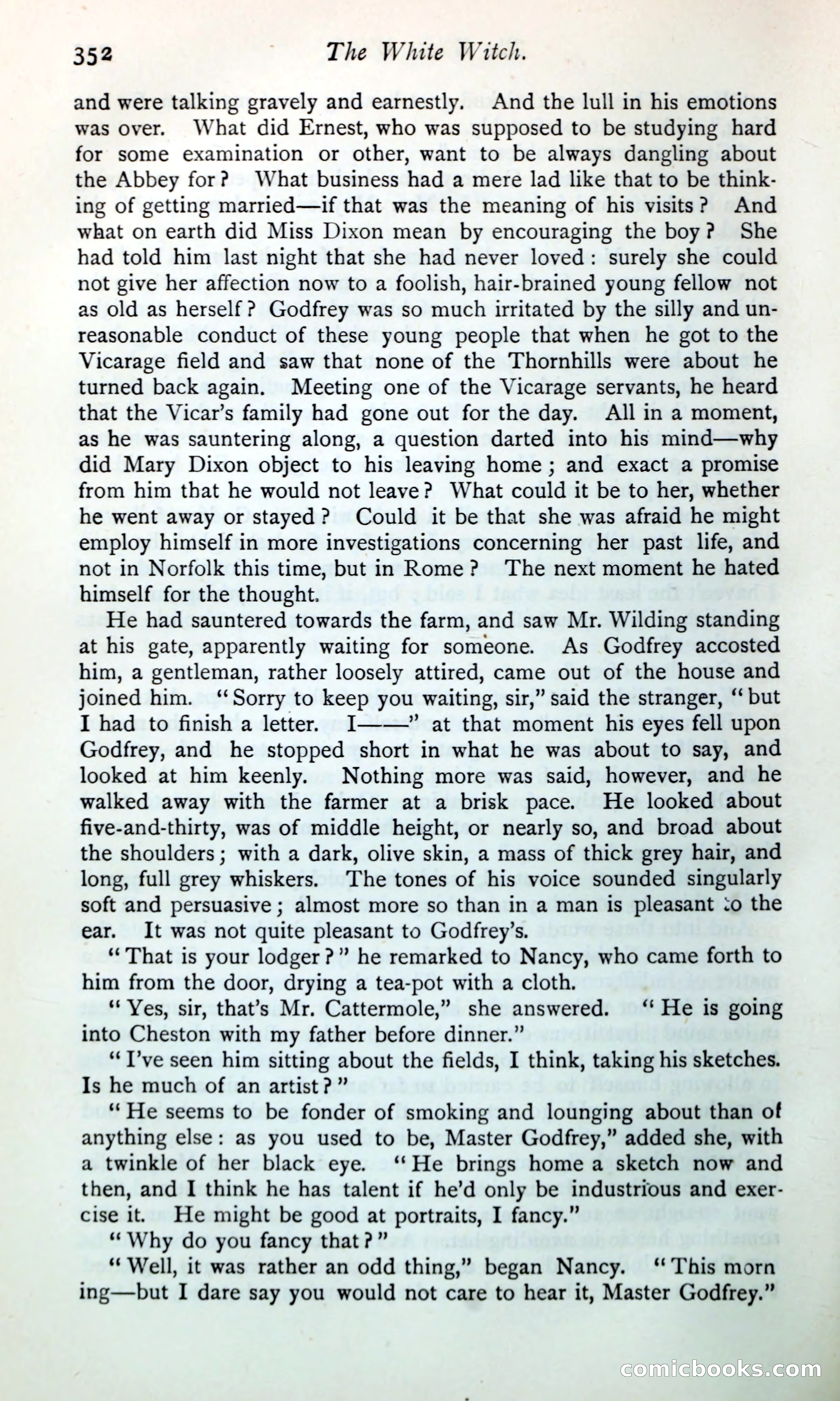
A restored page from Pulp Fiction, 1865. Page through the whole issue in the reader above.
📄 Transcribed text from this page (OCR, searchable)
Machine-transcribed from the original scan — historical spelling and the odd misread are preserved.
352 The White Witch. and were talking gravely and earnestly. And the lull in his emotions was over. What did Ernest, who was supposed to be studying hard for some examination or other, want to be always dangling about the Abbey for? What business had a mere lad like that to be think- ing of getting married—if that was the meaning of his visits? And what on earth did Miss Dixon mean by encouraging the boy? She had told him last night that she had never loved: surely she could not give her affection now to a foolish, hair-brained young fellow not as old as herself ? Godfrey was so much irritated by the silly and un- reasonable conduct of these young people that when he got to the Vicarage field and saw that none of the Thornhills were about he turned back again. Meeting one of the Vicarage servants, he heard that the Vicar’s family had gone out for the day. All in a moment, as he was sauntering along, a question darted into his mind—why did Mary Dixon object to his leaving home; and exact a promise from him that he would not leave? What could it be to her, whether he went away or stayed? Could it be that she was afraid he might employ himself in more investigations concerning her past life, and not in Norfolk this time, but in Rome? The next moment he hated himself for the thought. He had sauntered towards the farm, and saw Mr. Wilding standing at his gate, apparently waiting for someone. As Godfrey accosted him, a gentleman, rather loosely attired, came out of the house and joined him. ‘Sorry to keep you waiting, sir,” said the stranger, “ but I had to finish a letter. I—-—” at that moment his eyes fell upon Godfrey, and he stopped short in what he was about to say, and looked at him keenly. Nothing more was said, however, and he walked away with the farmer at a brisk pace. He looked about five-and-thirty, was of middle height, or nearly so, and broad about the shoulders; with a dark, olive skin, a mass of thick grey hair, and long, full grey whiskers. The tones of his voice sounded singularly soft and persuasive ; almost more so than in a man is pleasant <o the ear. It was not quite pleasant to Godfrey’s. “That is your lodger?” he remarked to Nancy, who came forth to him from the door, drying a tea-pot with a cloth. ‘‘ Yes, sir, that’s Mr. Cattermole,” she answered. ‘‘ He is going into Cheston with my father before dinner.” “T’ve seen him sitting about the fields, I think, taking his sketches. Is he much of an artist?” “He seems to be fonder of smoking and lounging about than of anything else: as you used to be, Master Godfrey,” added she, with a twinkle of her black eye. ‘‘He brings home a sketch now and then, and I think he has talent if he’d only be industrious and exer- cise it. He might be good at portraits, I fancy.” “Why do you fancy that?” ‘Well, it was rather an odd thing,” began Nancy. ‘This morn ing—but I dare say you would not care to hear it, Master Godfrey.” Eomichooks.co m