
Pulp Fiction, 1865 · page 358 of 400
The Argosy — page 358: what you’re looking at
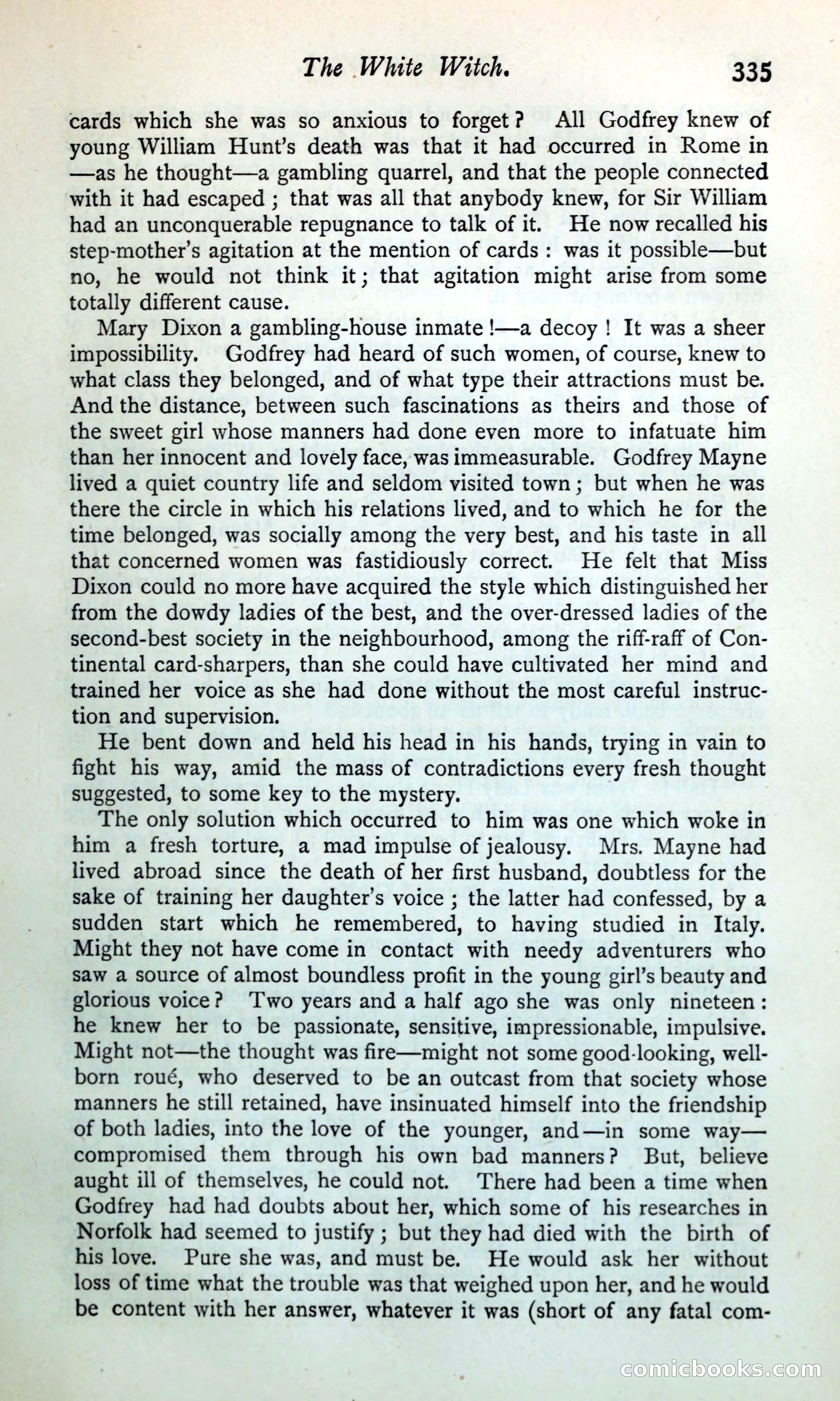
A restored page from Pulp Fiction, 1865. Page through the whole issue in the reader above.
📄 Transcribed text from this page (OCR, searchable)
Machine-transcribed from the original scan — historical spelling and the odd misread are preserved.
The White Witch. 335 cards which she was so anxious to forget? All Godfrey knew of young William Hunt’s death was that it had occurred in Rome in —as he thought—a gambling quarrel, and that the people connected with it had escaped ; that was all that anybody knew, for Sir William had an unconquerable repugnance to talk of it. He now recalled his step-mother’s agitation at the mention of cards: was it possible—but no, he would not think it; that agitation might arise from some totally different cause. Mary Dixon a gambling-house inmate !—a decoy! It was a sheer impossibility. Godfrey had heard of such women, of course, knew to what class they belonged, and of what type their attractions must be. And the distance, between such fascinations as theirs and those of the sweet girl whose manners had done even more to infatuate him than her innocent and lovely face, was immeasurable. Godfrey Mayne lived a quiet country life and seldom visited town; but when he was there the circle in which his relations lived, and to which he for the time belonged, was socially among the very best, and his taste in all that concerned women was fastidiously correct. He felt that Miss Dixon could no more have acquired the style which distinguished her from the dowdy ladies of the best, and the over-dressed ladies of the second-best society in the neighbourhood, among the riff-raff of Con- tinental card-sharpers, than she could have cultivated her mind and trained her voice as she had done without the most careful instruc- tion and supervision. He bent down and held his head in his hands, trying in vain to fight his way, amid the mass of contradictions every fresh thought suggested, to some key to the mystery. The only solution which occurred to him was one which woke in him a fresh torture, a mad impulse of jealousy. Mrs. Mayne had lived abroad since the death of her first husband, doubtless for the sake of training her daughter’s voice ; the latter had confessed, by a sudden start which he remembered, to having studied in Italy. Might they not have come in contact with needy adventurers who saw a source of almost boundless profit in the young girl’s beauty and glorious voice? ‘Two years and a half ago she was only nineteen: he knew her to be passionate, sensitive, impressionable, impulsive. Might not—the thought was fire—might not some good-looking, well- born roué, who deserved to be an outcast from that society whose manners he still retained, have insinuated himself into the friendship of both ladies, into the love of the younger, and—in some way— compromised them through his own bad manners? But, believe aught ill of themselves, he could not. There had been a time when Godfrey had had doubts about her, which some of his researches in Norfolk had seemed to justify ; but they had died with the birth of his love. Pure she was, and must be. He would ask her without loss of time what the trouble was that weighed upon her, and he would be content with her answer, whatever it was (short of any fatal com- EONNIE OO KS (EO) m