
Pulp Fiction, 1865 · page 277 of 400
The Argosy — page 277: what you’re looking at
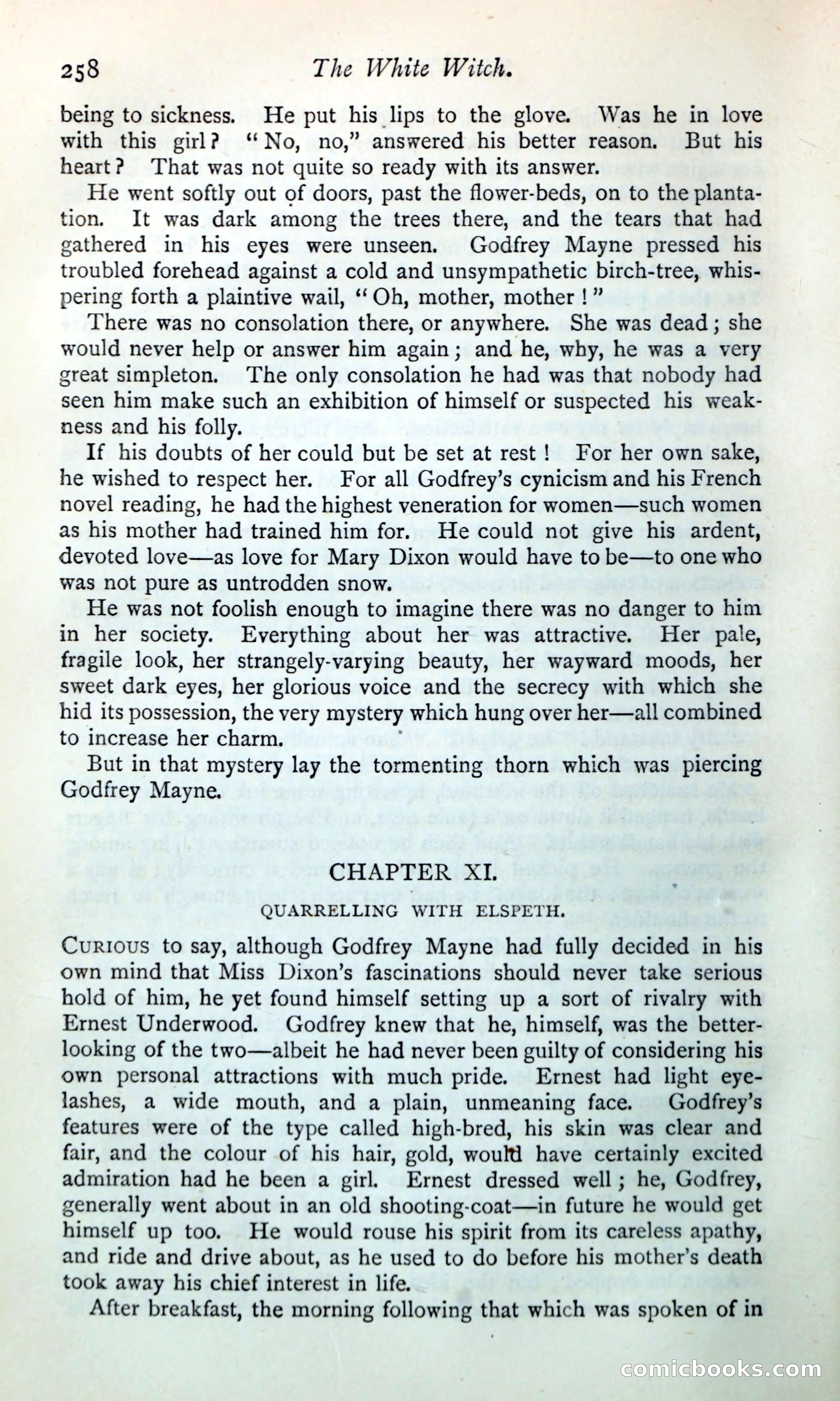
A restored page from Pulp Fiction, 1865. Page through the whole issue in the reader above.
📄 Transcribed text from this page (OCR, searchable)
Machine-transcribed from the original scan — historical spelling and the odd misread are preserved.
258 The White Witch. being to sickness. He put his lips to the glove. Was he in love with this girl? ‘No, no,” answered his better reason. But his heart? That was not quite so ready with its answer. He went softly out of doors, past the flower-beds, on to the planta- tion. It was dark among the trees there, and the tears that had gathered in his eyes were unseen. Godfrey Mayne pressed his troubled forehead against a cold and unsympathetic birch-tree, whis- pering forth a plaintive wail, ‘‘Oh, mother, mother !” There was no consolation there, or anywhere. She was dead; she would never help or answer him again; and he, why, he was a very great simpleton. The only consolation he had was that nobody had seen him make such an exhibition of himself or suspected his weak- ness and his folly. If his doubts of her could but be set at rest! For her own sake, he wished to respect her. For all Godfrey’s cynicism and his French novel reading, he had the highest veneration for women—such women as his mother had trained him for. He could not give his ardent, devoted love—as love for Mary Dixon would have to be—to one who was not pure as untrodden snow. He was not foolish enough to imagine there was no danger to him in her society. Everything about her was attractive. Her pale, fragile look, her strangely-varying beauty, her wayward moods, her sweet dark eyes, her glorious voice and the secrecy with which she hid its possession, the very mystery which hung over her—all combined to increase her charm. But in that mystery lay the tormenting thorn which was piercing Godfrey Mayne. CHAPTER XI. QUARRELLING WITH ELSPETH. Curious to say, although Godfrey Mayne had fully decided in his own mind that Miss Dixon’s fascinations should never take serious hold of him, he yet found himself setting up a sort of rivalry with Ernest Underwood. Godfrey knew that he, himself, was the better- looking of the two—albeit he had never been guilty of considering his own personal attractions with much pride. Ernest had light eye- lashes, a wide mouth, and a plain, unmeaning face. Godfrey’s features were of the type called high-bred, his skin was clear and fair, and the colour of his hair, gold, woul! have certainly excited admiration had he been a girl. Ernest dressed well; he, Godfrey, generally went about in an old shooting-coat—in future he would get himself up too. He would rouse his spirit from its careless apathy, and ride and drive about, as he used to do before his mother’s death took away his chief interest in life. After breakfast, the morning following that which was spoken of in Gomicbooks (e(o) m