
Pulp Fiction, 1865 · page 272 of 400
The Argosy — page 272: what you’re looking at
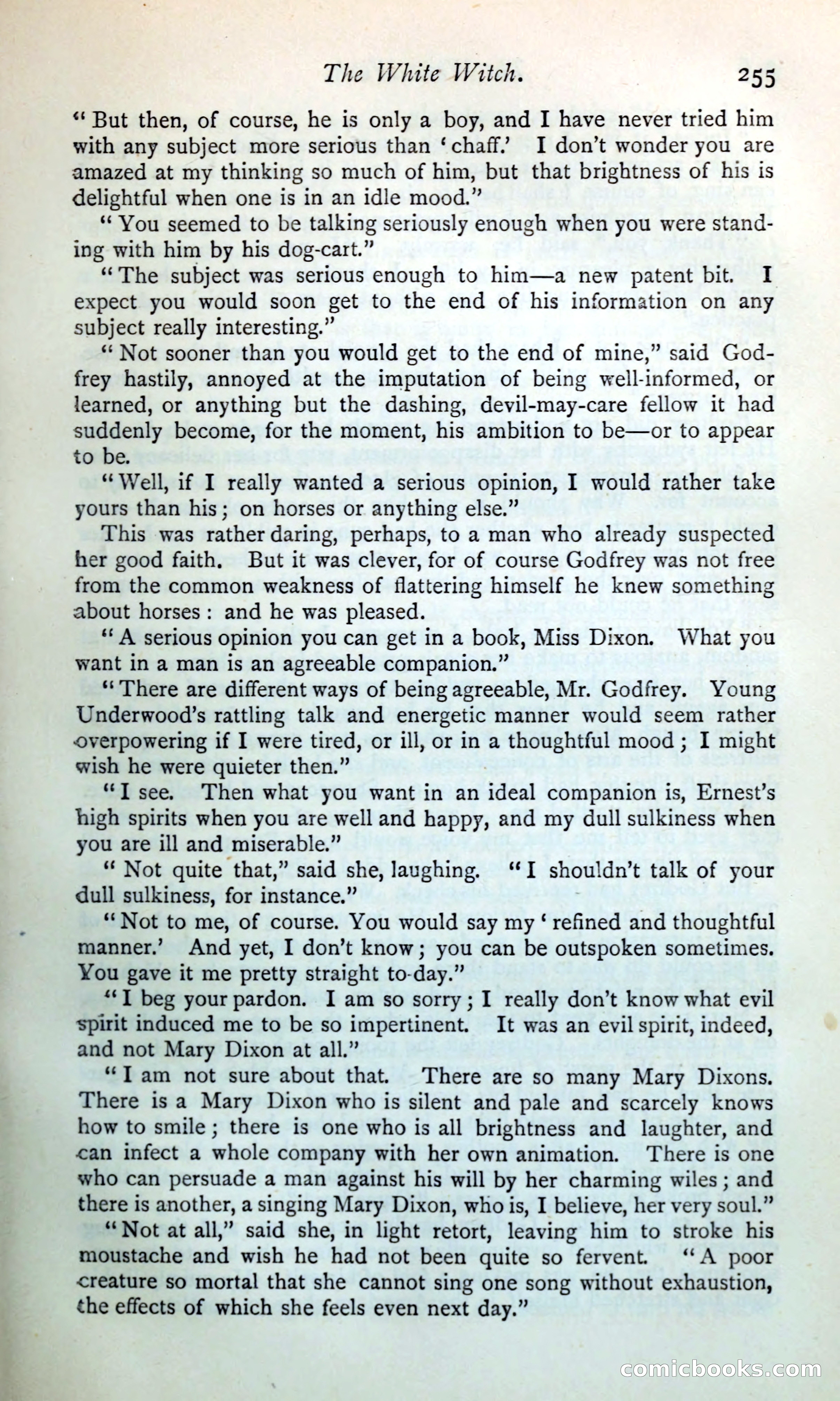
A restored page from Pulp Fiction, 1865. Page through the whole issue in the reader above.
📄 Transcribed text from this page (OCR, searchable)
Machine-transcribed from the original scan — historical spelling and the odd misread are preserved.
The White Witch. 255 “‘ But then, of course, he is only a boy, and I have never tried him with any subject more serious than ‘chaff. I don’t wonder you are amazed at my thinking so much of him, but that brightness of his is delightful when one is in an idle mood.” ‘You seemed to be talking seriously enough when you were stand- ing with him by his dog-cart.” “The subject was serious enough to him—a new patent bit. I expect you would soon get to the end of his information on any subject really interesting.” ** Not sooner than you would get to the end of mine,” said God- frey hastily, annoyed at the imputation of being well-informed, or learned, or anything but the dashing, devil-may-care fellow it had suddenly become, for the moment, his ambition to be—or to appear to be. “Well, if I really wanted a serious opinion, I would rather take yours than his; on horses or anything else.” This was rather daring, perhaps, to a man who already suspected her good faith. But it was clever, for of course Godfrey was not free from the common weakness of flattering himself he knew something about horses: and he was pleased. ** A serious opinion you can get in a book, Miss Dixon. What you want in a man is an agreeable companion.” ‘There are different ways of being agreeable, Mr. Godfrey. Young Underwood’s rattling talk and energetic manner would seem rather overpowering if I were tired, or ill, or in a thoughtful mood; I might wish he were quieter then.” “IT see. ‘Then what you want in an ideal companion is, Ernest’s high spirits when you are well and happy, and my dull sulkiness when you are ill and miserable.” “ Not quite that,” said she, laughing. “I shouldn’t talk of your dull sulkiness, for instance.” : “Not to me, of course. You would say my ‘ refined and thoughtful manner.’ And yet, I don’t know; you can be outspoken sometimes. You gave it me pretty straight to-day.” “*T beg your pardon. I am so sorry;I really don’t know what evil Spirit induced me to be so impertinent. It was an evil spirit, indeed, and not Mary Dixon at all.” “Tam not sure about that. There are so many Mary Dixons. There is a Mary Dixon who is silent and pale and scarcely knows how to smile; there is one who is all brightness and laughter, and <an infect a whole company with her own animation. There is one who can persuade a man against his will by her charming wiles ; and there is another, a singing Mary Dixon, whois, I believe, her very soul.” “Not at all,” said she, in light retort, leaving him to stroke his moustache and wish he had not been quite so fervent. ‘‘A poor creature so mortal that she cannot sing one song without exhaustion, the effects of which she feels even next day.” Eomichbooks.co m