
Pulp Fiction, 1865 · page 245 of 400
The Argosy — page 245: what you’re looking at
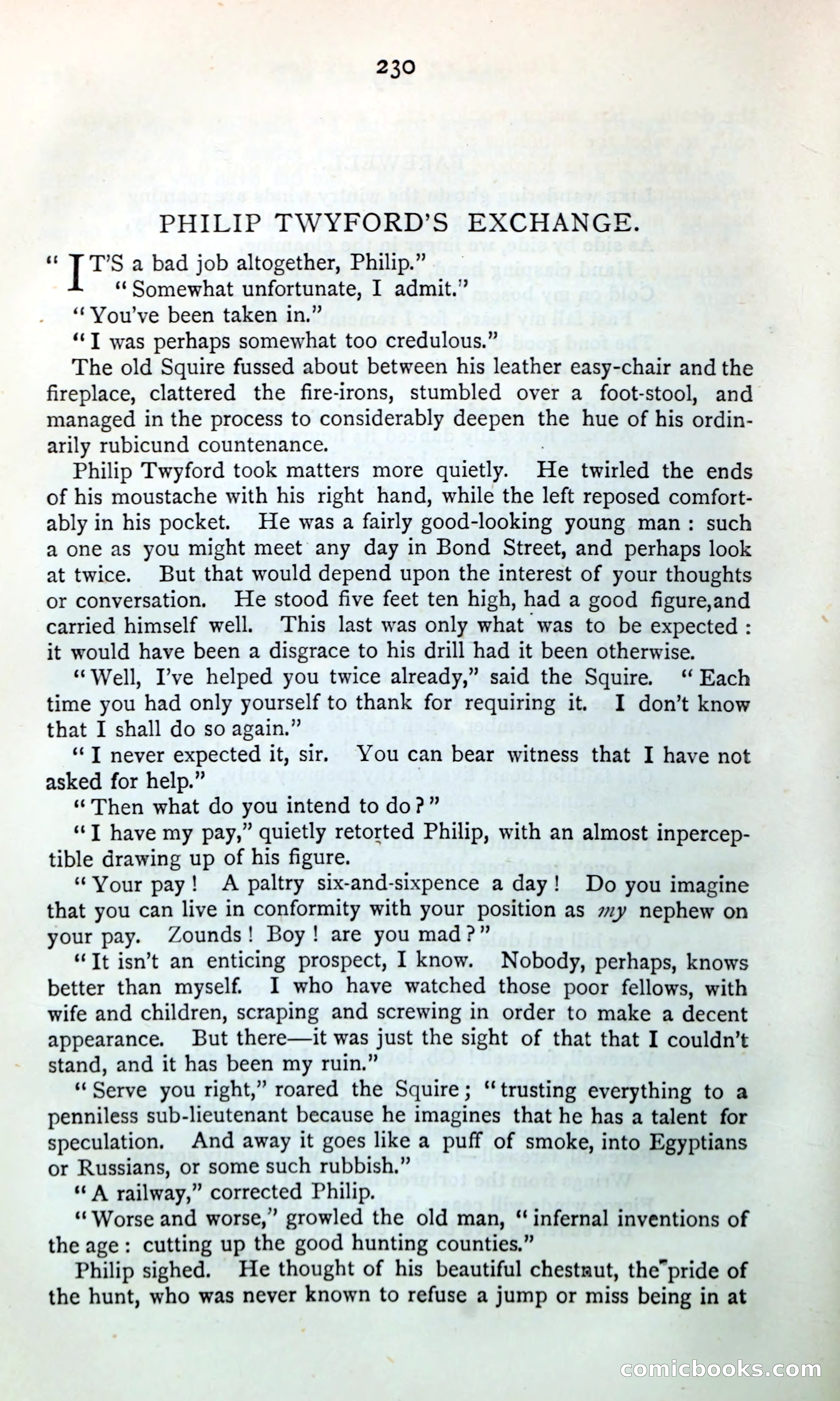
A restored page from Pulp Fiction, 1865. Page through the whole issue in the reader above.
📄 Transcribed text from this page (OCR, searchable)
Machine-transcribed from the original scan — historical spelling and the odd misread are preserved.
230 PHILIP TWYFORD’S EXCHANGE. = ‘Bt a bad job altogether, Philip.” ‘ Somewhat unfortunate, I admit.” ‘You've been taken in.” ‘‘T was perhaps somewhat too credulous.” The old Squire fussed about between his leather easy-chair and the fireplace, clattered the fire-irons, stumbled over a foot-stool, and managed in the process to considerably deepen the hue of his ordin- arily rubicund countenance. , Philip Twyford took matters more quietly. He twirled the ends of his moustache with his right hand, while the left reposed comfort- ably in his pocket. He was a fairly good-looking young man: such a one as you might meet any day in Bond Street, and perhaps look at twice. But that would depend upon the interest of your thoughts or conyersation. He stood five feet ten high, had a good figure,and carried himself well. This last was only what was to be expected : it would have been a disgrace to his drill had it been otherwise. “Well, I’ve helped you twice already,” said the Squire. ‘ Each time you had only yourself to thank for requiring it. I don’t know that I shall do so again.” ‘‘T never expected it, sir. You can bear witness that I have not asked for help.” ‘Then what do you intend to do?” ‘‘T have my pay,” quietly retorted Philip, with an almost inpercep- tible drawing up of his figure. “Your pay! A paltry six-and-sixpence a day! Do you imagine that you can live in conformity with your position as my nephew on your pay. Zounds! Boy! are you mad?” “Tt isn’t an enticing prospect, I know. Nobody, perhaps, knows better than myself. I who have watched those poor fellows, with wife and children, scraping and screwing in order to make a decent appearance. But there—it was just the sight of that that I couldn’t stand, and it has been my ruin.” ‘Serve you right,” roared the Squire; “trusting everything to a penniless sub-lieutenant because he imagines that he has a talent for speculation. And away it goes like a puff of smoke, into Egyptians or Russians, or some such rubbish.” “A railway,” corrected Philip. ‘‘ Worse and worse,” growled the old man, “ infernal inventions of the age: cutting up the good hunting counties.” Philip sighed. He thought of his beautiful chestnut, the”pride of the hunt, who was never known to refuse a jump or miss being in at (EOANIKEl exeyxe) (E(0) m