
Pulp Fiction, 1865 · page 236 of 400
The Argosy — page 236: what you’re looking at
A restored page from Pulp Fiction, 1865. Page through the whole issue in the reader above.
📄 Transcribed text from this page (OCR, searchable)
Machine-transcribed from the original scan — historical spelling and the odd misread are preserved.
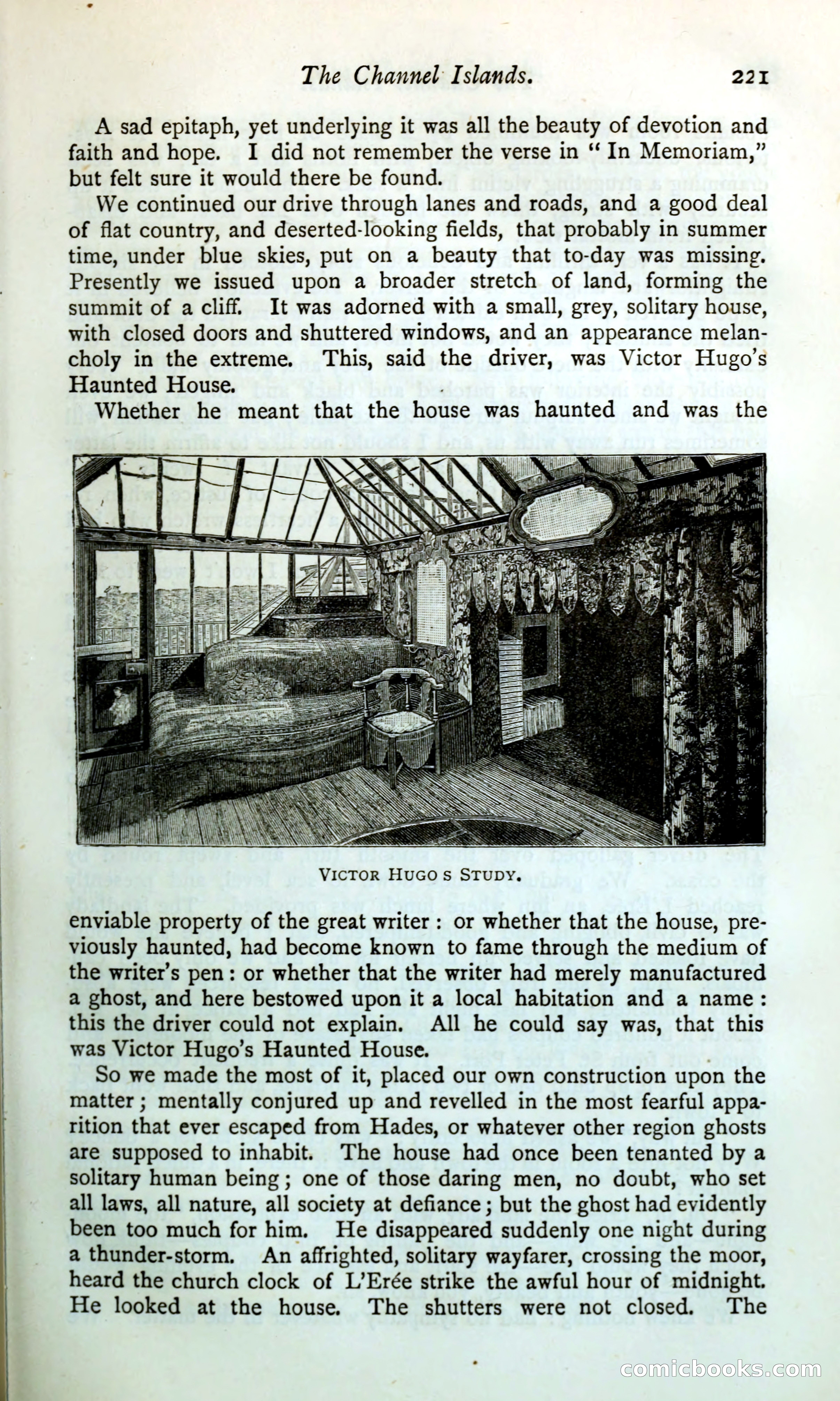
The Channel Islands. 221 A sad epitaph, yet underlying it was all the beauty of devotion and faith and hope. I did not remember the verse in “ In Memoriam,” but felt sure it would there be found. We continued our drive through lanes and roads, and a good deal of flat country, and deserted-looking fields, that probably in summer time, under blue skies, put on a beauty that to-day was missing. Presently we issued upon a broader stretch of land, forming the summit of a cliff. It was adorned with a small, grey, solitary house, with closed doors and shuttered windows, and an appearance melan- choly in the extreme. This, said the driver, was Victor Hugo’s Haunted House. , Whether he meant that the house was haunted and was the | : THT ATE 4 BL) bes iit rt Ait =e.) ee ety 1 NE : ath ! =i a ae ps te \ ‘ ra ee =.= > i) ae, bs a er _ = , - x Vv ~- mo- Na -_— 24 f » : -_ aay ey a KANN USSSS HN “KX NERS he SS S ~ ™~ >» SOO . N N . VICTOR HuGOS STUDY, enviable property of the great writer: or whether that the house, pre- viously haunted, had become known to fame through the medium of the writer’s pen: or whether that the writer had merely manufactured a ghost, and here bestowed upon it a local habitation and a name: this the driver could not explain. All he could say was, that this was Victor Hugo’s Haunted House. | So we made the most of it, placed our own construction upon the matter ; mentally conjured up and revelled in the most fearful appa- rition that ever escaped from Hades, or whatever other region ghosts are supposed to inhabit. ‘The house had once been tenanted by a solitary human being; one of those daring men, no doubt, who set all laws, all nature, all society at defiance ; but the ghost had evidently been too much for him. He disappeared suddenly one night during a thunder-storm. An affrighted, solitary wayfarer, crossing the moor, heard the church clock of L’Erée strike the awful hour of midnight. He looked at the house. The shutters were not closed. The EOMIIGIOOKS (C(O)