
Pulp Fiction, 1865 · page 220 of 400
The Argosy — page 220: what you’re looking at
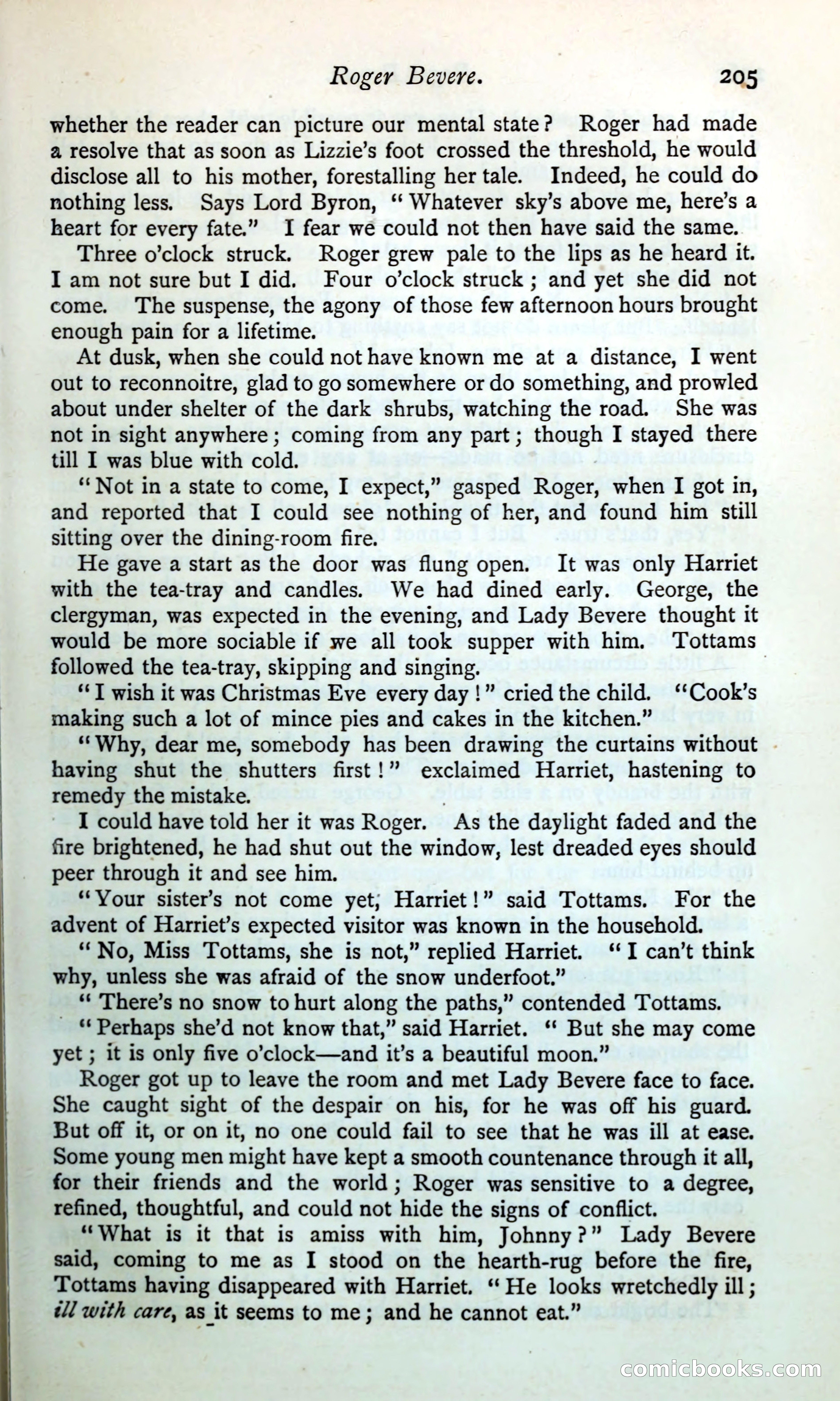
A restored page from Pulp Fiction, 1865. Page through the whole issue in the reader above.
📄 Transcribed text from this page (OCR, searchable)
Machine-transcribed from the original scan — historical spelling and the odd misread are preserved.
Roger Bevere. 205 whether the reader can picture our mental state? Roger had made a resolve that as soon as Lizzie’s foot crossed the threshold, he would disclose all to his mother, forestalling her tale. Indeed, he could do nothing less. Says Lord Byron, ‘*‘ Whatever sky’s above me, here’s a heart for every fate.” I fear we could not then have said the same. Three o’clock struck. Roger grew pale to the lips as he heard it. I am not sure but I did. Four o’clock struck ; and yet she did not come. The suspense, the agony of those few afternoon hours brought enough pain for a lifetime. At dusk, when she could not have known me at a distance, I went out to reconnoitre, glad to go somewhere or do something, and prowled about under shelter of the dark shrubs, watching the road. She was not in sight anywhere ; coming from any part; though I stayed there till I was blue with cold. ‘Not in a state to come, I expect,” gasped Roger, when I got in, and reported that I could see nothing of her, and found him still sitting over the dining-room fire. He gave a start as the door was flung open. It was only Harriet with the tea-tray and candles. We had dined early. George, the clergyman, was expected in the evening, and Lady Bevere thought it would be more sociable if we all took supper with him. Tottams followed the tea-tray, skipping and singing. *T wish it was Christmas Eve every day!” criedthe child. ‘‘Cook’s making such a lot of mince pies and cakes in the kitchen.” “Why, dear me, somebody has been drawing the curtains without . having shut the shutters first!” exclaimed Harriet, hastening to remedy the mistake. , I could have told her it was Roger. As the daylight faded and the fire brightened, he had shut out the window, lest dreaded eyes should peer through it and see him. “Your sister’s not come yet; Harriet!” said Tottams. For the advent of Harriet’s expected visitor was known in the household. “No, Miss Tottams, she is not,” replied Harriet. ‘I can’t think why, unless she was afraid of the snow underfoot.” “ There’s no snow to hurt along the paths,” contended Tottams. _ “ Perhaps she’d not know that,” said Harriet. ‘‘ But she may come yet ; it is only five o’clock—and it’s a beautiful moon.” Roger got up to leave the room and met Lady Bevere face to face. She caught sight of the despair on his, for he was off his guard. But off it, or on it, no one could fail to see that he was ill at ease. Some young men might have kept a smooth countenance through it all, for their friends and the world; Roger was sensitive to a degree, refined, thoughtful, and could not hide the signs of conflict. “What is it that is amiss with him, Johnny?” Lady Bevere said, coming to me as I stood on the hearth-rug before the fire, Tottams having disappeared with Harriet. “‘He looks wretchedly ill; tll with care, as it seems to me; and he cannot eat.” EOMIIGHOOKS (E(0)