
Pulp Fiction, 1865 · page 195 of 400
The Argosy — page 195: what you’re looking at
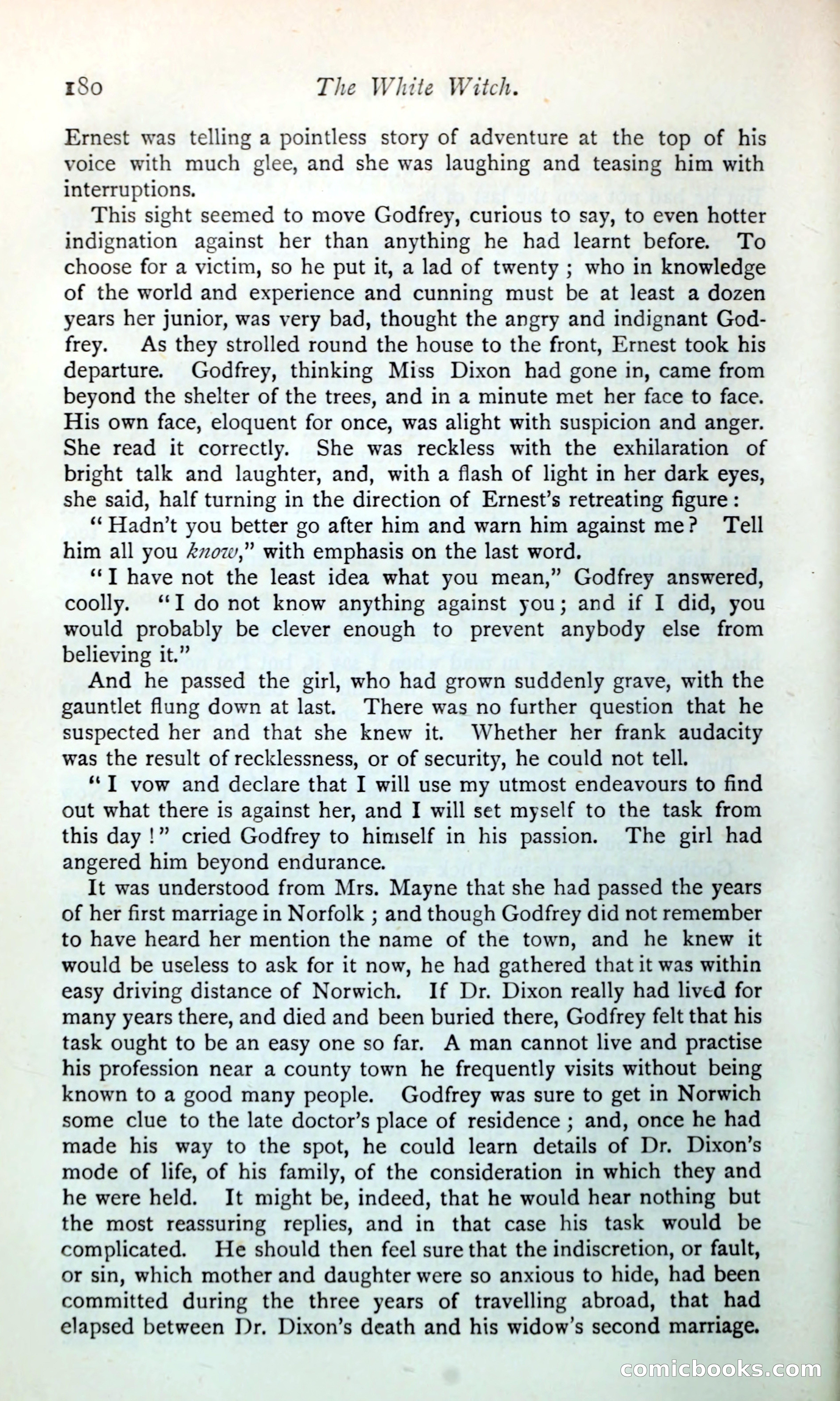
A restored page from Pulp Fiction, 1865. Page through the whole issue in the reader above.
📄 Transcribed text from this page (OCR, searchable)
Machine-transcribed from the original scan — historical spelling and the odd misread are preserved.
rSo The White Witch. Ernest was telling a pointless story of adventure at the top of his voice with much glee, and she was laughing and teasing him with interruptions. This sight seemed to move Godfrey, curious to say, to even hotter indignation against her than anything he had learnt before. To choose for a victim, so he put it, a lad of twenty ; who in knowledge of the world and experience and cunning must be at least a dozen years her junior, was very bad, thought the angry and indignant God- frey. As they strolled round the house to the front, Ernest took his departure. Godfrey, thinking Miss Dixon had gone in, came from beyond the shelter of the trees, and in a minute met her face to face. His own face, eloquent for once, was alight with suspicion and anger. She read it correctly. She was reckless with the exhilaration of bright talk and laughter, and, with a flash of light in her dark eyes, she said, half turning in the direction of Ernest’s retreating figure: “Hadn’t you better go after him and warn him against me? Tell him all you £ow,” with emphasis on the last word. ‘“‘T have not the least idea what you mean,” Godfrey answered, coolly. ‘I do not know anything against you; and if I did, you would probably be clever enough to prevent anybody else from believing it.” And he passed the girl, who had grown suddenly grave, with the gauntlet flung down at last. There was no further question that he suspected her and that she knew it. Whether her frank audacity was the result of recklessness, or of security, he could not tell. **T vow and declare that I will use my utmost endeavours to find out what there is against her, and I will set myself to the task from this day !” cried Godfrey to himself in his passion. The girl had angered him beyond endurance. It was understood from Mrs. Mayne that she had passed the years of her first marriage in Norfolk ; and though Godfrey did not remember to have heard her mention the name of the town, and he knew it would be useless to ask for it now, he had gathered that it was within easy driving distance of Norwich. If Dr. Dixon really had lived for many years there, and died and been buried there, Godfrey felt that his task ought to be an easy one so far. A man cannot live and practise his profession near a county town he frequently visits without being known to a good many people. Godfrey was sure to get in Norwich some clue to the late doctor’s place of residence ; and, once he had made his way to the spot, he could learn details of Dr. Dixon’s mode of life, of his family, of the consideration in which they and he were held. It might be, indeed, that he would hear nothing but the most reassuring replies, and in that case his task would be complicated. He should then feel sure that the indiscretion, or fault, or sin, which mother and daughter were so anxious to hide, had been committed during the three years of travelling abroad, that had elapsed between Dr. Dixon’s death and his widow’s second marriage. EOMmiicbooks (E(0) m