
Pulp Fiction, 1865 · page 164 of 400
The Argosy — page 164: what you’re looking at
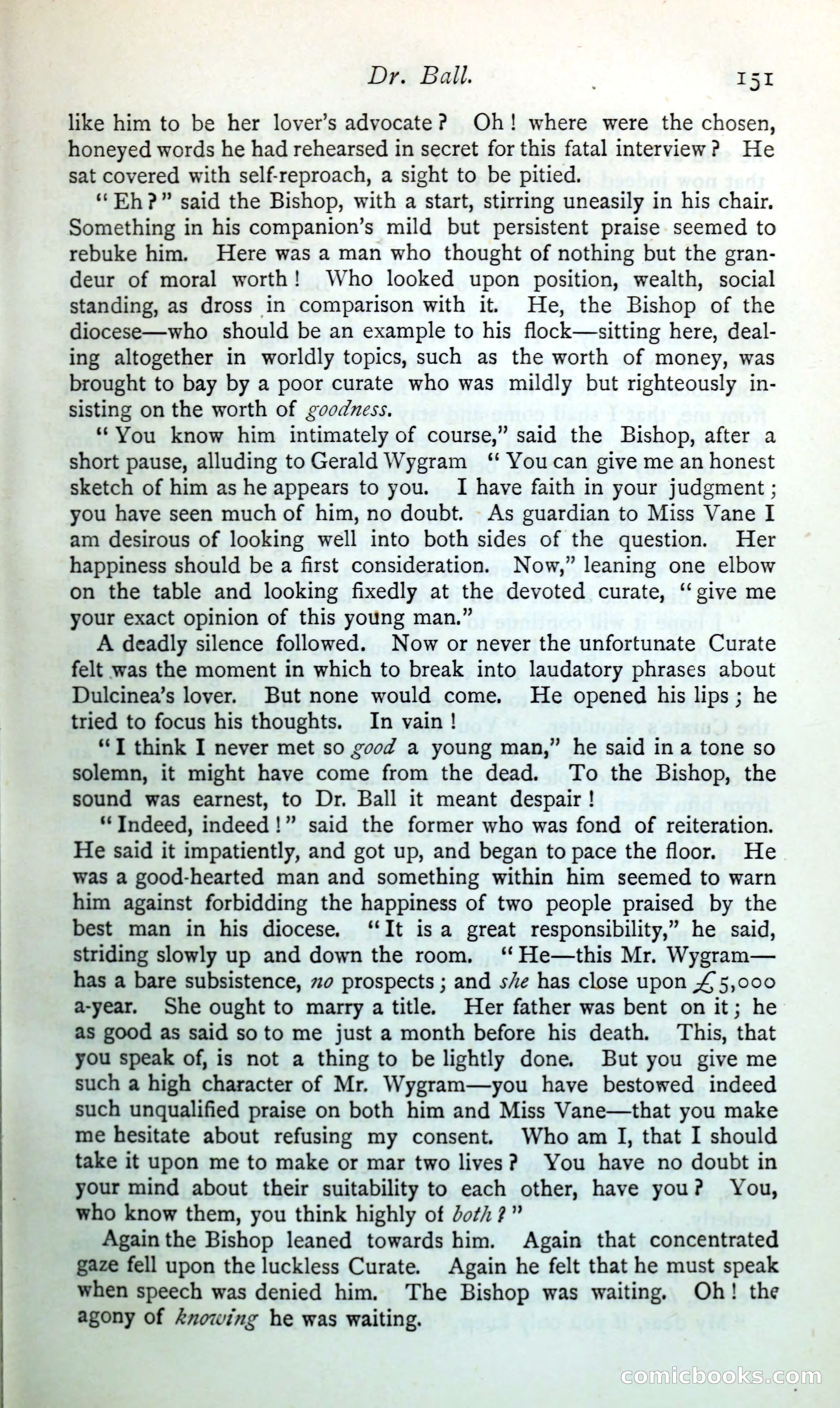
A restored page from Pulp Fiction, 1865. Page through the whole issue in the reader above.
📄 Transcribed text from this page (OCR, searchable)
Machine-transcribed from the original scan — historical spelling and the odd misread are preserved.
Dr. Ball. I51 like him to be her lover’s advocate? Oh! where were the chosen, honeyed words he had rehearsed in secret for this fatal interview? He sat covered with self-reproach, a sight to be pitied. ‘* Eh?” said the Bishop, with a start, stirring uneasily in his chair. Something in his companion’s mild but persistent praise seemed to rebuke him. Here was a man who thought of nothing but the gran- deur of moral worth! Who looked upon position, wealth, social standing, as dross in comparison with it. He, the Bishop of the diocese—who should be an example to his flock—sitting here, deal- ing altogether in worldly topics, such as the worth of money, was brought to bay by a poor curate who was mildly but righteously in- sisting on the worth of goodness. ‘You know him intimately of course,” said the Bishop, after a short pause, alluding to Gerald Wygram ‘‘ Youcan give me an honest sketch of him as he appears to you. I have faith in your judgment ; you have seen much of him, no doubt. - As guardian to Miss Vane I am desirous of looking well into both sides of the question. Her happiness should be a first consideration. Now,” leaning one elbow on the table and looking fixedly at the devoted curate, ‘‘ give me your exact opinion of this young man.” A deadly silence followed. Now or never the unfortunate Curate felt was the moment in which to break into laudatory phrases about Dulcinea’s lover. But none would come. He opened his lips; he tried to focus his thoughts. In vain! *T think I never met so good a young man,” he said ina tone so solemn, it might have come from the dead. To the Bishop, the sound was earnest, to Dr. Ball it meant despair ! "Indeed, indeed!” said the former who was fond of reiteration. He said it impatiently, and got up, and began to pace the floor. He was a good-hearted man and something within him seemed to warn him against forbidding the happiness of two people praised by the best man in his diocese. ‘It isa great responsibility,” he said, striding slowly up and down the room. ‘“ He—this Mr. Wygram— has a bare subsistence, 7o prospects ; and se has close upon £ 5,000 a-year. She ought to marry a title. Her father was bent on it; he as good as said soto me just a month before his death. This, that you speak of, is not a thing to be lightly done. But you give me such a high character of Mr. Wygram—you have bestowed indeed such unqualified praise on both him and Miss Vane—that you make me hesitate about refusing my consent. Who am I, that I should take it upon me to make or mar two lives? You have no doubt in your mind about their suitability to each other, have you? You, who know them, you think highly of doth?” Again the Bishop leaned towards him. Again that concentrated gaze fell upon the luckless Curate. Again he felt that he must speak when speech was denied him. The Bishop was waiting. Oh! the agony of knowing he was waiting. m CORNICE OOOKS (EO