
Pulp Fiction, 1865 · page 144 of 400
The Argosy — page 144: what you’re looking at
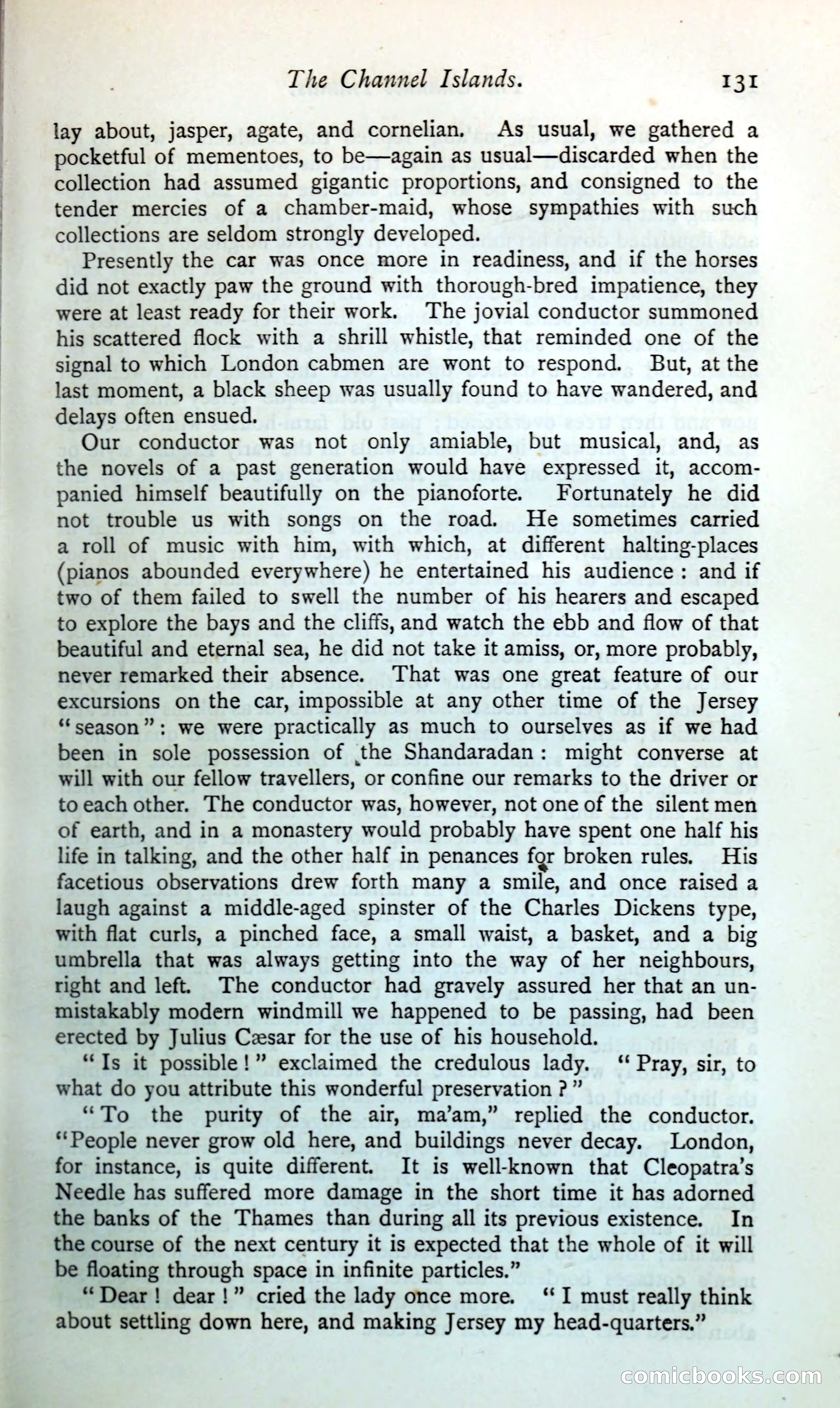
A restored page from Pulp Fiction, 1865. Page through the whole issue in the reader above.
📄 Transcribed text from this page (OCR, searchable)
Machine-transcribed from the original scan — historical spelling and the odd misread are preserved.
The Channel Islands. 131 lay about, jasper, agate, and cornelian. As usual, we gathered a pocketful of mementoes, to be—again as usual—discarded when the collection had assumed gigantic proportions, and consigned to the tender mercies of a chamber-maid, whose sympathies with such collections are seldom strongly developed. Presently the car was once more in readiness, and if the horses did not exactly paw the ground with thorough-bred impatience, they were at least ready for their work. The jovial conductor summoned his scattered flock with a shrill whistle, that reminded one of the signal to which London cabmen are wont to respond. But, at the last moment, a black sheep was usually found to have wandered, and delays often ensued. Our conductor was not only amiable, but musical, and, as the novels of a past generation would have expressed it, accom- panied himself beautifully on the pianoforte. Fortunately he did not trouble us with songs on the road. He sometimes carried a roll of music with him, with which, at different halting-places (pianos abounded everywhere) he entertained his audience: and if two of them failed to swell the number of his hearers and escaped to explore the bays and the cliffs, and watch the ebb and flow of that beautiful and eternal sea, he did not take it amiss, or, more probably, never remarked their absence. That was one great feature of our excursions on the car, impossible at any other time of the Jersey “season”: we were practically as much to ourselves as if we had been in sole possession of the Shandaradan: might converse at will with our fellow travellers, or confine our remarks to the driver or to each other. The conductor was, however, not one of the silent men of earth, and in a monastery would probably have spent one half his life in talking, and the other half in penances fgr broken rules. His facetious observations drew forth many a smile, and once raised a laugh against a middle-aged spinster of the Charles Dickens type, with flat curls, a pinched face, a small waist, a basket, and a big umbrella that was always getting into the way of her neighbours, right and left. The conductor had gravely assured her that an un- mistakably modern windmill we happened to be passing, had been erected by Julius Czesar for the use of his household. “Is it possible!” exclaimed the credulous lady. ‘‘ Pray, sir, to what do you attribute this wonderful preservation ?” “To the purity of the air, ma’am,” replied the conductor. “People never grow old here, and buildings never decay. London, for instance, is quite different. It is well-known that Cleopatra’s Needle has suffered more damage in the short time it has adorned the banks of the Thames than during all its previous existence. In the course of the next century it is expected that the whole of it will be floating through space in infinite particles.” “Dear! dear!” cried the lady once more. ‘I must really think about settling down here, and making Jersey my head-quarters.” CONMIEIOOKS (E(©) m