
Pulp Fiction, 1865 · page 205 of 400
The Argosy — page 205: what you’re looking at
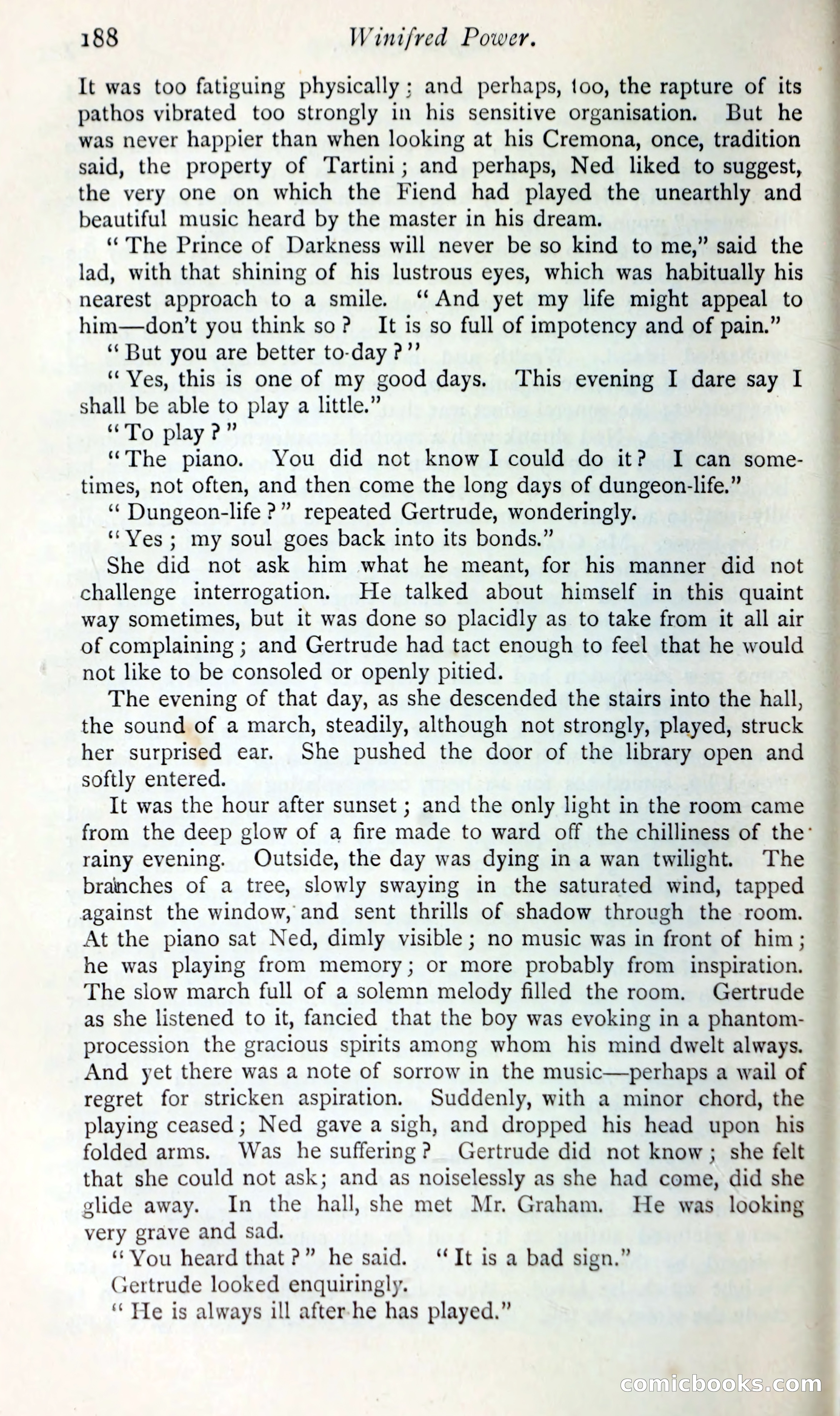
A restored page from Pulp Fiction, 1865. Page through the whole issue in the reader above.
📄 Transcribed text from this page (OCR, searchable)
Machine-transcribed from the original scan — historical spelling and the odd misread are preserved.
188 Winifred Power. It was too fatiguing physically; and perhaps, too, the rapture of its pathos vibrated too strongly in his sensitive organisation. But he was never happier than when looking at his Cremona, once, tradition said, the property of Tartini; and perhaps, Ned liked to suggest, the very one on which the Fiend had played the unearthly and beautiful music heard by the master in his dream. ‘The Prince of Darkness will never be so kind to me,” said the lad, with that shining of his lustrous eyes, which was habitually his nearest approach to a smile. ‘‘And yet my life might appeal to him—don’t you think so? It is so full of impotency and of pain.” ‘But you are better to-day ?”’ ‘Ves, this is one of my good days. ‘This evening I dare say I shall be able to play a little.” To play ?” ‘The piano. You did not know I could do it? I can some- times, not often, and then come the long days of dungeon-life.” ‘‘ Dungeon-life ?” repeated Gertrude, wonderingly. ‘‘ Ves; my soul goes back into its bonds.” She did not ask him what he meant, for his manner did not challenge interrogation. He talked about himself in this quaint way sometimes, but it was done so placidly as to take from it all air of complaining ; and Gertrude had tact enough to feel that he would not like to be consoled or openly pitied. , The evening of that day, as she descended the stairs into the hall, _ the sound of a march, steadily, although not strongly, played, struck — her surprised ear. She pushed the door of the library open and softly entered. ; It was the hour after sunset ; and the only light in the room came from the deep glow of a fire made to ward off the chilliness of the’ | rainy evening. Outside, the day was dying in a wan twilight. The ~ branches of a tree, slowly swaying in the saturated wind, tapped against the window, and sent thrills of shadow through the room. At the piano sat Ned, dimly visible; no music was in front of him; he was playing from memory; or more probably from inspiration. The slow march full of a solemn melody filled the room. Gertrude as she listened to it, fancied that the boy was evoking in a phantom- procession the gracious spirits among whom his mind dwelt always. And yet there was a note of sorrow in the music—perhaps a wail of regret for stricken aspiration. Suddenly, with a minor chord, the playing ceased; Ned gave a sigh, and dropped his head upon his folded arms. Was he suffering? Gertrude did not know; she felt that she could not ask; and as noiselessly as she had come, did she glide away. In the hall, she met Mr. Graham. He was looking very grave and sad. ‘You heard that?” he said. “It is a bad sign.” Gertrude looked enquiringly. ‘ Te is always ill after-he has played.” y 4 : t COMME KOO <S,Colnae