
Pulp Fiction, 1865 · page 204 of 400
The Argosy — page 204: what you’re looking at
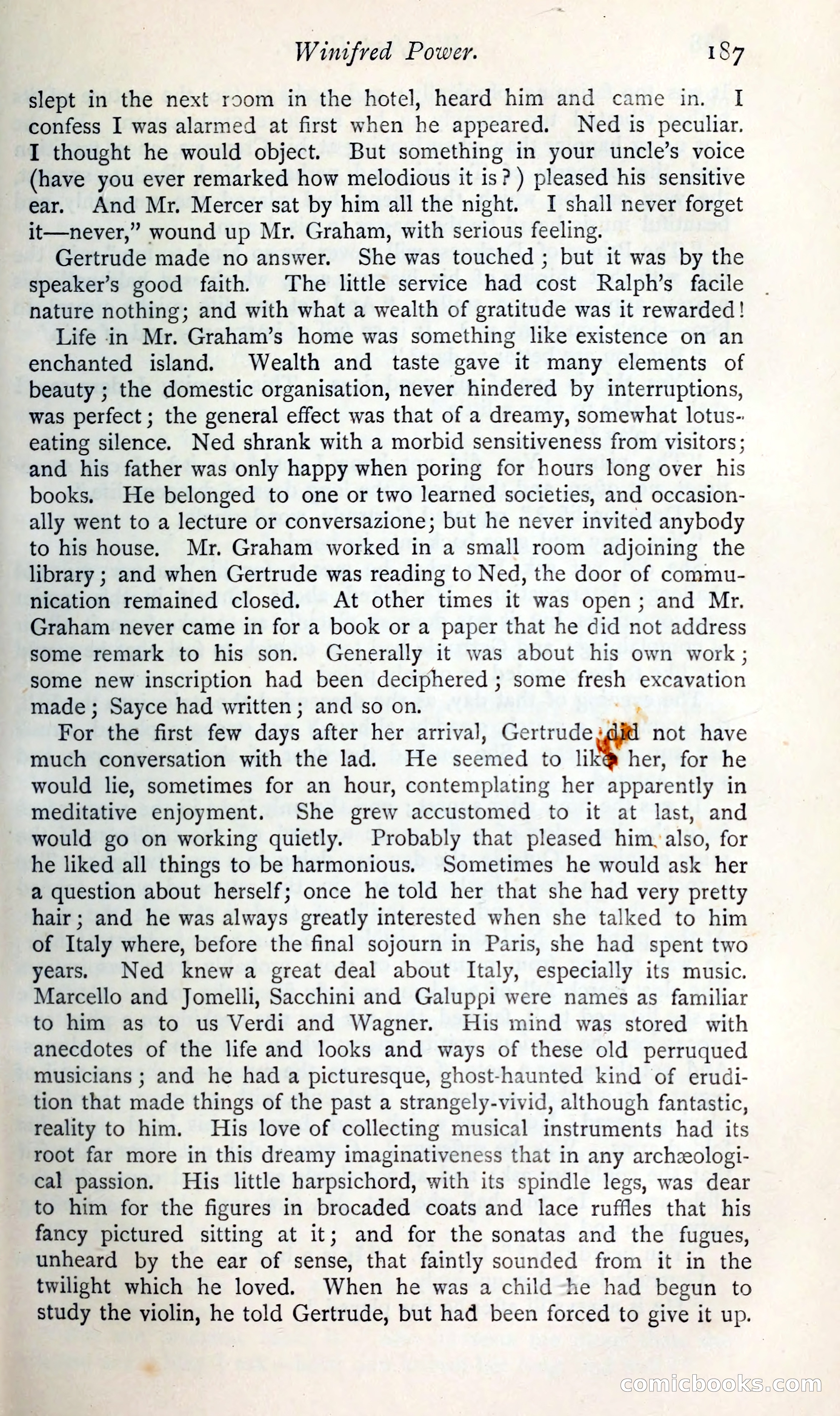
A restored page from Pulp Fiction, 1865. Page through the whole issue in the reader above.
📄 Transcribed text from this page (OCR, searchable)
Machine-transcribed from the original scan — historical spelling and the odd misread are preserved.
Winifred Power. 187 slept in the next room in the hotel, heard him and came in. I confess I was alarmed at first when he appeared, Ned is peculiar. I thought he would object. But something in your uncle’s voice (have you ever remarked how melodious it is?) pleased his sensitive ear. And Mr. Mercer sat by him all the night. I shall never forget it—never,” wound up Mr. Graham, with serious feeling. Gertrude made no answer. She was touched ; but it was by the speaker’s good faith. The little service had cost Ralph’s facile nature nothing; and with what a wealth of gratitude was it rewarded! Life in Mr. Graham’s home was something like existence on an enchanted island. Wealth and taste gave it many elements of beauty ; the domestic organisation, never hindered by interruptions, was perfect ; the general effect was that of a dreamy, somewhat lotus- eating silence. Ned shrank with a morbid sensitiveness from visitors; and his father was only happy when poring for hours long over his books. He belonged to one or two learned societies, and occasion- ally went to a lecture or conversazione; but he never invited anybody to his house. Mr. Graham worked in a small room adjoining the library ; and when Gertrude was reading to Ned, the door of commu- nication remained closed. At other times it was open; and Mr. Graham never came in for a book or a paper that he did not address some remark to his son. Generally it was about his own work ; some new inscription had been deciphered ; some fresh excavation made; Sayce had written; and so on. “oy For the first few days after her arrival, Gertrude;@jtl not have much conversation with the lad. He seemed to lik@ her, for he would lie, sometimes for an hour, contemplating her apparently in meditative enjoyment. She grew accustomed to it at last, and would go on working quietly. Probably that pleased him, also, for he liked all things to be harmonious. Sometimes he would ask her a question about herself; once he told her that she had very pretty hair; and he was always greatly interested when she talked to him of Italy where, before the final sojourn in Paris, she had spent two years. Ned knew a great deal about Italy, especially its music. Marcello and Jomelli, Sacchini and Galuppi were names as familiar to him as to us Verdi and Wagner. His mind was stored with anecdotes of the life and looks and ways of these old perruqued musicians ; and he had a picturesque, ghost-haunted kind of erudi- tion that made things of the past a strangely-vivid, although fantastic, reality to him. His love of collecting musical instruments had its root far more in this dreamy imaginativeness that in any archzologi- cal passion. Huis little harpsichord, with its spindle legs, was dear to him for the figures in brocaded coats and lace ruffles that his fancy pictured sitting at it; and for the sonatas and the fugues, unheard by the ear of sense, that faintly sounded from it in the twilight which he loved. When he was a child -he had begun to study the violin, he told Gertrude, but had been forced to give it up. ECORnnICLOOOKS (CO)