
Pulp Fiction, 1865 · page 57 of 399
The Argosy — page 57: what you’re looking at
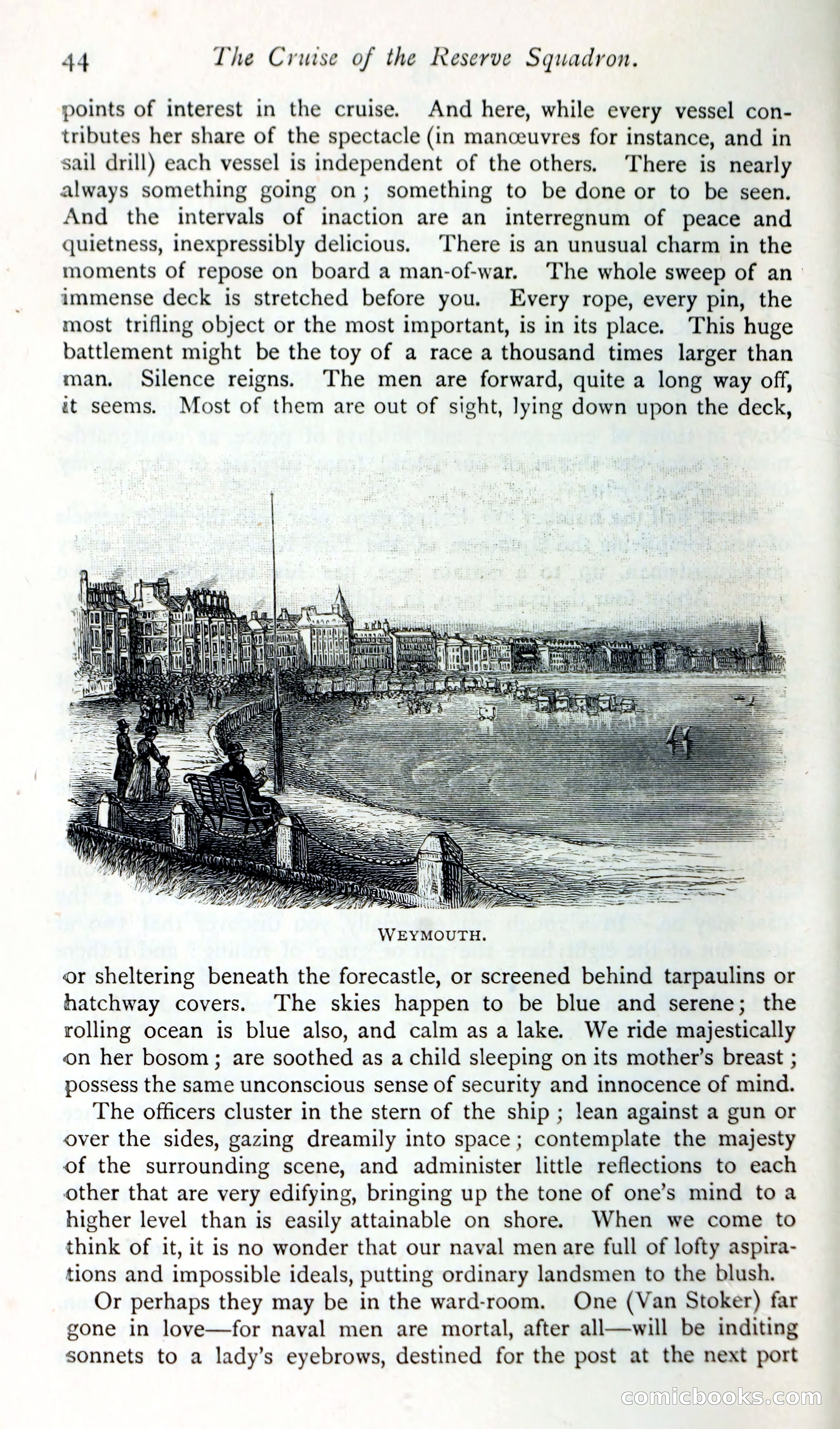
A restored page from Pulp Fiction, 1865. Page through the whole issue in the reader above.
📄 Transcribed text from this page (OCR, searchable)
Machine-transcribed from the original scan — historical spelling and the odd misread are preserved.
44 The Cruise of the Reserve Squadron. points of interest in the cruise. And here, while every vessel con- tributes her share of the spectacle (in manceuvres for instance, and in sail drill) each vessel is independent of the others. ‘There is nearly always something going on; something to be done or to be seen. And the intervals of inaction are an interregnum of peace and quietness, inexpressibly delicious. There is an unusual charm in the moments of repose on board a man-of-war. The whole sweep of an- immense deck is stretched before you. Every rope, every pin, the most trifling object or the most important, is in its place. This huge battlement might be the toy of a race a thousand times larger than man. Silence reigns. ‘The men are forward, quite a long way off, it seems. Most of them are out of sight, lying down upon the deck, F sii LTH Hts Ef ee ee 3! Fittee te : —~ == ——_ —————————————— = a ws ~~cnerar ——— = ——— —=s Pescetiaeanan = has : Sq pyle Me sii Mute - ‘ we ~~ ee =: TLL OTANI al yb thane i - . —_ =~ = iis ! = itu = | Mit nan \ wre aS aN = > ~~ 2 ~ = Ts Rt) n allt ‘it ————. See = —— | _—T 4 IF —— 2 = = — ‘ ' ‘5 — i". ~— e a = AS LAA f) ! Whiz¥ LSS, ) >. = WEYMOUTH. or sheltering beneath the forecastle, or screened behind tarpaulins or hatchway covers. ‘The skies happen to be blue and serene; the rolling ocean is blue also, and calm as a lake. We ride majestically on her bosom; are soothed as a child sleeping on its mother’s breast ; possess the same unconscious sense of security and innocence of mind. The officers cluster in the stern of the ship ; lean against a gun or over the sides, gazing dreamily into space; contemplate the majesty of the surrounding scene, and administer little reflections to each other that are very edifying, bringing up the tone of one’s mind toa higher level than is easily attainable on shore. When we come to think of it, it is no wonder that our naval men are full of lofty aspira- tions and impossible ideals, putting ordinary landsmen to the blush. Or perhaps they may be in the ward-room. One (Van Stoker) far gone in love—for naval men are mortal, after all—will be inditing sonnets to a lady’s eyebrows, destined for the post at the next port COnmicloooxs.c@