
Pulp Fiction, 1865 · page 56 of 399
The Argosy — page 56: what you’re looking at
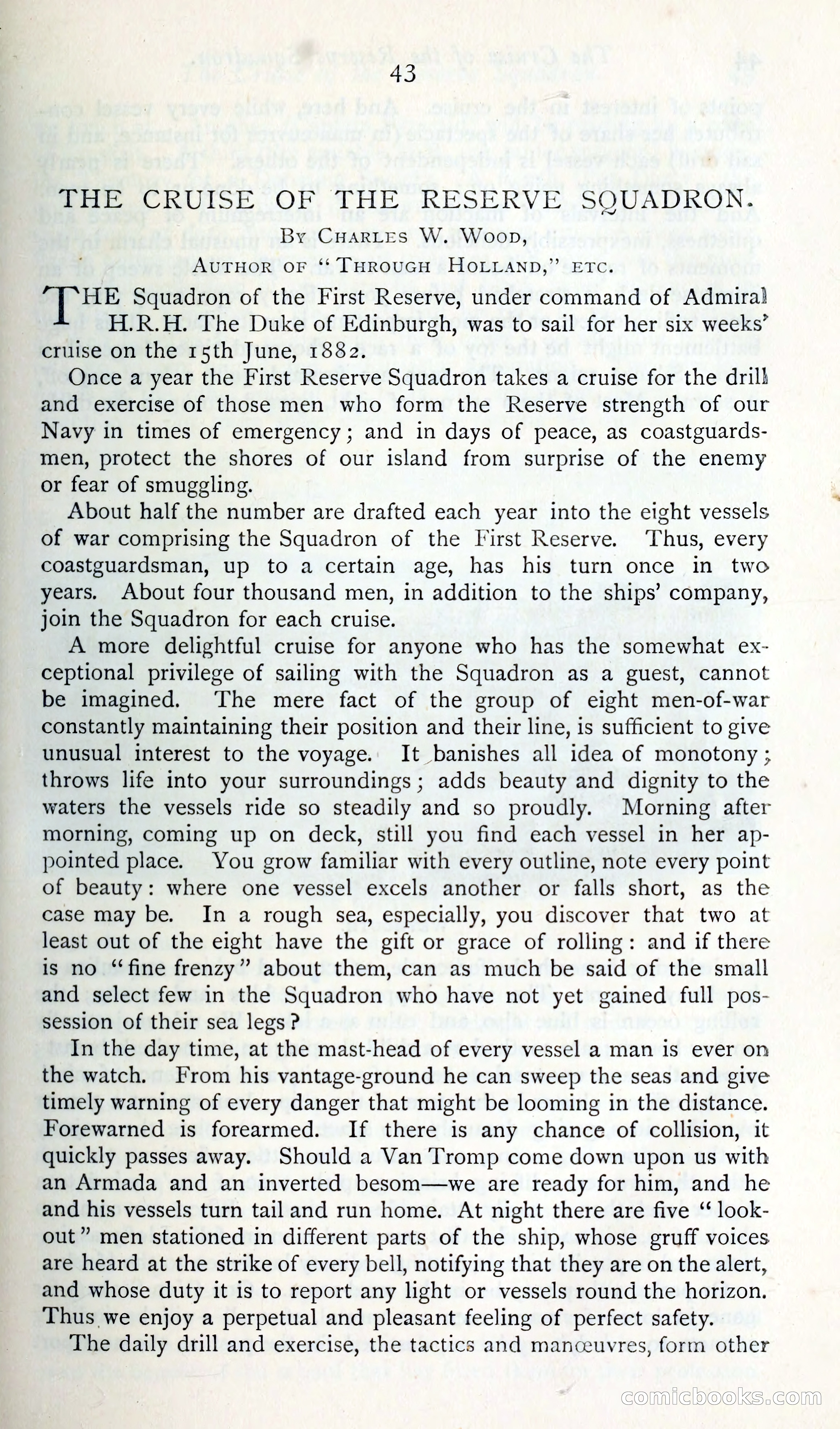
A restored page from Pulp Fiction, 1865. Page through the whole issue in the reader above.
📄 Transcribed text from this page (OCR, searchable)
Machine-transcribed from the original scan — historical spelling and the odd misread are preserved.
43 eee oRUISE OF THE RESERVE SOUADKON. By CHARLES W. Woop, AUTHOR OF ‘*S [THROUGH HOLLAND,” ETC. HE Squadron of the First Reserve, under command of Admiral) H.R.H. The Duke of Edinburgh, was to sail for her six weeks’ cruise on the 15th June, 1882. Once a year the First Reserve Squadron takes a cruise for the drill and exercise of those men who form the Reserve strength of our Navy in times of emergency; and in days of peace, as coastguards- men, protect the shores of our island from surprise of the enemy or fear of smuggling. About half the number are drafted each year into the eight vessels of war comprising the Squadron of the First Reserve. Thus, every coastguardsman, up to a certain age, has his turn once in two years. About four thousand men, in addition to the ships’ company, join the Squadron for each cruise. A more delightful cruise for anyone who has the somewhat ex- ceptional privilege of sailing with the Squadron as a guest, cannot be imagined. The mere fact of the group of eight men-of-war constantly maintaining their position and their line, is sufficient to give unusual interest to the voyage. It banishes all idea of monotony ; throws life into your surroundings; adds beauty and dignity to the waters the vessels ride so steadily and so proudly. Morning after morning, coming up on deck, still you find each vessel in her ap- pointed place. You grow familiar with every outline, note every point of beauty: where one vessel excels another or falls short, as the case may be. In a rough sea, especially, you discover that two at least out of the eight have the gift or grace of rolling: and if there is no “fine frenzy” about them, can as much be said of the small and select few in the Squadron who have not yet gained full pos- session of their sea legs P In the day time, at the mast-head of every vessel a man is ever on the watch. From his vantage-ground he can sweep the seas and give timely warning of every danger that might be looming in the distance. Forewarned is forearmed. If there is any chance of collision, it quickly passes away. Should a Van Tromp come down upon us with an Armada and an inverted besom—we are ready for him, and he and his vessels turn tailand run home. At night there are five ‘ look- out” men stationed in different parts of the ship, whose gruff voices are heard at the strike of every bell, notifying that they are on the alert, and whose duty it is to report any light or vessels round the horizon. Thus we enjoy a perpetual and pleasant feeling of perfect safety. The daily drill and exercise, the tactics and manceuvres, form other ECORnnicloooks (CO)