
Pulp Fiction, 1865 · page 99 of 399
The Argosy — page 99: what you’re looking at
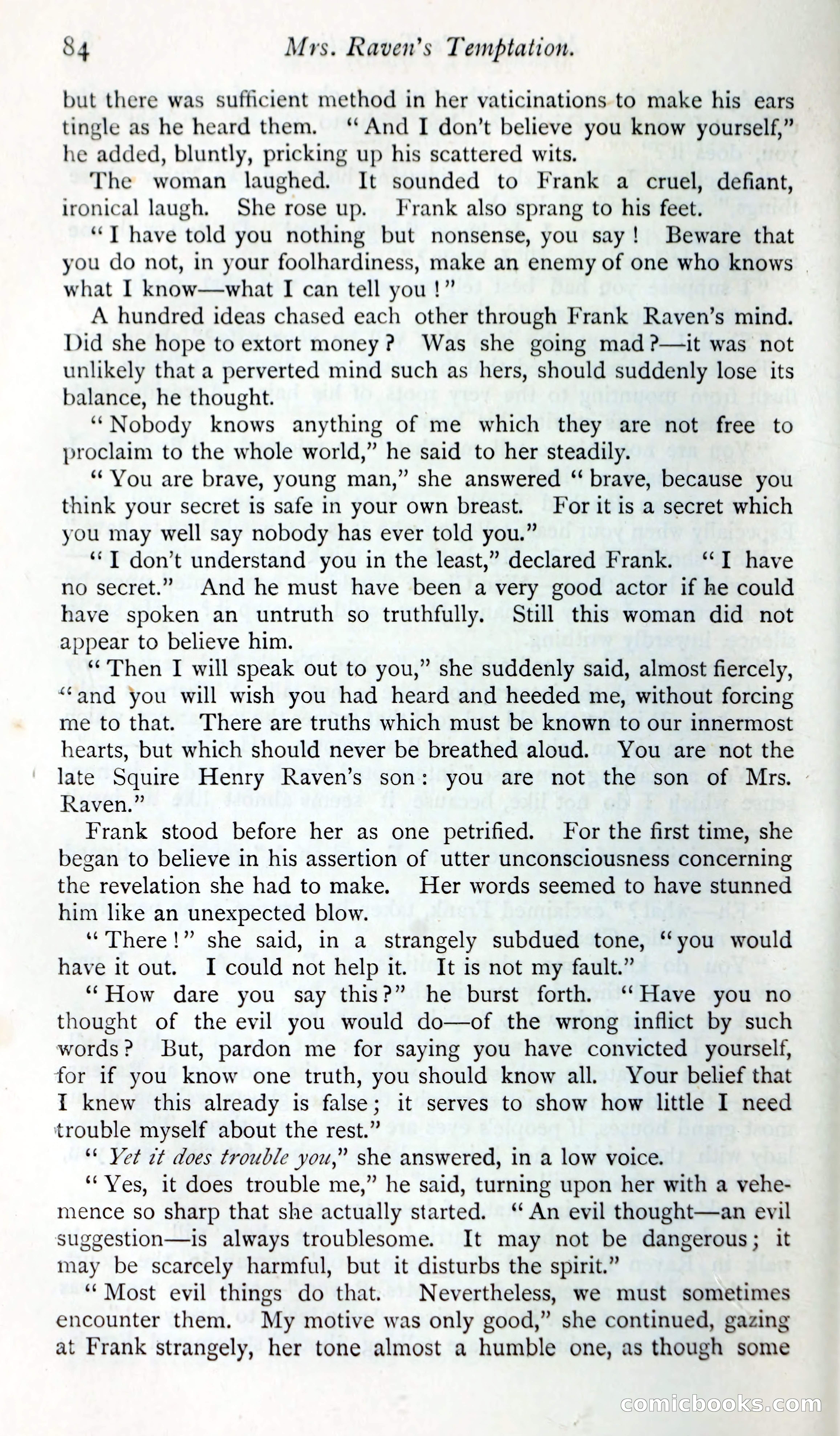
A restored page from Pulp Fiction, 1865. Page through the whole issue in the reader above.
📄 Transcribed text from this page (OCR, searchable)
Machine-transcribed from the original scan — historical spelling and the odd misread are preserved.
84 Mrs. Raven’s Temptation. but there was sufficient method in her vaticinations to make his ears tingle as he heard them. ‘And I don’t believe you know yourself,” he added, bluntly, pricking up his scattered wits. The woman laughed. It sounded to Frank a cruel, defiant, ironical laugh. She rose up. Frank also sprang to his feet. ‘“T have told you nothing but nonsense, you say! Beware that you do not, in your foolhardiness, make an enemy of one who knows | what I know—what I can tell you !” A hundred ideas chased each other through Frank Raven’s mind. Did she hope to extort money? Was she going mad ?—it was not unlikely that a perverted mind such as hers, should suddenly lose its balance, he thought. ‘Nobody knows anything of me which they are not free to proclaim to the whole world,” he said to her steadily. “You are brave, young man,” she answered ‘“‘ brave, because you think your secret 1s safe in your own breast. For it is a secret which you may well say nobody has ever told you.” ‘‘T don’t understand you in the least,” declared Frank. ‘‘I have no secret.” And he must have been a very good actor if he could have spoken an untruth so truthfully. Still this woman did not appear to believe him. “Then I will speak out to you,” she suddenly said, almost fiercely, “‘and you will wish you had heard and heeded me, without forcing me to that. There are truths which must be known to our innermost hearts, but which should never be breathed aloud. You are not the late Squire Henry Raven’s son: you are not the son of Mrs. » Raven.” Frank stood before her as one petrified. For the first time, she began to believe in his assertion of utter unconsciousness concerning the revelation she had to make. Her words seemed to have stunned him hke an unexpected blow. “There!” she said, in a strangely subdued tone, “‘you would have it out. I could not help it. It is not my fault.” “How dare you say this?” he burst forth. ‘“‘ Have you no thought of the evil you would do—of the wrong inflict by such words? But, pardon me for saying you have convicted yourself, for if you know one truth, you should know all. Your belief that { knew this already is false; it serves to show how little I need trouble myself about the rest.” “ Yet zt does trouble you,” she answered, in a low voice. “Yes, it does trouble me,” he said, turning upon her with a vehe- mence so sharp that she actually started. ‘ An evil thought—an evil suggestion—is always troublesome. It may not be dangerous; it may be scarcely harmful, but it disturbs the spirit.” ‘“Most evil things do that. Nevertheless, we must sometimes encounter them. My motive was only good,” she continued, gazing at Frank strangely, her tone almost a humble one, as though some ECOPMICLIOO KS, Eo)