
Pulp Fiction, 1865 · page 89 of 399
The Argosy — page 89: what you’re looking at
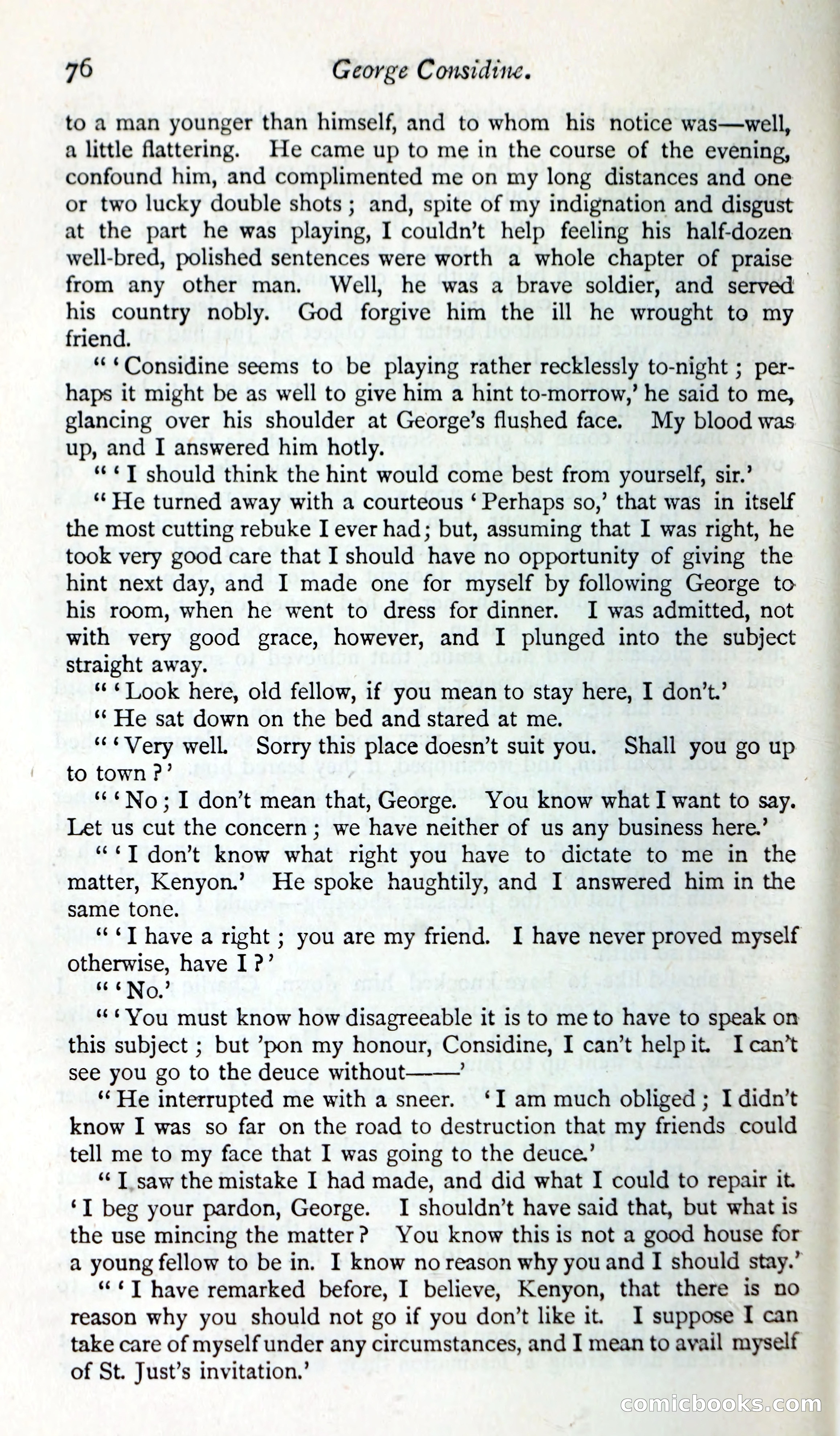
A restored page from Pulp Fiction, 1865. Page through the whole issue in the reader above.
📄 Transcribed text from this page (OCR, searchable)
Machine-transcribed from the original scan — historical spelling and the odd misread are preserved.
76 George Considine. to a man younger than himself, and to whom his notice was—well, a little flattering. He came up to me in the course of the evening, confound him, and complimented me on my long distances and one or two lucky double shots ; and, spite of my indignation and disgust at the part he was playing, I couldn’t help feeling his half-dozen well-bred, polished sentences were worth a whole chapter of praise from any other man. Well, he was a brave soldier, and served | his country nobly. God forgive him the ill he wrought to my friend. ‘*Considine seems to be playing rather recklessly to-night ; per- haps it might be as well to give him a hint to-morrow,’ he said to me, glancing over his shoulder at George’s flushed face. My blood was up, and I answered him hotly. *€¢T should think the hint would come best from yourself, sir.’ ‘He turned away with a courteous ‘ Perhaps so,’ that was in itself the most cutting rebuke I ever had; but, assuming that I was right, he took very good care that I should have no opportunity of giving the hint next day, and I made one for myself by following George to his room, when he went to dress for dinner. I was admitted, not with very good grace, however, and I plunged into the subject straight away. © ¢ Took here, old fellow, if you mean to stay here, I don’t.’ ‘* He sat down on the bed and stared at me. ***Very well. Sorry this place doesn’t suit you. Shall you go up to town P’ ‘°* No; 1 don’t mean that, George. You know what I want to say. Let us cut the concern; we have neither of us any business here.’ ‘“¢] don’t know what right you have to dictate to me in the matter, Kenyon.’ He spoke haughtily, and I answered him in the same tone. ““¢«T have a right ; you are my friend. I have never proved myself otherwise, have I P’ 6c ¢ No.’ “¢ Vou must know how disagreeable it is to me to have to speak on this subject ; but ’pon my honour, Considine, I can’t helpit. I can’t see you go to the deuce without . ‘He interrupted me with a sneer. ‘I am much obliged; I didn’t know I was so far on the road to destruction that my friends could tell me to my face that I was going to the deuce.’ ‘‘T saw the mistake I had made, and did what I could to repair it. ‘I beg your pardon, George. I shouldn’t have said that, but what is the use mincing the matter? You know this is not a good house for a young fellow to be in. I know noreason why you and I should stay.” ‘““¢T have remarked before, I believe, Kenyon, that there is no reason why you should not go if you don’t like it. I suppose I can take care of myself under any circumstances, and I mean to avail myself of St. Just’s invitation.’ EOLMICLNOOL KS, (E00)