
Pulp Fiction, 1865 · page 67 of 399
The Argosy — page 67: what you’re looking at
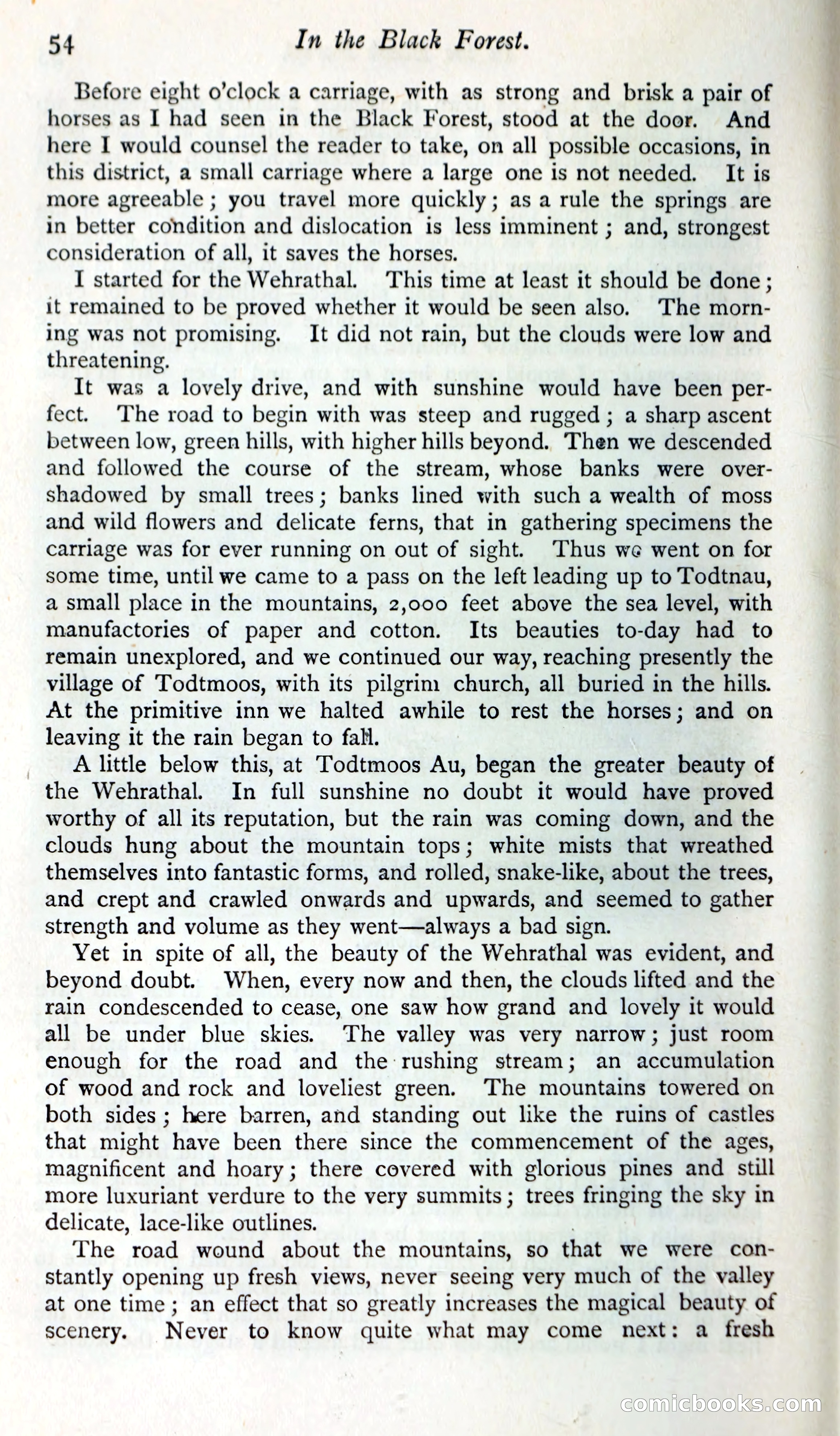
A restored page from Pulp Fiction, 1865. Page through the whole issue in the reader above.
📄 Transcribed text from this page (OCR, searchable)
Machine-transcribed from the original scan — historical spelling and the odd misread are preserved.
54 In the Black Forest. Before eight o’clock a carriage, with as strong and brisk a pair of horses as I had seen in the Black Forest, stood at the door. And here I would counsel the reader to take, on all possible occasions, in this district, a small carriage where a large one is not needed. It is more agreeable ; you travel more quickly; as a rule the springs are in better condition and dislocation is less imminent ; and, strongest consideration of all, it saves the horses. I started for the Wehrathal. This time at least it should be done; it remained to be proved whether it would be seen also. ‘The morn- ing was not promising. It did not rain, but the clouds were low and threatening. It was a lovely drive, and with sunshine would have been per- fect. The road to begin with was steep and rugged ; a sharp ascent between low, green hills, with higher hills beyond. Then we descended and followed the course of the stream, whose banks were over- shadowed by small trees; banks lined with such a wealth of moss and wild flowers and delicate ferns, that in gathering specimens the carriage was for ever running on out of sight. Thus we went on for some time, until we came to a pass on the left leading up to Todtnau, a small place in the mountains, 2,000 feet above the sea level, with manufactories of paper and cotton. Its beauties to-day had to remain unexplored, and we continued our way, reaching presently the village of ‘Todtmoos, with its pilgrim church, all buried in the hills. At the primitive inn we halted awhile to rest the horses; and on leaving it the rain began to fall. A little below this, at Todtmoos Au, began the greater beauty of the Wehrathal. In full sunshine no doubt it would have proved worthy of all its reputation, but the rain was coming down, and the clouds hung about the mountain tops; white mists that wreathed themselves into fantastic forms, and rolled, snake-like, about the trees, and crept and crawled onwards and upwards, and seemed to gather strength and volume as they went—always a bad sign. Yet in spite of all, the beauty of the Wehrathal was evident, and beyond doubt. When, every now and then, the clouds lifted and the rain condescended to cease, one saw how grand and lovely it would all be under blue skies. The valley was very narrow; just room enough for the road and the rushing stream; an accumulation of wood and rock and loveliest green. ‘The mountains towered on both sides ; here barren, and standing out like the ruins of castles that might have been there since the commencement of the ages, magnificent and hoary; there covered with glorious pines and still more luxuriant verdure to the very summits; trees fringing the sky in delicate, lace-like outlines. The road wound about the mountains, SO that we were con- stantly opening up fresh views, never seeing very much of the valley at one time; an effect that so greatly increases the magical beauty of scenery. Never to know quite what may come next: a fresh ECOMICLDIOO KS, EO)