
Pulp Fiction, 1865 · page 63 of 399
The Argosy — page 63: what you’re looking at
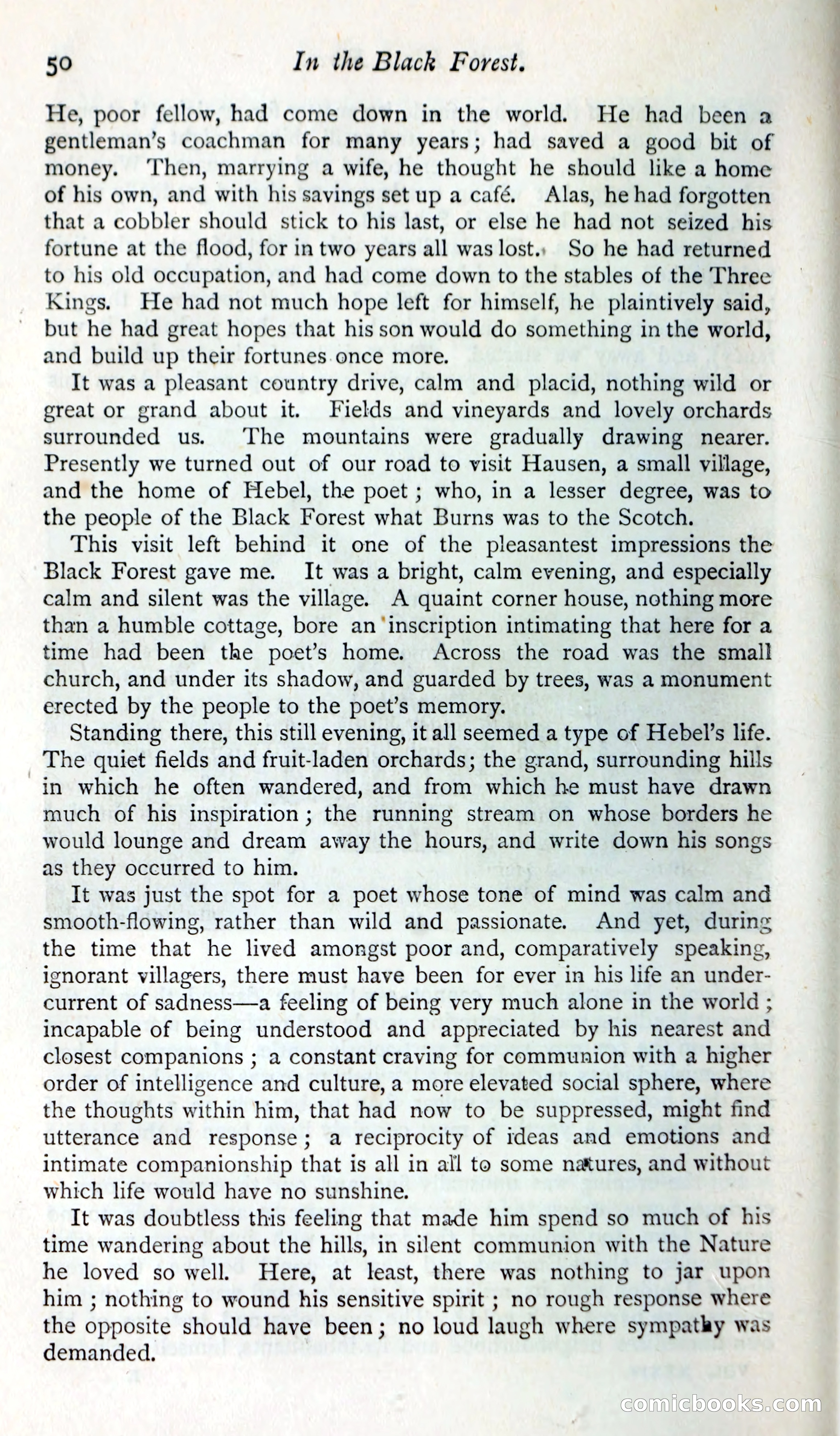
A restored page from Pulp Fiction, 1865. Page through the whole issue in the reader above.
📄 Transcribed text from this page (OCR, searchable)
Machine-transcribed from the original scan — historical spelling and the odd misread are preserved.
50 In the Black Forest. He, poor fellow, had come down in the world. He had been a gentleman’s coachman for many years; had saved a good bit of money. ‘Then, marrying a wife, he thought he should like a home of his own, and with his savings set up a café. Alas, he had forgotten that a cobbler should stick to his last, or else he had not seized his fortune at the flood, for in two years all was lost.. So he had returned to his old occupation, and had come down to the stables of the Three Kings. He had not much hope left for himself, he plaintively said, but he had great hopes that his son would do something in the world, and build up their fortunes. once more. It was a pleasant country drive, calm and placid, nothing wild or great or grand about it. Fields and vineyards and lovely orchards surrounded us. ‘The mountains were gradually drawing nearer. Presently we turned out of our road to visit Hausen, a small village, and the home of Hebel, the poet ; who, in a lesser degree, was to the people of the Black Forest what Burns was to the Scotch. This visit left behind it one of the pleasantest impressions the Black Forest gave me. It was a bright, calm evening, and especially calm and silent was the village. A quaint corner house, nothing more than a humble cottage, bore an ‘inscription intimating that here for a time had been the poet’s home. Across the road was the small church, and under its shadow, and guarded by trees, was a monument erected by the people to the poet’s memory. Standing there, this still evening, it all seemed a type of Hebel’s life. The quiet fields and fruit-laden orchards; the grand, surrounding hills in which he often wandered, and from which he must have drawn much of his inspiration; the running stream on whose borders he would lounge and dream away the hours, and write down his songs as they occurred to him. | It was just the spot for a poet whose tone of mind was calm and smooth-flowing, rather than wild and passionate. And yet, during the time that he lived amongst poor and, comparatively speaking, ignorant villagers, there must have been for ever in his life an under- current of sadness—a feeling of being very much alone in the world ; incapable of being understood and appreciated by his nearest and closest companions ; a constant craving for communion with a higher order of intelligence and culture, a more elevated social sphere, where the thoughts within htm, that had now to be suppressed, might find utterance and response; a reciprocity of ideas and emotions and intimate companionship that is all in all to some natures, and without which life would have no sunshine. It was doubtless this feeling that made him spend so much of his time wandering about the hills, in silent communion with the Nature he loved so well. Here, at least, there was nothing to jar upon him ; nothing to wound his sensitive spirit ; no rough response where the opposite should have been; no loud laugh where sympathy was demanded. CORNICE OOO KS (E(@)