
Pulp Fiction, 1865 · page 50 of 399
The Argosy — page 50: what you’re looking at
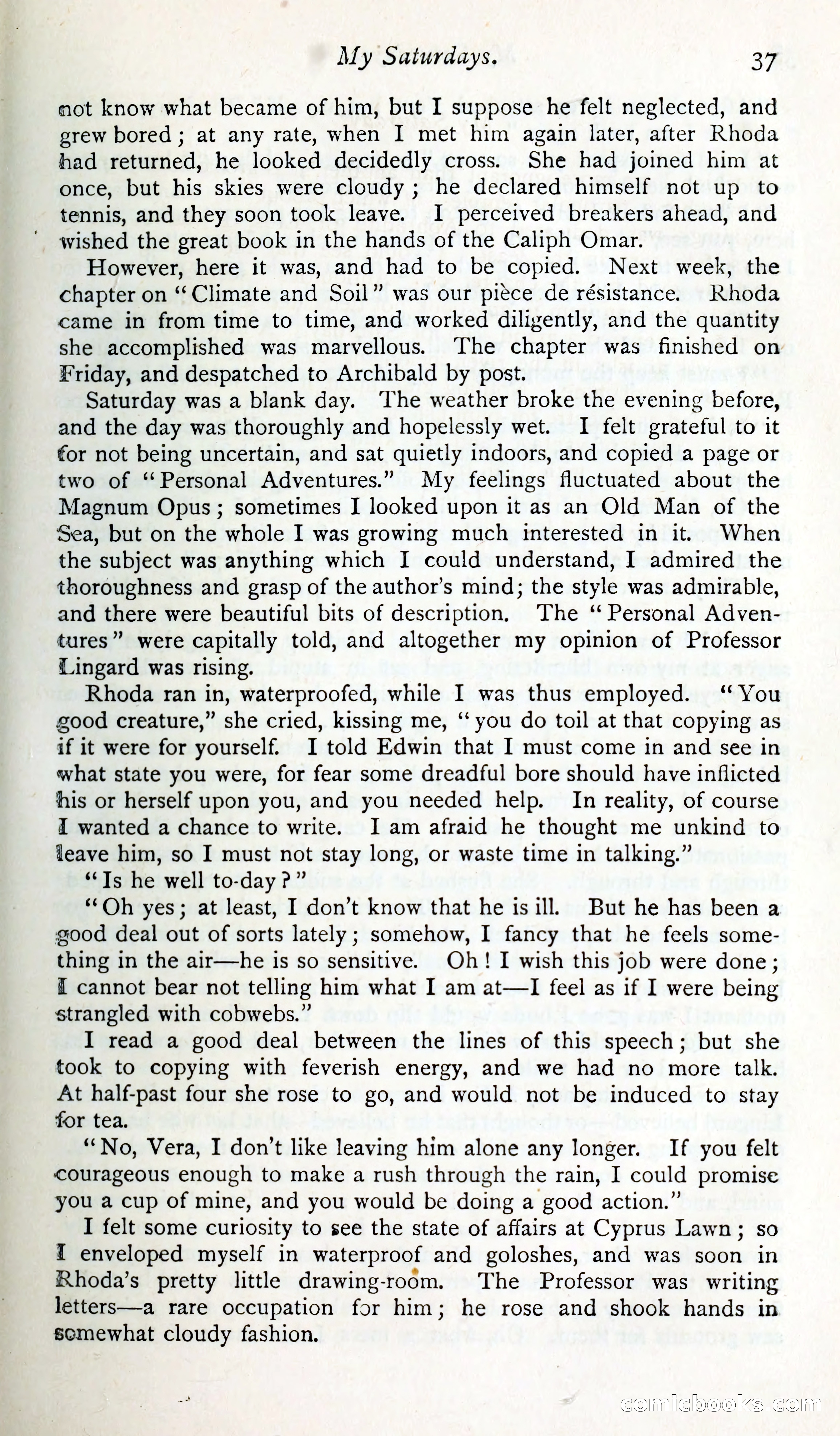
A restored page from Pulp Fiction, 1865. Page through the whole issue in the reader above.
📄 Transcribed text from this page (OCR, searchable)
Machine-transcribed from the original scan — historical spelling and the odd misread are preserved.
My Saturdays. 37 mot know what became of him, but I suppose he felt neglected, and grew bored; at any rate, when I met him again later, after Rhoda had returned, he looked decidedly cross. She had joined him at once, but his skies were cloudy; he declared himself not up to tennis, and they soon took leave. I perceived breakers ahead, and wished the great book in the hands of the Caliph Omar. However, here it was, and had to be copied. Next week, the chapter on ‘‘ Climate and Soil” was our piéce de résistance. Rhoda came in from time to time, and worked diligently, and the quantity she accomplished was marvellous. The chapter was finished on Friday, and despatched to Archibald by post. Saturday was a blank day. ‘The weather broke the evening before, and the day was thoroughly and hopelessly wet. I felt grateful to it for not being uncertain, and sat quietly indoors, and copied a page or two of ‘Personal Adventures.” My feelings fluctuated about the Magnum Opus; sometimes I looked upon it as an Old Man of the Sea, but on the whole I was growing much interested in it. When the subject was anything which I could understand, I admired the thoroughness and grasp of the author’s mind; the style was admirable, and there were beautiful bits of description. The ‘‘ Personal Adven- tures” were capitally told, and altogether my opinion of Professor Lingard was rising. Rhoda ran in, waterproofed, while I was thus employed. ‘You good creature,” she cried, kissing me, “‘ you do toil at that copying as if it were for yourself. I told Edwin that I must come in and see in what state you were, for fear some dreadful bore should have inflicted his or herself upon you, and you needed help. In reality, of course I wanted a chance to write. Iam afraid he thought me unkind to deave him, so I must not stay long, or waste time in talking.” “Ts he well to-day P” “Oh yes; at least, I don’t know that he isill. But he has been a good deal out of sorts lately; somehow, I fancy that he feels some- thing in the air—he is so sensitive. Oh! I wish this job were done; i cannot bear not telling him what I am at—I feel as if I were being strangled with cobwebs.” I read a good deal between the lines of this speech; but she took to copying with feverish energy, and we had no more talk. At half-past four she rose to go, and would not be induced to stay for tea. ““No, Vera, I don’t like leaving him alone any longer. If you felt courageous enough to make a rush through the rain, I could promise you a cup of mine, and you would be doing a good action.” I felt some curiosity to see the state of affairs at Cyprus Lawn; so { enveloped myself in waterproof and goloshes, and was soon in Rhoda’s pretty little drawing-room. The Professor was writing letters—a rare occupation for him; he rose and shook hands in scmewhat cloudy fashion. CONIC MHOOKS.E@