
Pulp Fiction, 1865 · page 394 of 399
The Argosy — page 394: what you’re looking at
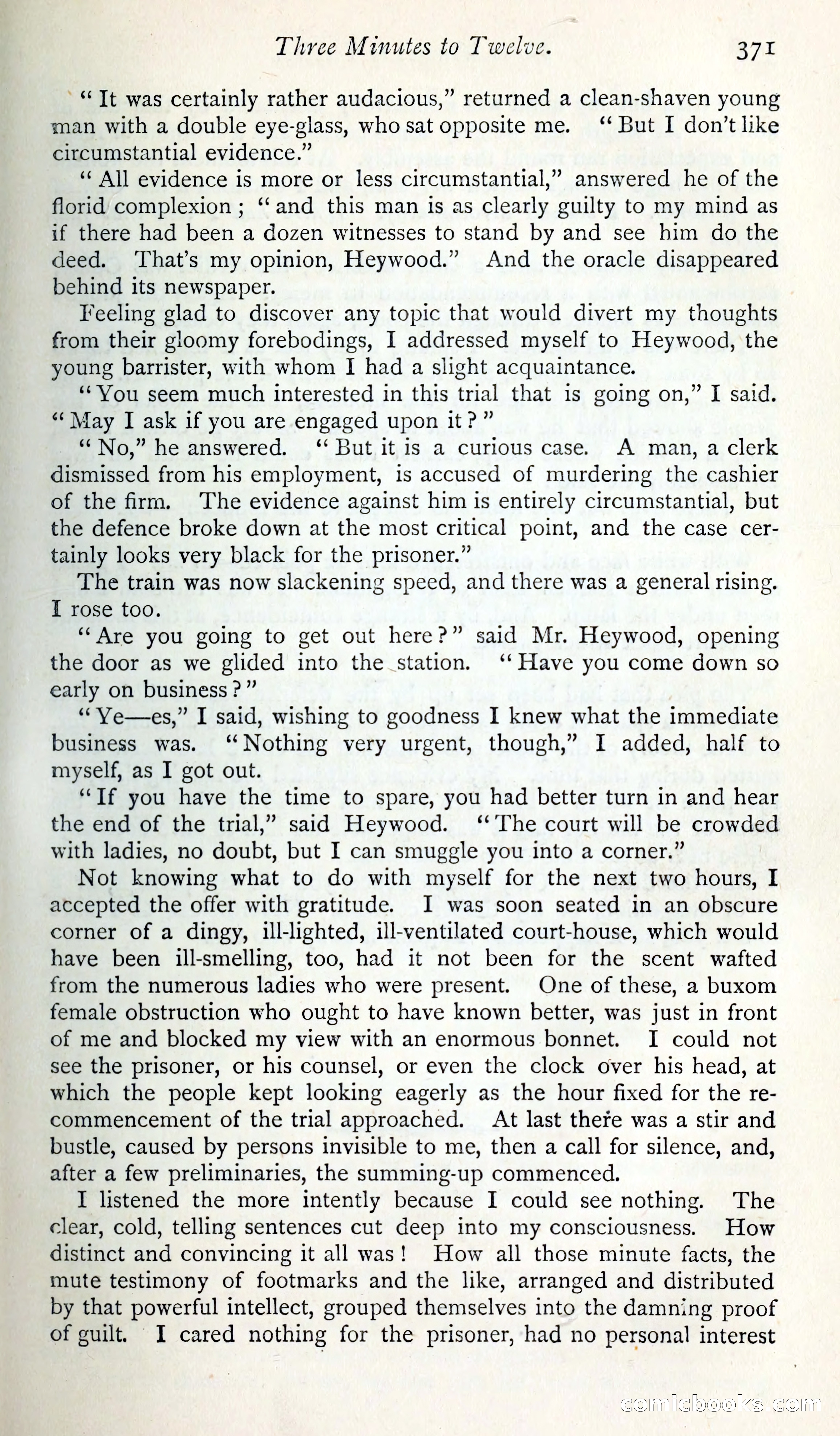
A restored page from Pulp Fiction, 1865. Page through the whole issue in the reader above.
📄 Transcribed text from this page (OCR, searchable)
Machine-transcribed from the original scan — historical spelling and the odd misread are preserved.
Three Minutes to Twelve. 371 “Tt was certainly rather audacious,” returned a clean-shaven young man with a double eye-glass, whosat opposite me. ‘‘ But I don’t like circumstantial evidence.” ‘‘ All evidence is more or less circumstantial,” answered he of the florid complexion ; “and this man 1s as clearly guilty to my mind as if there had been a dozen witnesses to stand by and see him do the deed. ‘That’s my opinion, Heywood.” And the oracle disappeared behind its newspaper. Feeling glad to discover any topic that would divert my thoughts from their gloomy forebodings, I addressed myself to Heywood, the young barrister, with whom I had a slight acquaintance. “You seem much interested in this trial that 1s going on,” I said. “¢ May I ask if you are engaged upon it?” * No,” he answered. .‘‘ But, itis a curious case. A man, a clerk dismissed from his employment, is accused of murdering the cashier of the firm. The evidence against him is entirely circumstantial, but the defence broke down at the most critical point, and the case cer- tainly looks very black for the prisoner.” The train was now slackening speed, and there was a general rising. { rose too. “Are you going to get out here?” said Mr. Heywood, opening the door as we glided into the-station. ‘‘ Have you come down so early on business ?” “*Ve—es,” I said, wishing to goodness I knew what the immediate business was. ‘‘ Nothing very urgent, though,” I added, half to myself, as I got out. “If you have the time to spare, you had better turn in and hear the end of the trial,” said Heywood. ‘‘ The court will be crowded with ladies, no doubt, but I can smuggle you into a corner.” Not knowing what to do with myself for the next two hours, I accepted the offer with gratitude. I was soon seated in an obscure corner of a dingy, il-lighted, ill-ventilated court-house, which would have been ill-smelling, too, had it not been for the scent wafted from the numerous ladies who were present. One of these, a buxom female obstruction who ought to have known better, was just in front of me and blocked my view with an enormous bonnet. I could not see the prisoner, or his counsel, or even the clock over his head, at which the people kept looking eagerly as the hour fixed for the re- commencement of the trial approached. At last there was a stir and bustle, caused by persons invisible to me, then a call for silence, and, after a few preliminaries, the summing-up commenced. I listened the more intently because I could see nothing. The clear, cold, telling sentences cut deep into my consciousness. How distinct and convincing it all was! How all those minute facts, the mute testimony of footmarks and the like, arranged and distributed by that powerful intellect, grouped themselves into the damning proof of guilt. I cared nothing for the prisoner, had no personal interest COMICHOOKS. CO