
Pulp Fiction, 1865 · page 381 of 399
The Argosy — page 381: what you’re looking at
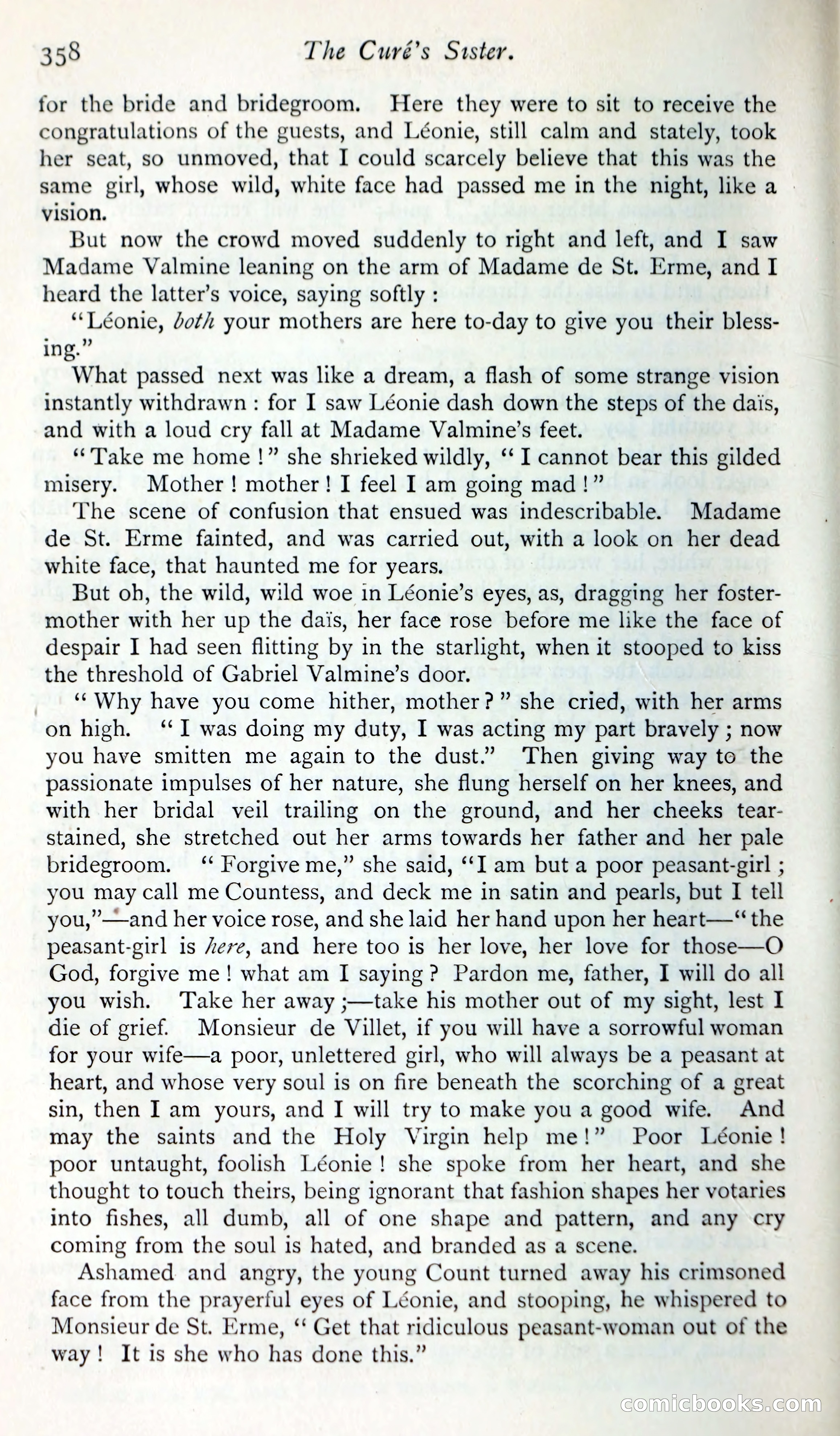
A restored page from Pulp Fiction, 1865. Page through the whole issue in the reader above.
📄 Transcribed text from this page (OCR, searchable)
Machine-transcribed from the original scan — historical spelling and the odd misread are preserved.
358 The Curé’s Sister. for the bride and bridegroom. Here they were to sit to receive the congratulations of the guests, and Léonie, still calm and stately, took her seat, so unmoved, that I could scarcely believe that this was the same girl, whose wild, white face had passed me in the night, like a | vision. But now the crowd moved suddenly to right and left, and I saw Madame Valmine leaning on the arm of Madame de St. Erme, and I heard the latter’s voice, saying softly : ‘“Téonie, doth your mothers are here to-day to give you their bless- ing.” What passed next was like a dream, a flash of some strange vision instantly withdrawn : for I saw Léonie dash down the steps of the dais, and with a loud cry fall at Madame Valmine’s feet. “Take me home !” she shrieked wildly, ‘‘ I cannot bear this gilded misery. Mother! mother! I feel I am going mad!” The scene of confusion that ensued was indescribable. Madame de St. Erme fainted, and was carried out, with a look on her dead white face, that haunted me for years, But oh, the wild, wild woe in Léonie’s eyes, as, dragging her foster- mother with her up the dais, her face rose before me like the face of despair I had seen flitting by in the starlight, when it stooped to kiss the threshold of Gabriel Valmine’s door. ‘“Why have you come hither, mother?” she cried, with her arms on high. ‘‘I was doing my duty, I was acting my part bravely ; now you have smitten me again to the dust.” ‘Then giving way to the passionate impulses of her nature, she flung herself on her knees, and with her bridal veil trailing on the ground, and her cheeks tear- stained, she stretched out her arms towards her father and her pale bridegroom. ‘‘ Forgive me,” she said, ‘‘I am but a poor peasant-girl ; you may call me Countess, and deck me in satin and pearls, but I tell you,’—and her voice rose, and she laid her hand upon her heart—‘“‘ the peasant-girl is ere, and here too is her love, her love for those—O God, forgive me! what am I saying? Pardon me, father, I will do all you wish. Take her away ;—take his mother out of my sight, lest I die of grief. Monsieur de Villet, if you will have a sorrowful woman for your wife—a poor, unlettered girl, who will always be a peasant at heart, and whose very soul is on fire beneath the scorching of a great sin, then I am yours, and I will try to make you a good wife. And may the saints and the Holy Virgin help me!” Poor Léonie! poor untaught, foolish Léonie! she spoke from her heart, and she thought to touch theirs, being ignorant that fashion shapes her votaries into fishes, all dumb, all of one shape and pattern, and any cry coming from the soul is hated, and branded as a scene. Ashamed and angry, the young Count turned away his crimsoned face from the prayerful eyes of Léonie, and stooping, he whispered to Monsieur de St. Erme, ‘‘ Get that ridiculous peasant-woman out of the way! It is she who has done this.” COPMICLIOO KS, (Eo)