
Pulp Fiction, 1865 · page 379 of 399
The Argosy — page 379: what you’re looking at
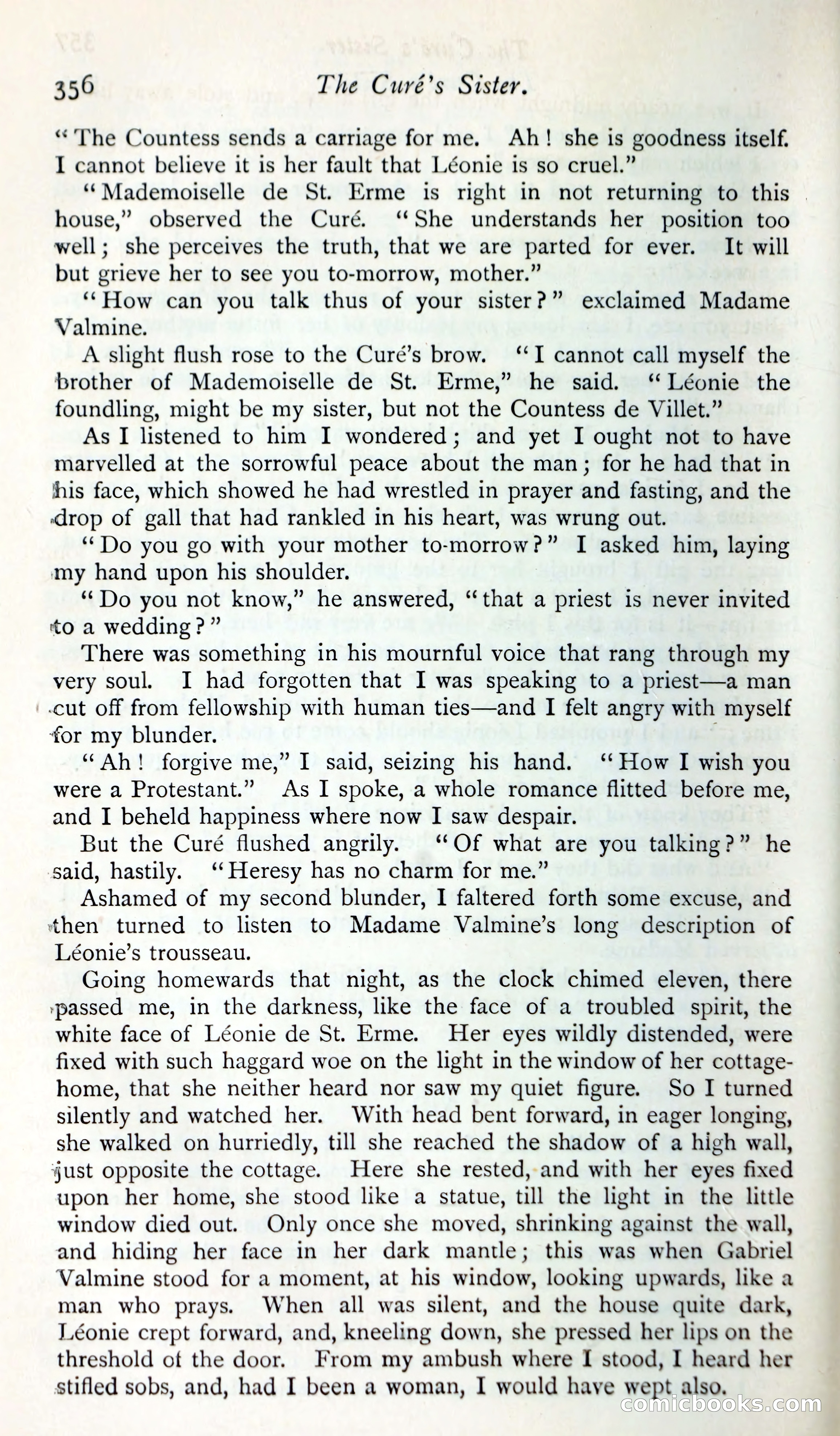
A restored page from Pulp Fiction, 1865. Page through the whole issue in the reader above.
📄 Transcribed text from this page (OCR, searchable)
Machine-transcribed from the original scan — historical spelling and the odd misread are preserved.
356 The Curé’s Sister. “The Countess sends a carriage forme. Ah! she is goodness itself. I cannot believe it is her fault that Léonie is so cruel.” ‘Mademoiselle de St. Erme is right in not returning to this — house,” observed the Curé. “She understands her position too well; she perceives the truth, that we are parted for ever. It will but grieve her to see you to-morrow, mother.” ‘How can you talk thus of your sister?” exclaimed Madame Valmine. A slight flush rose to the Curé’s brow. ‘‘I cannot call myself the brother of Mademolselle de St. Erme,” he said. ‘ Léonie the foundling, might be my sister, but not the Countess de Villet.” As I listened to him I wondered; and yet I ought not to have marvelled at the sorrowful peace about the man; for he had that in his face, which showed he had wrestled in prayer and fasting, and the drop of gall that had rankled in his heart, was wrung out. ‘Do you go with your mother to-morrow?” I asked him, laying my hand upon his shoulder. ‘Do you not know,” he answered, ‘“‘that a priest is never invited ‘to a wedding ?” There was something in his mournful voice that rang through my very soul. I had forgotten that I was speaking to a priest—a man .cut off from fellowship with human ties—and I felt angry with myself for my blunder. “Ah! forgive me,” I said, seizing his hand. ‘‘ How I wish you were a Protestant.” As I spoke, a whole romance flitted before me, and I beheld happiness where now I saw despair. But the Curé flushed angrily. ‘‘Of what are you talking?” he said, hastily. ‘‘ Heresy has no charm for me.” Ashamed of my second blunder, I faltered forth some excuse, and then turned to listen to Madame Valmine’s long description of Léonie’s trousseau. Going homewards that night, as the clock chimed eleven, there ‘passed me, in the darkness, like the face of a troubled spirit, the white face of Léonie de St. Erme. Her eyes wildly distended, were fixed with such haggard woe on the light in the window of her cottage- home, that she neither heard nor saw my quiet figure. So I turned silently and watched her. With head bent forward, in eager longing, she walked on hurriedly, till she reached the shadow of a high wall, just opposite the cottage. Here she rested, and with her eyes fixed upon her home, she stood like a statue, till the light in the little window died out. Only once she moved, shrinking against the wall, and hiding her face in her dark mantle; this was when Gabriel Valmine stood for a moment, at his window, looking upwards, like a man who prays. When all was silent, and the house quite dark, Léonie crept forward, and, kneeling down, she pressed her lips on the threshold of the door. From my ambush where I stood, I heard her stifled sobs, and, had I been a woman, I would have wept also, CO) f| Ebooksneo