
Pulp Fiction, 1865 · page 329 of 399
The Argosy — page 329: what you’re looking at
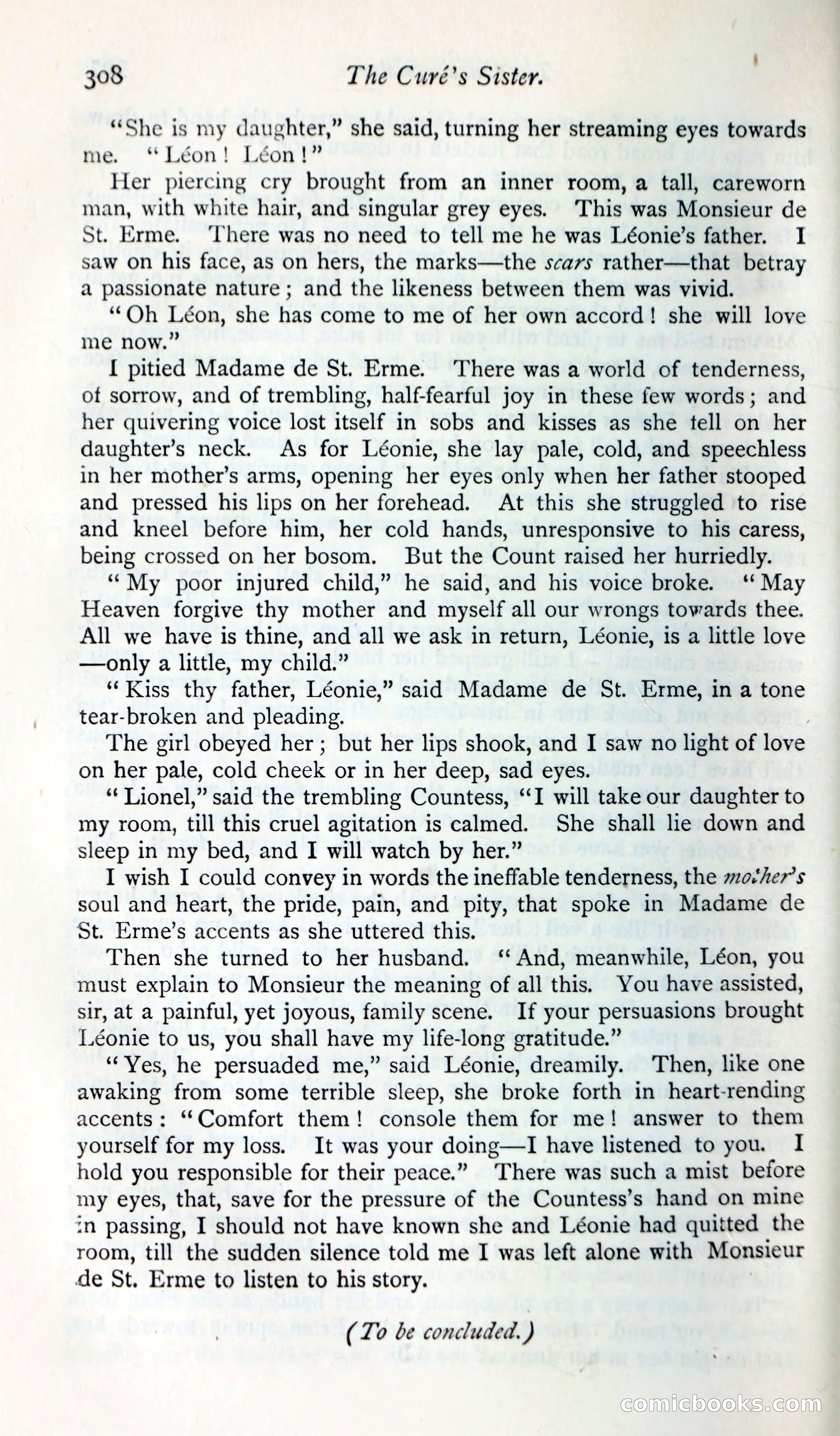
A restored page from Pulp Fiction, 1865. Page through the whole issue in the reader above.
📄 Transcribed text from this page (OCR, searchable)
Machine-transcribed from the original scan — historical spelling and the odd misread are preserved.
308 The Curé’s Sister. “She is my daughter,” she said, turning her streaming eyes towards me. ‘Léon! Léon!” Her piercing cry brought from an inner room, a tall, careworn man, with white hair, and singular grey eyes. ‘This was Monsieur de St. Erme. ‘here was no need to tell me he was Léonie’s father. I saw on his face, as on hers, the marks—the scars rather—that betray a passionate nature; and the likeness between them was vivid. “Oh Léon, she has come to me of her own accord! she will love me now.” [ pitied Madame de St. Erme. There was a world of tenderness, of sorrow, and of trembling, half-fearful joy in these few words; and her quivering voice lost itself in sobs and kisses as she tell on her daughter’s neck. As for Léonie, she lay pale, cold, and speechless in her mother’s arms, opening her eyes only when her father stooped and pressed his lips on her forehead. At this she struggled to rise and kneel before him, her cold hands, unresponsive to his caress, being crossed on her bosom. But the Count raised her hurriedly. “My poor injured child,” he said, and his voice broke. ‘ May Heaven forgive thy mother and myself all our wrongs towards thee. All we have is thine, and all we ask in return, Léonie, 1s a little love —only a little, my child.” ‘Kiss thy father, Léonie,” said Madame de St. Erme, in a tone tear-broken and pleading. The girl obeyed her; but her lips shook, and I saw no light of love on her pale, cold cheek or in her deep, sad eyes. “Lionel,” said the trembling Countess, ‘‘I will take our daughter to my room, till this cruel agitation is calmed. She shall le down and sleep in my bed, and I will watch by her.” I wish I could convey in words the ineffable tenderness, the so'her’s soul and heart, the pride, pain, and pity, that spoke in Madame de St. Erme’s accents as she uttered this. Then she turned to her husband. ‘ And, meanwhile, Léon, you must explain to Monsieur the meaning of all this. You have assisted, sir, at a painful, yet joyous, family scene. If your persuasions brought Léonie to us, you shall have my life-long gratitude.” ‘Ves, he persuaded me,” said Léonie, dreamily. Then, like one awaking from some terrible sleep, she broke forth in heart-rending accents: “Comfort them! console them for me! answer to them yourself for my loss. It was your doing—I have listened to you. I hold you responsible for their peace.” There was such a mist before my eyes, that, save for the pressure of the Countess’s hand on mine ‘n passing, I should not have known she and Léonie had quitted the room, till the sudden silence told me I was left alone with Monsieur de St, Erme to listen to his story. (Zo be concluded.) CORMICLIOO KS, EO)