
Pulp Fiction, 1865 · page 325 of 399
The Argosy — page 325: what you’re looking at
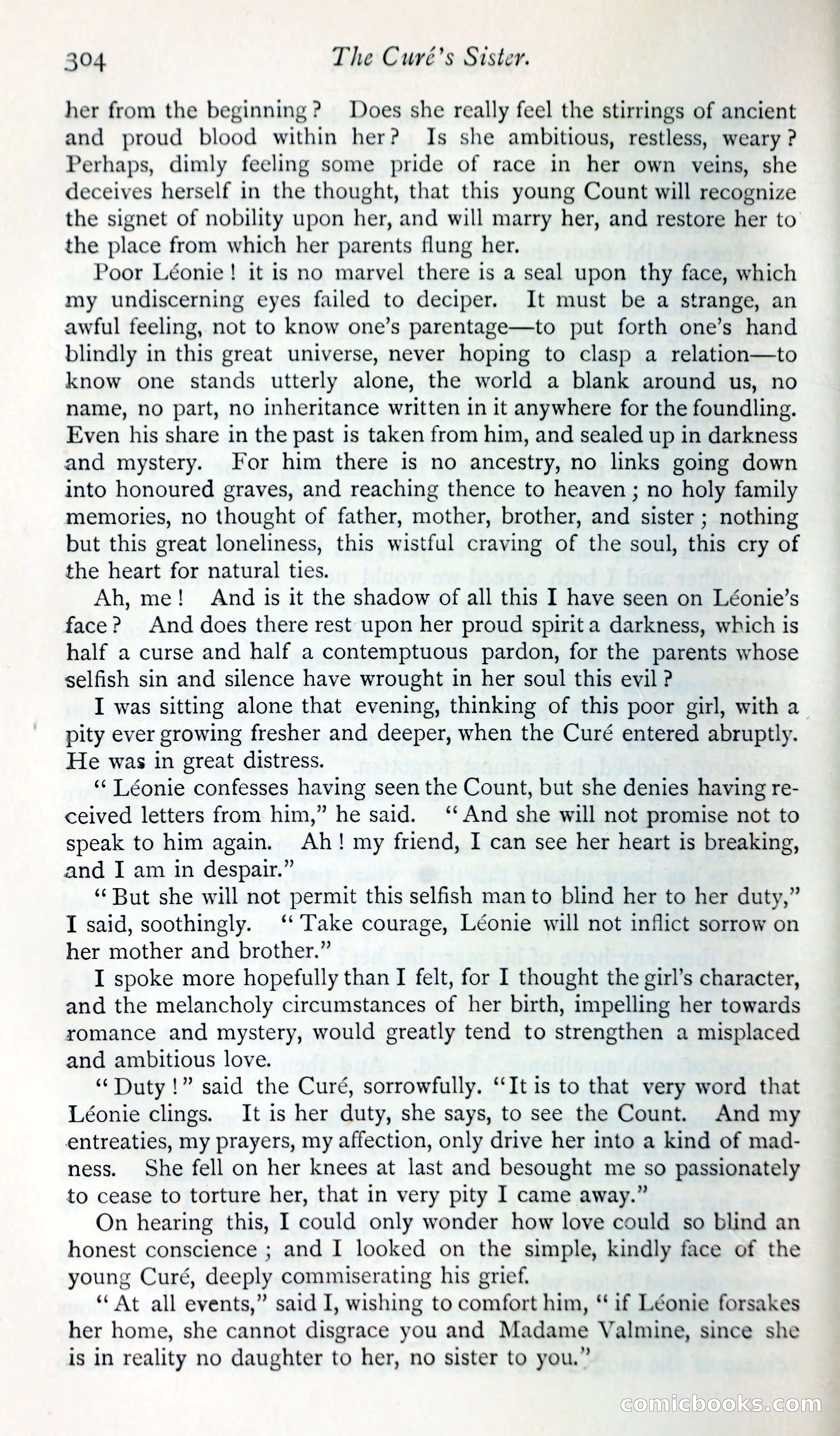
A restored page from Pulp Fiction, 1865. Page through the whole issue in the reader above.
📄 Transcribed text from this page (OCR, searchable)
Machine-transcribed from the original scan — historical spelling and the odd misread are preserved.
304 The Curé’s Sister. her from the beginning? Does she really feel the stirrings of ancient and proud blood within her? Is she ambitious, restless, weary ? Perhaps, dimly feeling some pride of race in her own veins, she deceives herself in the thought, that this young Count will recognize the signet of nobility upon her, and will marry her, and restore her to the place from which her parents flung her. Poor Léonie! it is no marvel there is a seal upon thy face, which my undiscerning eyes failed to deciper. It must be a strange, an awful feeling, not to know one’s parentage—to put forth one’s hand blindly in this great universe, never hoping to clasp a relation—to know one stands utterly alone, the world a blank around us, no name, no part, no inheritance written in it anywhere for the foundling. Even his share in the past is taken from him, and sealed up in darkness and mystery. For him there is no ancestry, no links going down into honoured graves, and reaching thence to heaven ; no holy family memories, no thought of father, mother, brother, and sister ; nothing but this great loneliness, this wistful craving of the soul, this cry of the heart for natural ties. Ah, me! And is it the shadow of all this I have seen on Léonie’s face? And does there rest upon her proud spirita darkness, which is half a curse and half a contemptuous pardon, for the parents whose selfish sin and silence have wrought in her soul this evil ? I was sitting alone that evening, thinking of this poor girl, with a pity ever growing fresher and deeper, when the Curé entered abruptly. He was in great distress. ‘‘Léonie confesses having seen the Count, but she denies having re- ceived letters from him,” he said. ‘‘And she will not promise not to speak to him again. Ah! my friend, I can see her heart is breaking, and I am in despair.” ‘But she will not permit this selfish man to blind her to her duty,” I said, soothingly. ‘‘ Take courage, Léonie will not inflict sorrow on her mother and brother.” I spoke more hopefully than I felt, for I thought the girl’s character, and the melancholy circumstances of her birth, impelling her towards romance and mystery, would greatly tend to strengthen a misplaced and ambitious love. “Duty!” said the Curé, sorrowfully. “‘It is to that very word that Léonie clings. It is her duty, she says, to see the Count. And my entreaties, my prayers, my affection, only drive her into a kind of mad- ness. She fell on her knees at last and besought me so passionately to cease to torture her, that in very pity I came away.” On hearing this, I could only wonder how love could so blind an honest conscience ; and I looked on the simple, kindly face of the young Curé, deeply commiserating his grief. ‘ At all events,” said I, wishing to comfort him, “ if Léonie forsakes her home, she cannot disgrace you and Madame Valmine, since she is in reality no daughter to her, no sister to you.” COPMICLIOO KS, (Eo)