
Pulp Fiction, 1865 · page 312 of 399
The Argosy — page 312: what you’re looking at
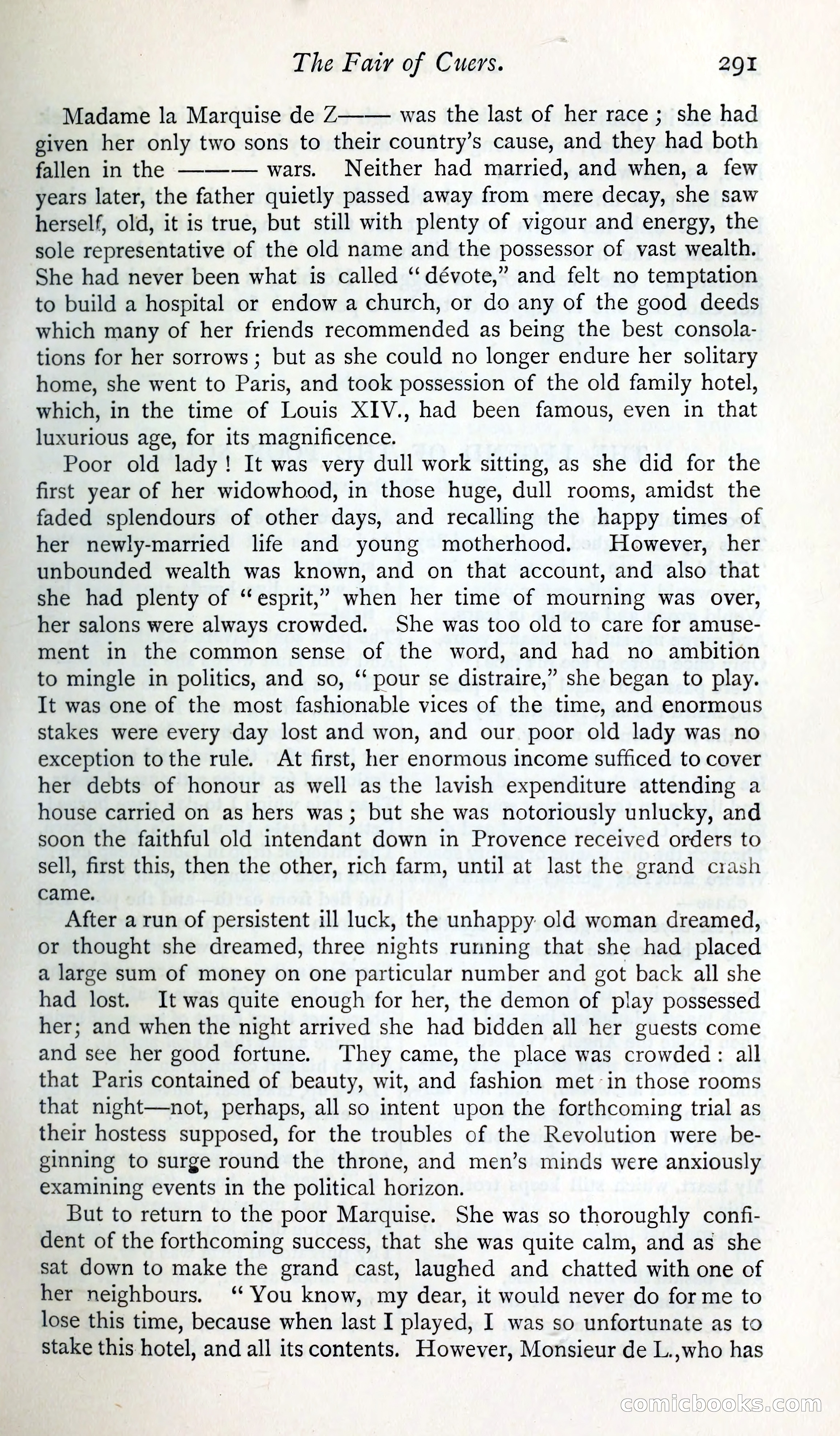
A restored page from Pulp Fiction, 1865. Page through the whole issue in the reader above.
📄 Transcribed text from this page (OCR, searchable)
Machine-transcribed from the original scan — historical spelling and the odd misread are preserved.
The Far of Cuers. 291 Madame la Marquise de Z—-— was the last of her race; she had given her only two sons to their country’s cause, and they had both fallen in the —-—-— wars. Neither had married, and when, a few years later, the father quietly passed away from mere decay, she saw herself, old, it is true, but still with plenty of vigour and energy, the sole representative of the old name and the possessor of vast wealth. She had never been what is called “‘ dévote,” and felt no temptation to build a hospital or endow a church, or do any of the good deeds which many of her friends recommended as being the best consola- tions for her sorrows; but as she could no longer endure her solitary home, she went to Paris, and took possession of the old family hotel, which, in the time of Louis XIV., had been famous, even in that luxurious age, for its magnificence. Poor old lady! It was very dull work sitting, as she did for the first year of her widowhood, in those huge, dull rooms, amidst the faded splendours of other days, and recalling the happy times of her newly-married life and young motherhood. However, her unbounded wealth was known, and on that account, and also that she had plenty of “esprit,” when her time of mourning was over, her salons were always crowded. She was too old to care for amuse- ment in the common sense of the word, and had no ambition to mingle in politics, and so, “ pour se distraire,” she began to play. It was one of the most fashionable vices of the time, and enormous stakes were every day lost and won, and our poor old lady was no exception tothe rule. At first, her enormous income sufficed to cover her debts of honour as well as the lavish expenditure attending a house carried on as hers was; but she was notoriously unlucky, and soon the faithful old intendant down in Provence received orders to sell, first this, then the other, rich farm, until at last the grand crash came. After a run of persistent ill luck, the unhappy old woman dreamed, or thought she dreamed, three nights running that she had placed a large sum of money on one particular number and got back all she had lost. It was quite enough for her, the demon of play possessed her; and when the night arrived she had bidden all her guests come and see her good fortune. ‘They came, the place was crowded: all that Paris contained of beauty, wit, and fashion met-in those rooms that night—not, perhaps, all so intent upon the forthcoming trial as their hostess supposed, for the troubles of the Revolution were be- ginning to surge round the throne, and men’s minds were anxiously examining events in the political horizon. But to return to the poor Marquise. She was so thoroughly confi- dent of the forthcoming success, that she was quite calm, and as she sat down to make the grand cast, laughed and chatted with one of her neighbours. ‘‘ You know, my dear, it would never do for me to lose this time, because when last I played, I was so unfortunate as to stake this hotel, and all its contents. However, Monsieur de L.,who has COMmicoooks (©)