
Pulp Fiction, 1865 · page 308 of 399
The Argosy — page 308: what you’re looking at
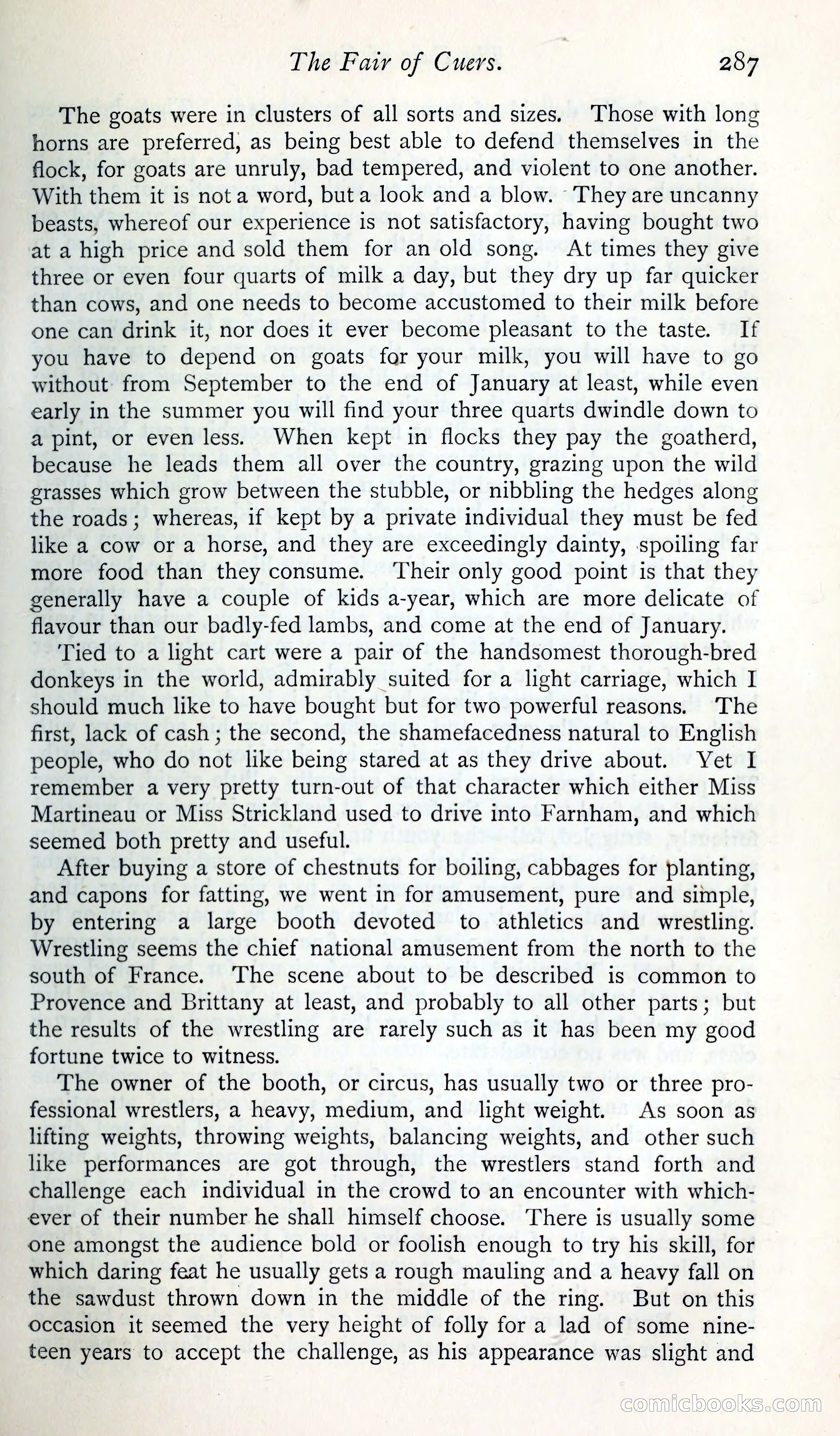
A restored page from Pulp Fiction, 1865. Page through the whole issue in the reader above.
📄 Transcribed text from this page (OCR, searchable)
Machine-transcribed from the original scan — historical spelling and the odd misread are preserved.
The Fair of Cuers. 287 The goats were in clusters of all sorts and sizes. Those with long horns are preferred, as being best able to defend themselves in the flock, for goats are unruly, bad tempered, and violent to one another. With them it is not a word, but a look and a blow. They are uncanny beasts, whereof our experience is not satisfactory, having bought two at a high price and sold them for an old song. At times they give three or even four quarts of milk a day, but they dry up far quicker than cows, and one needs to become accustomed to their milk before one can drink it, nor does it ever become pleasant to the taste. If you have to depend on goats for your milk, you will have to go without from September to the end of January at least, while even early in the summer you will find your three quarts dwindle down to a pint, or even less. When kept in flocks they pay the goatherd, because he leads them all over the country, grazing upon the wild grasses which grow between the stubble, or nibbling the hedges along the roads; whereas, if kept by a private individual they must be fed like a cow ora horse, and they are exceedingly dainty, spoiling far more food than they consume. ‘Their only good point is that they generally have a couple of kids a-year, which are more delicate of flavour than our badly-fed lambs, and come at the end of January. Tied to a light cart were a pair of the handsomest thorough-bred donkeys in the world, admirably suited for a light carriage, which I should much like to have bought but for two powerful reasons. ‘The first, lack of cash; the second, the shamefacedness natural to English people, who do not like being stared at as they drive about. Yet I remember a very pretty turn-out of that character which either Miss Martineau or Miss Strickland used to drive into Farnham, and which seemed both pretty and useful. After buying a store of chestnuts for boiling, cabbages for planting, and capons for fatting, we went in for amusement, pure and simple, by entering a large booth devoted to athletics and wrestling. Wrestling seems the chief national amusement from the north to the south of France. ‘The scene about to be described is common to Provence and Brittany at least, and probably to all other parts; but the results of the wrestling are rarely such as it has been my good fortune twice to witness. The owner of the booth, or circus, has usually two or three pro- fessional wrestlers, a heavy, medium, and light weight. As soon as lifting weights, throwing weights, balancing weights, and other such like performances are got through, the wrestlers stand forth and challenge each individual in the crowd to an encounter with which- ever of their number he shall himself choose. There is usually some one amongst the audience bold or foolish enough to try his skill, for which daring feat he usually gets a rough mauling and a heavy fall on the sawdust thrown down in the middle of the ring. But on this occasion it seemed the very height of folly for a lad of some nine- teen years to accept the challenge, as his appearance was slight and COMmicoooks (C©) mn