
Pulp Fiction, 1865 · page 132 of 399
The Argosy — page 132: what you’re looking at
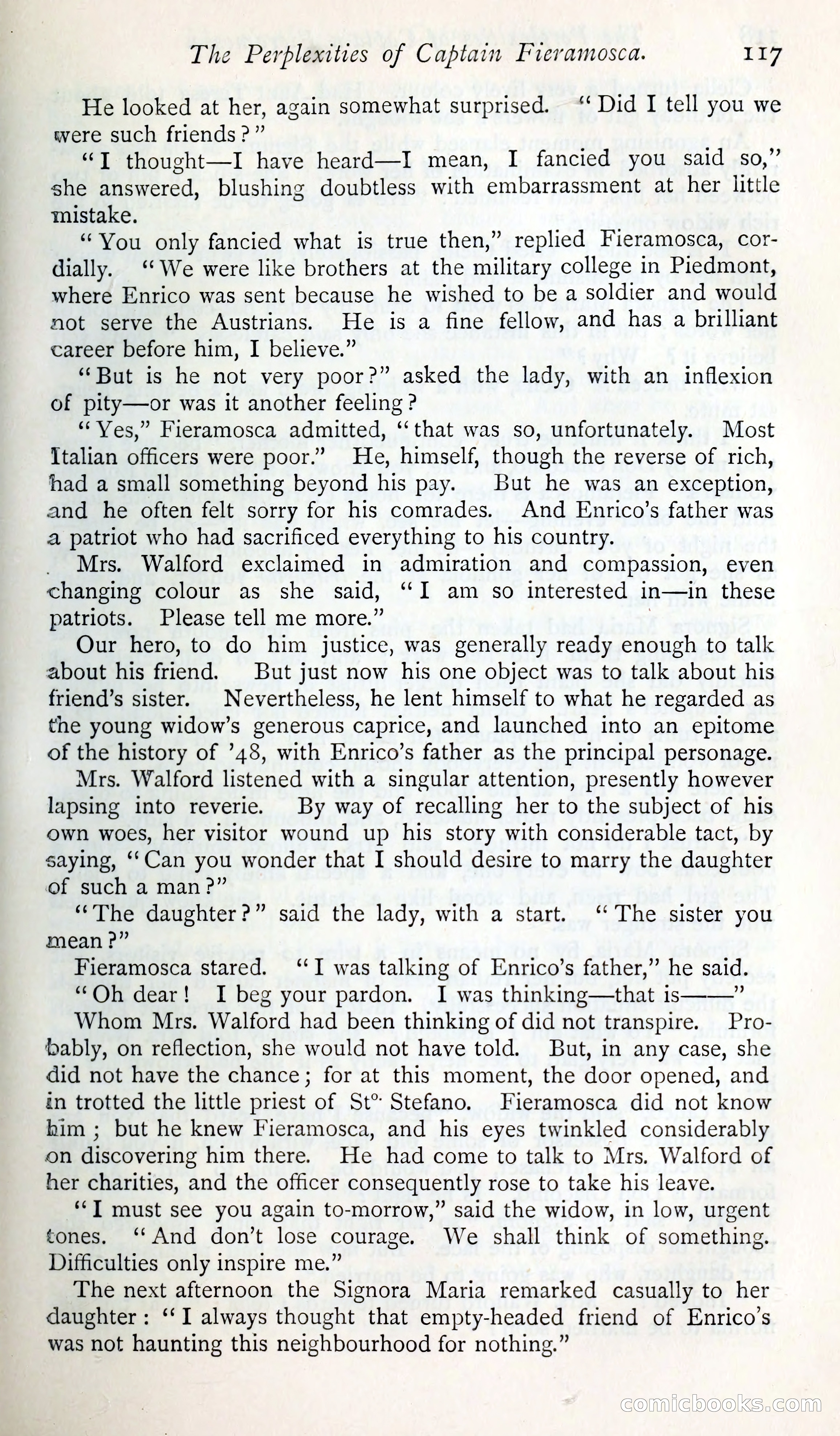
A restored page from Pulp Fiction, 1865. Page through the whole issue in the reader above.
📄 Transcribed text from this page (OCR, searchable)
Machine-transcribed from the original scan — historical spelling and the odd misread are preserved.
The Perplexities of Captain Freramosca. LE7 He looked at her, again somewhat surprised. “‘‘ Did I tell you we were such friends ?” “I thought—I have heard—I mean, I fancied you said so,” she answered, blushing doubtless with embarrassment at her little mistake. “Vou only fancied what is true then,” replied Fieramosca, cor- dially. ‘‘We were like brothers at the military college in Piedmont, where Enrico was sent because he wished to be a soldier and would not serve the Austrians. He is a fine fellow, and has a brilliant career before him, I believe.” ‘But is he not very poor?” asked the lady, with an inflexion of pity—or was it another feeling? “Ves,” Fieramosca admitted, ‘‘that was so, unfortunately. Most Italian officers were poor.” He, himself, though the reverse of rich, had a small something beyond his pay. But he was an exception, and he often felt sorry for his comrades. And Enrico’s father was a patriot who had sacrificed everything to his country. _ Mrs. Walford exclaimed in admiration and compassion, even changing colour as she said, ‘‘I am so interested in—in these patriots. Please tell me more.” | Our hero, to do him justice, was generally ready enough to talk about his friend. But just now his one object was to talk about his friend’s sister. Nevertheless, he lent himself to what he regarded as the young widow’s generous caprice, and launched into an epitome of the history of ’48, with Enrico’s father as the principal personage. Mrs. Walford listened with a singular attention, presently however lapsing into reverie. By way of recalling her to the subject of his own woes, her visitor wound up his story with considerable tact, by saying, ‘‘Can you wonder that I should desire to marry the daughter of such a man?” “The daughter?” said the lady, with a start. ‘‘ The sister you mean ?” Fieramosca stared. ‘‘I was talking of Enrico’s father,” he said. “Oh dear! I beg your pardon. I was thinking—that is—-—” Whom Mrs. Walford had been thinking of did not transpire. Pro- Dably, on reflection, she would not have told. JBut, in any case, she did not have the chance; for at this moment, the door opened, and in trotted the little priest of St® Stefano. Fieramosca did not know him ; but he knew Fieramosca, and his eyes twinkled considerably on discovering him there. He had come to talk to Mrs. Walford of her charities, and the officer consequently rose to take his leave. ‘I must see you again to-morrow,” said the widow, in low, urgent tones. ‘‘And don’t lose courage. We shall think of something. Difficulties only inspire me.” The next afternoon the Signora Maria remarked casually to her daughter: ‘‘I always thought that empty-headed friend of Enrico’s was not haunting this neighbourhood for nothing.” EORnniclooks (CO)