
Pulp Fiction, 1865 · page 282 of 400
The Argosy — page 282: what you’re looking at
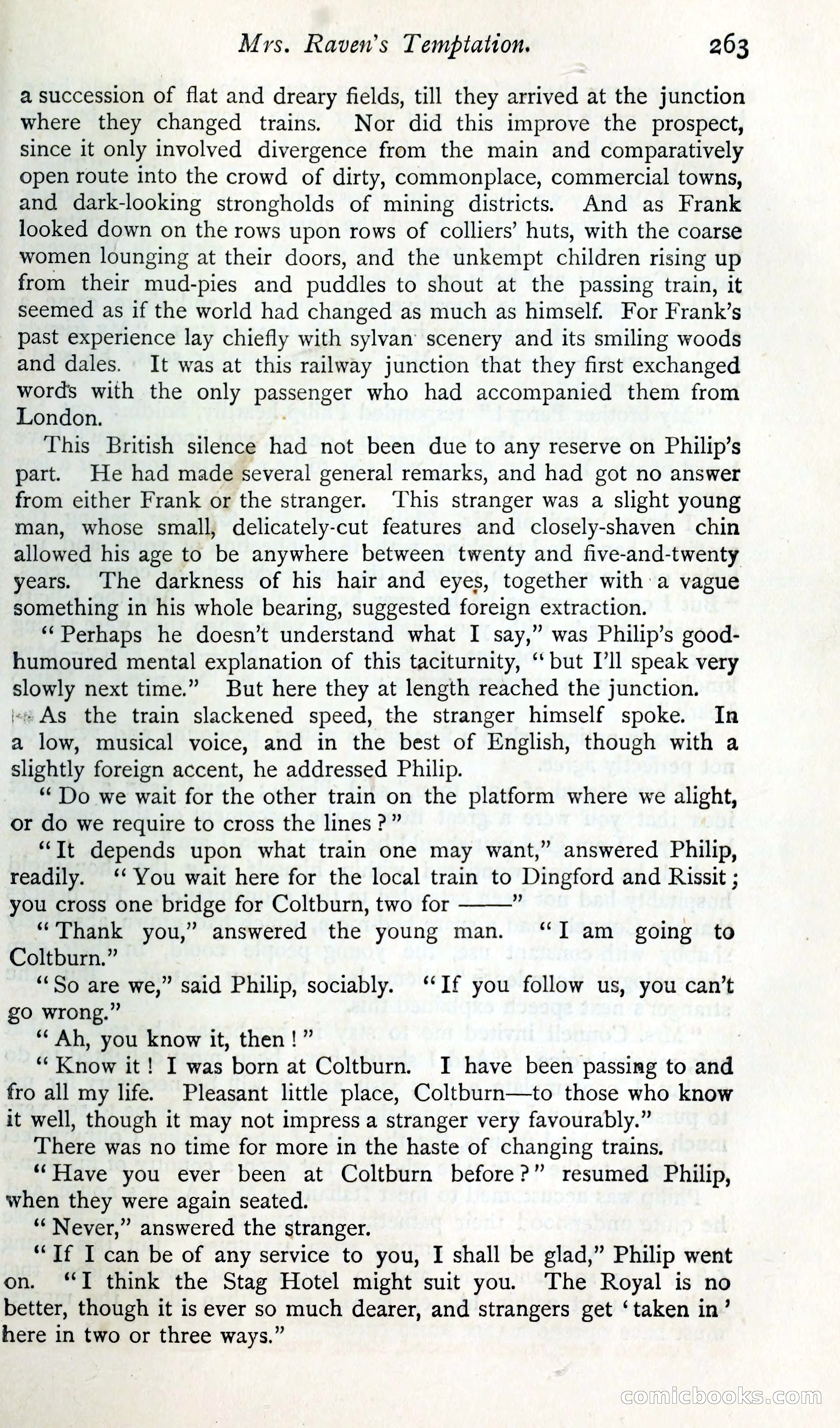
A restored page from Pulp Fiction, 1865. Page through the whole issue in the reader above.
📄 Transcribed text from this page (OCR, searchable)
Machine-transcribed from the original scan — historical spelling and the odd misread are preserved.
Mrs. Raven's Temptation. 263 a succession of flat and dreary fields, till they arrived at the junction where they changed trains. Nor did this improve the prospect, since it only involved divergence from the main and comparatively open route into the crowd of dirty, commonplace, commercial towns, and dark-looking strongholds of mining districts. And as Frank looked down on the rows upon rows of colliers’ huts, with the coarse women lounging at their doors, and the unkempt childreh rising up from their mud-pies and puddles to shout at the passing train, it seemed as if the world had changed as much as himself. For F rank’s past experience lay chiefly with sylvan scenery and its smiling woods and dales. It was at this railway junction that they first exchanged words with the only pascenect who had accompanied them from London. This British silence had not been due to any reserve on Philip’s part. He had made several general remarks, and had got no answer from either Frank or the stranger. ‘This stranger was a slight young man, whose small, delicately-cut features and closely-shaven chin allowed his age to be anywhere between twenty and five-and-twenty years. ‘The darkness of his hair and eyes, together with a vague something in his whole bearing, suggested foreign extraction. “Perhaps he doesn’t understand what I say,” was Philip’s good- humoured mental explanation of this taciturnity, ‘but [ll speak very slowly next time.” But here they at length reached the junction. ie As the train slackened speed, the stranger himself spoke. In a low, musical voice, and in the best of English, though with a slightly foreign accent, he addressed Philip. “Do we wait for the other train on the platform where we alight, or do we require to cross the lines ?” “It depends upon what train one may want,” answered Philip, readily. ‘* You wait here for the local train to Dingford and Rissit ; you cross one bridge for Coltburn, two for : “Thank you,” answered the young man. ‘I am going to Coltburn.” ‘So are we,” said Philip, sociably. ‘If you follow us, you can’t go wrong.” ** Ah, you know it, then!” “Know it! I was born at Coltburn. I have been passing to and fro all my life. Pleasant little place, Coltburn—to those who know it well, though it may not impress a stranger very favourably.” There was no time for more in the haste of changing trains, ‘“‘Have you ever been at Coltburn before?” resumed Philip, when they were again seated. ** Never,” answered the stranger. “If I can be of any service to you, I shall be glad,” Philip went on. “I think the Stag Hotel might suit you. The Royal is no better, though it is ever so much dearer, and strangers get ‘taken in’ here in two or three ways.” COMnnICloO© S (SO)