
Pulp Fiction, 1865 · page 281 of 400
The Argosy — page 281: what you’re looking at
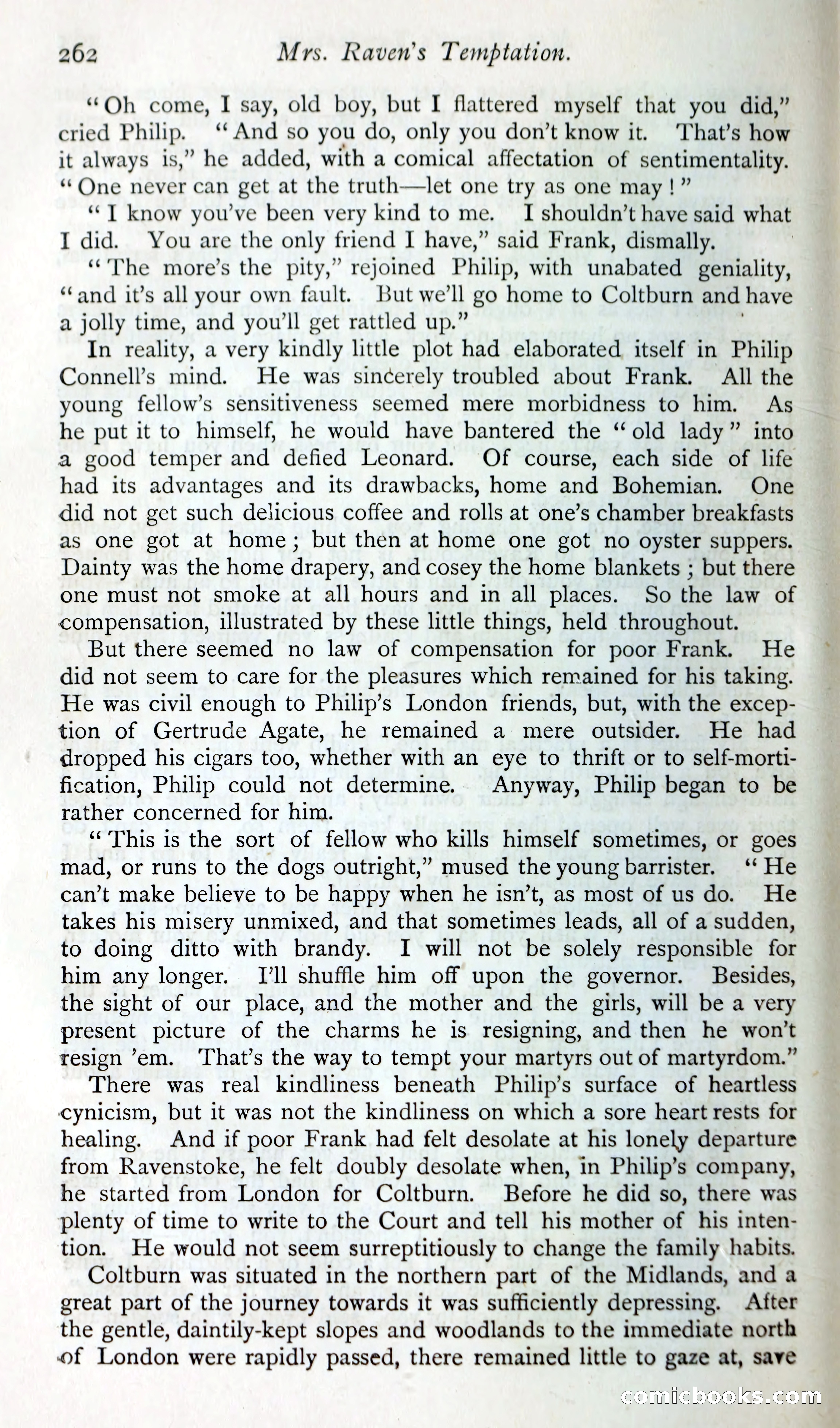
A restored page from Pulp Fiction, 1865. Page through the whole issue in the reader above.
📄 Transcribed text from this page (OCR, searchable)
Machine-transcribed from the original scan — historical spelling and the odd misread are preserved.
262 Mrs. Raven's Temptation. “Oh come, I say, old boy, but I flattered myself that you did,” cried Philip. ‘‘ And so you do, only you don’t know it. ‘That’s how it always is,” he added, with a comical affectation of sentimentality. ‘One never can get at the truth—let one try as one may!” ‘“T know you've been very kind to me. I shouldn’t have said what I did. You are the only friend I have,” said Frank, dismally. “The more’s the pity,” rejoined Philip, with unabated geniality, ‘and it’s all your own fault. But we'll go home to Coltburn and have a jolly time, and you'll get rattled up.” | In reality, a very kindly little plot had elaborated itself in Philip Connell’s mind. He was sincerely troubled about Frank. All the young fellow’s sensitiveness seemed mere morbidness to him. As he put it to himself, he would have bantered the “old lady” into a good temper and defied Leonard. Of course, each side of life had its advantages and its drawbacks, home and Bohemian. One did not get such delicious coffee and rolls at one’s chamber breakfasts as one got at home; but then at home one got no oyster suppers. Dainty was the home drapery, and cosey the home blankets ; but there one must not smoke at all hours and in all places. So the law of compensation, illustrated by these little things, held throughout. But there seemed no law of compensation for poor Frank. He did not seem to care for the pleasures which remained for his taking. He was civil enough to Philip’s London friends, but, with the excep- tion of Gertrude Agate, he remained a mere outsider. He had dropped his cigars too, whether with an eye to thrift or to self-morti- fication, Philip could not determine. Anyway, Philip began to be rather concerned for him. “This is the sort of fellow who kills himself sometimes, or goes mad, or runs to the dogs outright,” mused the young barrister. ‘‘ He can’t make believe to be happy when he isn’t, as most of us do. He takes his misery unmixed, and that sometimes leads, all of a sudden, to doing ditto with brandy. I will not be solely responsible for him any longer. I'll shuffle him off upon the governor. Besides, the sight of our place, and the mother and the girls, will be a very present picture of the charms he 1s resigning, and then he won't resign ’em. ‘That’s the way to tempt your martyrs out of martyrdom.” There was real kindliness beneath Philip’s surface of heartless — cynicism, but it was not the kindliness on which a sore heart rests for healing. And if poor Frank had felt desolate at his lonely departure from Ravenstoke, he felt doubly desolate when, in Philip’s company, he started from London for Coltburn. Before he did so, there was plenty of time to write to the Court and tell his mother of his inten- tion. He would not seem surreptitiously to change the family habits. Coltburn was situated in the northern part of the Midlands, and a great part of the journey towards it was sufficiently depressing. Atter the gentle, daintily-kept slopes and woodlands to the immediate north of London were rapidly passed, there remained little to gaze at, save Gomicbooks.Gco