
Pulp Fiction, 1865 · page 205 of 400
The Argosy — page 205: what you’re looking at
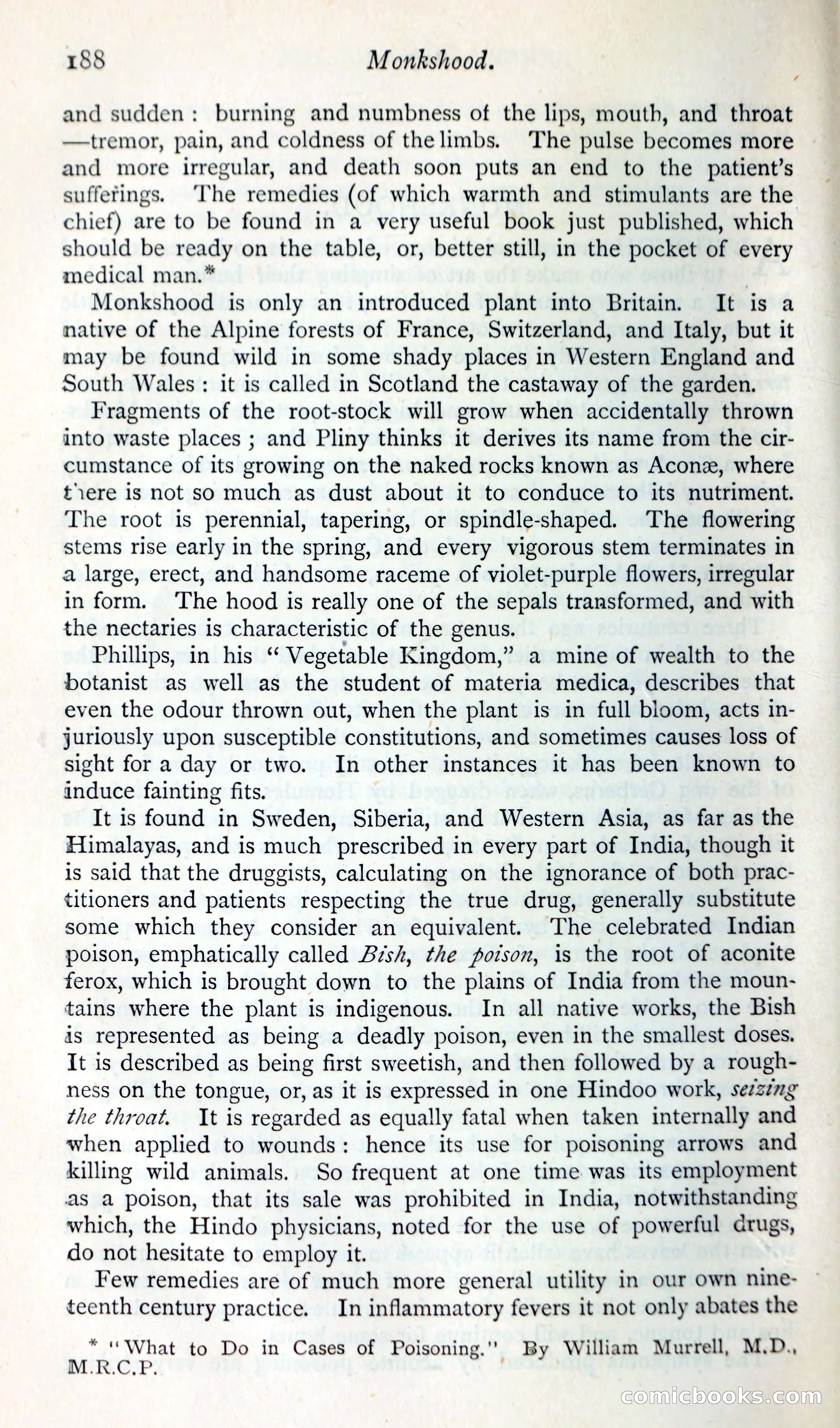
A restored page from Pulp Fiction, 1865. Page through the whole issue in the reader above.
📄 Transcribed text from this page (OCR, searchable)
Machine-transcribed from the original scan — historical spelling and the odd misread are preserved.
188 Monkshood. and sudden: burning and numbness of the lips, mouth, and throat —tremor, pain, and coldness of the limbs. ‘The pulse becomes more and more irregular, and death soon puts an end to the patient’s sufferings. ‘The remedies (of which warmth and stimulants are the chief) are to be found in a very useful book just published, which should be ready on the table, or, better still, in the pocket of every medical man.” | Monkshood is only an introduced plant into Britain. It is a native of the Alpine forests of France, Switzerland, and Italy, but it may be found wild in some shady places in Western England and South Wales : it is called in Scotland the castaway of the garden. Fragments of the root-stock will grow when accidentally thrown into waste places ; and Pliny thinks it derives its name from the cir- cumstance of its growing on the naked rocks known as Aconz, where tere is not so much as dust about it to conduce to its nutriment. The root is perennial, tapering, or spindle-shaped. The flowering stems rise early in the spring, and every vigorous stem terminates in a large, erect, and handsome raceme of violet-purple flowers, irregular in form. The hood is really one of the sepals transformed, and with the nectaries is characteristic of the genus. Phillips, in his “ Vegetable Kingdom,” a mine of wealth to the botanist as well as the student of materia medica, describes that even the odour thrown out, when the plant is in full bloom, acts in- juriously upon susceptible constitutions, and sometimes causes loss of sight for a day or two. In other instances it has been known to induce fainting fits. | It is found in Sweden, Siberia, and Western Asia, as far as the Himalayas, and is much prescribed in every part of India, though it is said that the druggists, calculating on the ignorance of both prac- titioners and patients respecting the true drug, generally substitute some which they consider an equivalent. The celebrated Indian poison, emphatically called Bzsh, the potson, is the root of aconite ferox, which is brought down to the plains of India from the moun- tains where the plant is indigenous. In all native works, the Bish is represented as being a deadly poison, even in the smallest doses. It is described as being first sweetish, and then followed by a rough- ness on the tongue, or, as it is expressed in one Hindoo work, sezzeng the throat. It is regarded as equally fatal when taken internally and when applied to wounds: hence its use for poisoning arrows and killing wild animals. So frequent at one time was its employment as a poison, that its sale was prohibited in India, notwithstanding which, the Hindo physicians, noted for the use of powerful drugs, do not hesitate to employ it. Few remedies are of much more general utility in our own nine- teenth century practice. In inflammatory fevers it not only abates the * “What to Do in Cases of Poisoning.”’ By William Murrell, M.D., Gomichooks Go m