
Pulp Fiction, 1865 · page 204 of 400
The Argosy — page 204: what you’re looking at
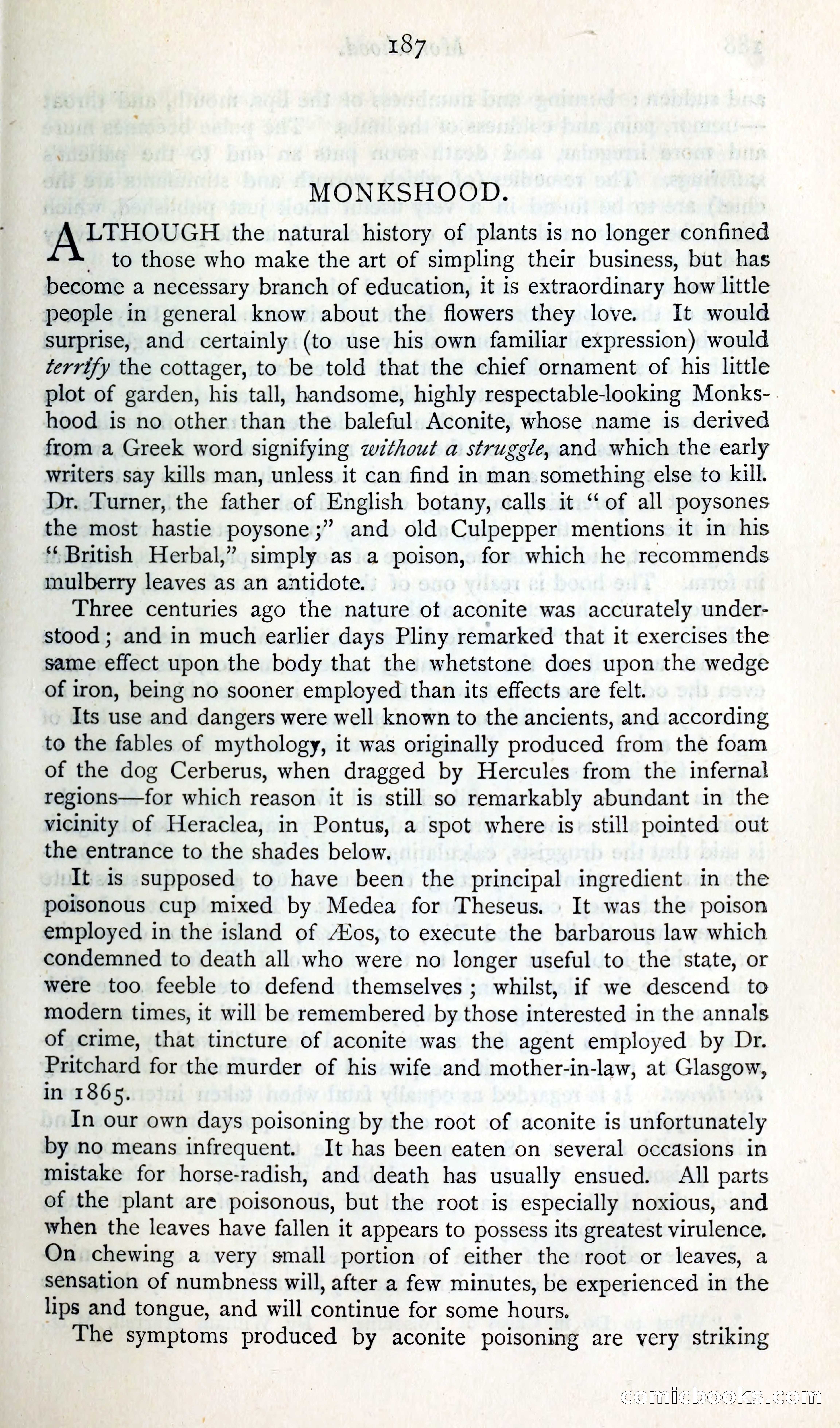
A restored page from Pulp Fiction, 1865. Page through the whole issue in the reader above.
📄 Transcribed text from this page (OCR, searchable)
Machine-transcribed from the original scan — historical spelling and the odd misread are preserved.
187 MONKSHOOD. , ieee LOUGH the natural history of plants is no longer confined _ to those who make the art of simpling their business, but has become a necessary branch of education, it is extraordinary how little people in general know about the flowers they love. It would surprise, and certainly (to use his own familiar expression) would terrify the cottager, to be told that the chief ornament of his little plot of garden, his tall, handsome, highly respectable-looking Monks-. hood is no other than the baleful Aconite, whose name is derived from a Greek word signifying without a struggle, and which the early writers say kills man, unless it can find in man something else to kill. Dr. Turner, the father of English botany, calls it “of all poysones the most hastie poysone;” and old Culpepper mentions it in his ‘British Herbal,” simply as a poison, for which he recommends mulberry leaves as an antidote. Three centuries ago the nature ot aconite was accurately under- stood ; and in much earlier days Pliny remarked that it exercises the same effect upon the body that the whetstone does upon the wedge of iron, being no sooner employed than its effects are felt. Its use and dangers were well known to the ancients, and according to the fables of mythology, it was originally produced from the foam of the dog Cerberus, when dragged by Hercules from the infernal regions—for which reason it is still so remarkably abundant in the vicinity of Heraclea, in Pontus, a spot where is still pointed out the entrance to the shades below. It is supposed to have been the principal ingredient in the poisonous cup mixed by Medea for Theseus. | It was the poison employed in the island of A“os, to execute the barbarous law which condemned to death all who were no longer useful to the state, or were too. feeble to defend themselves; whilst, if we descend to modern times, it will be remembered by those interested in the annals of crime, that tincture of aconite was the agent employed by Dr. Pritchard for the murder of his wife and mother-in-law, at Glasgow, in 1865. In our own days poisoning by the root of aconite is unfortunately by no means infrequent. It has been eaten on several occasions in mistake for horse-radish, and death has usually ensued. All parts of the plant are poisonous, but the root is especially noxious, and when the leaves have fallen it appears to possess its greatest virulence, On chewing a very small portion of either the root or leaves, a sensation of numbness will, after a few minutes, be experienced in the lips and tongue, and will continue for some hours. The symptoms produced by aconite poisoning are very striking conniclbooolks (C(O)