
Pulp Fiction, 1865 · page 168 of 400
The Argosy — page 168: what you’re looking at
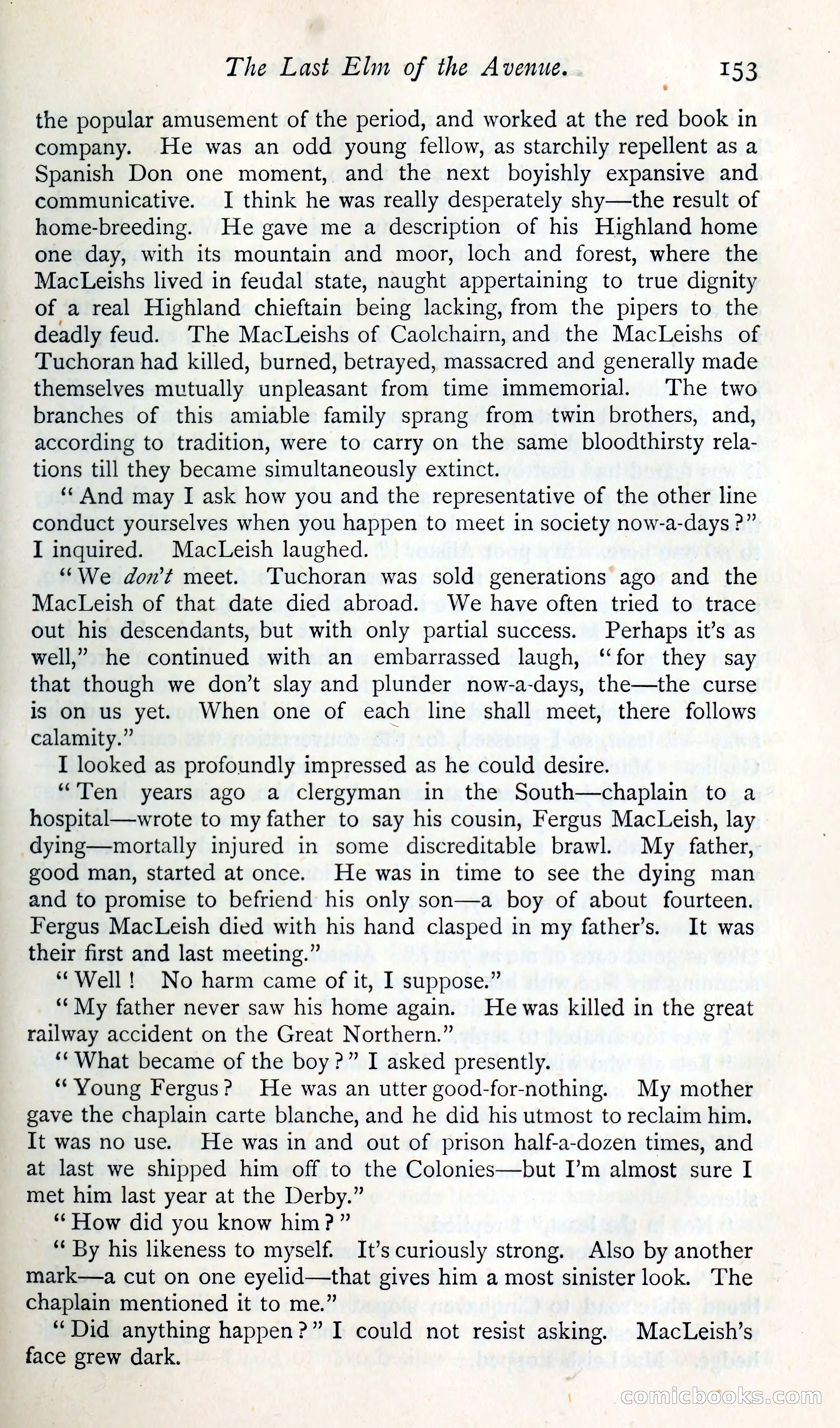
A restored page from Pulp Fiction, 1865. Page through the whole issue in the reader above.
📄 Transcribed text from this page (OCR, searchable)
Machine-transcribed from the original scan — historical spelling and the odd misread are preserved.
The Last Elm of the Avenue. 153 the popular amusement of the period, and worked at the red book in company. He was an odd young fellow, as starchily repellent as a Spanish Don one moment, and the next boyishly expansive and communicative. I think he was really desperately shy—the result of home-breeding. He gave me a description of his Highland home one day, with its mountain and moor, loch and forest, where the MacLeishs lived in feudal state, naught appertaining to true dignity of a real Highland chieftain being lacking, from the pipers to the deadly feud. The MacLeishs of Caolchairn,and the MacLeishs of Tuchoran had killed, burned, betrayed, massacred and generally made themselves mutually unpleasant from time immemorial. The two branches of this amiable family sprang from twin brothers, and, according to tradition, were to carry on the same bloodthirsty rela- tions till they became simultaneously extinct. ‘ And may I ask how you and the representative of the other line conduct yourselves when you happen to meet in society now-a-days ?” I inquired. MacLeish laughed. “We don’t meet. ‘Tuchoran was sold generations ago and the MacLeish of that date died abroad. We have often tried to trace out his descendants, but with only partial success. Perhaps it’s as well,” he continued with an embarrassed laugh, ‘‘for they say that though we don’t slay and plunder now-a-days, the—the curse is on us yet. When one of each line shall meet, there follows calamity.” I looked as profoundly impressed as he could desire. “Ten years ago a clergyman in the South—chaplain to a hospital—wrote to my father to say his cousin, Fergus MacLeish, lay dying—mortally injured in some discreditable brawl. My father, good man, started at once. He was in time to see the dying man and to promise to befriend his only son—a boy of about fourteen. Fergus MacLeish died with his hand clasped in my father’s. It was their first and last meeting.” “Well! No harm came of it, I suppose.” ‘My father never saw his home again. Hewas killed in the great railway accident on the Great Northern.” ‘What became of the boy ?” I asked presently. “* Young Fergus? He was an utter good-for-nothing. My mother gave the chaplain carte blanche, and he did his utmost to reclaim him. It was no use. He was in and out of prison half-a-dozen times, and at last we shipped him off to the Colonies—but I’m almost sure I met him last year at the Derby.” “How did you know him P” ‘* By his likeness to myself. It’s curiously strong. Also by another mark—a cut on one eyelid—that gives him a most sinister look. The chaplain mentioned it to me.” “Did anything happen?” I could not resist asking. MacLeish’s face grew dark. Conmicooaolks (SO)