
Pulp Fiction, 1865 · page 167 of 400
The Argosy — page 167: what you’re looking at
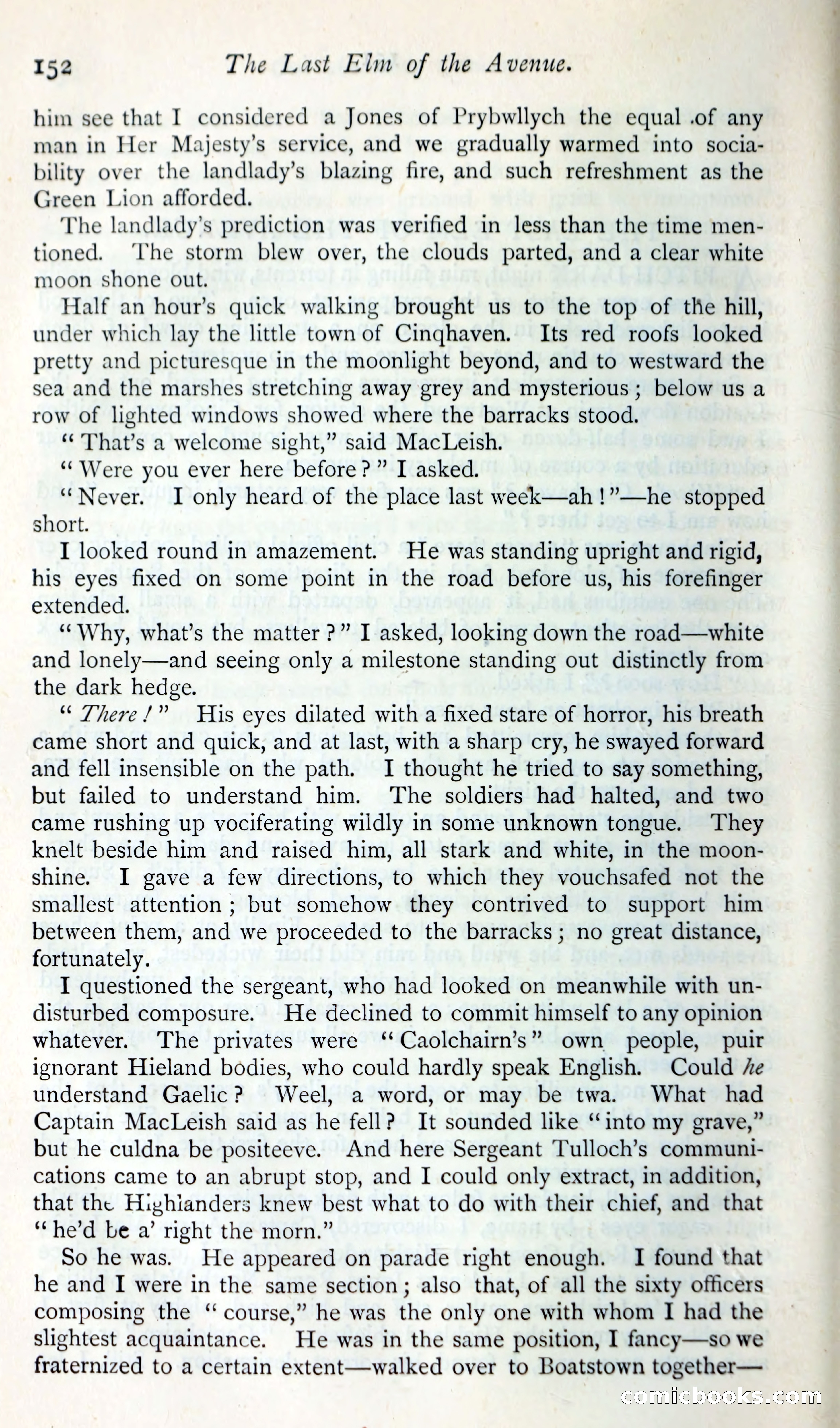
A restored page from Pulp Fiction, 1865. Page through the whole issue in the reader above.
📄 Transcribed text from this page (OCR, searchable)
Machine-transcribed from the original scan — historical spelling and the odd misread are preserved.
152 The Last Elm of the Avenue. him see that I considered a Jones of Prybwllych the equal .of any man in Her Majesty’s service, and we gradually warmed into socia- bility over the landlady’s blazing fire, and such refreshment as the Green Lion afforded. The landlady’s prediction was verified in less than the time men- tioned. ‘The storm blew over, the clouds parted, and a clear white moon shone out. Half an hour’s quick walking brought us to the top of the hill, under which lay the httle town of Cinqhaven. Its red roofs looked pretty and picturesque in the moonlight beyond, and to westward the sea and the marshes stretching away grey and mysterious ; below us a row of lighted windows showed where the barracks stood. “ That’s a welcome sight,” said MacLeish. ‘Were you ever here before?” I asked. “Never. I only heard of the place last week—ah!”—he stopped short. I looked round in amazement. He was standing upright and rigid, his eyes fixed on some point in the road before us, his forefinger extended. ‘““ Why, what’s the matter ?” I asked, looking down the road—white and lonely—and seeing only a milestone standing out distinctly from the dark hedge. “There!” Wiis eyes dilated with a fixed stare of horror, his breath came short and quick, and at last, with a sharp cry, he swayed forward and fell insensible on the path. I thought he tried to say something, but failed to understand him. ‘The soldiers had halted, and two came rushing up vociferating wildly in some unknown tongue. They knelt beside him and raised him, all stark and white, in the moon- shine. I gave a few directions, to which they vouchsafed not the smallest attention; but somehow they contrived to support him between them, and we proceeded to the barracks; no great distance, fortunately. I questioned the sergeant, who had looked on meanwhile with un- disturbed composure. He declined to commit himself to any opinion whatever. ‘The privates were ‘‘Caolchairn’s” own people, puir ignorant Hieland bodies, who could hardly speak English. Could “e understand Gaelic? Weel, a word, or may be twa. What had Captain MacLeish said as he fell? It sounded like ‘‘into my grave,” but he culdna be positeeve. And here Sergeant Tulloch’s communi- cations came to an abrupt stop, and I could only extract, in addition, that the Hiyhianders knew best what to do with their chief, and that “he’d be a’ right the morn.” So he was. He appeared on parade right enough. I found that he and I were in the same section; also that, of all the sixty officers composing the ‘ course,” he was the only one with whom I had the slightest acquaintance. He was in the same position, I fancy—so we fraternized to a certain extent—walked over to Boatstown together— Gomichbooks m ——————————