
Pulp Fiction, 1865 · page 322 of 400
The Argosy — page 322: what you’re looking at
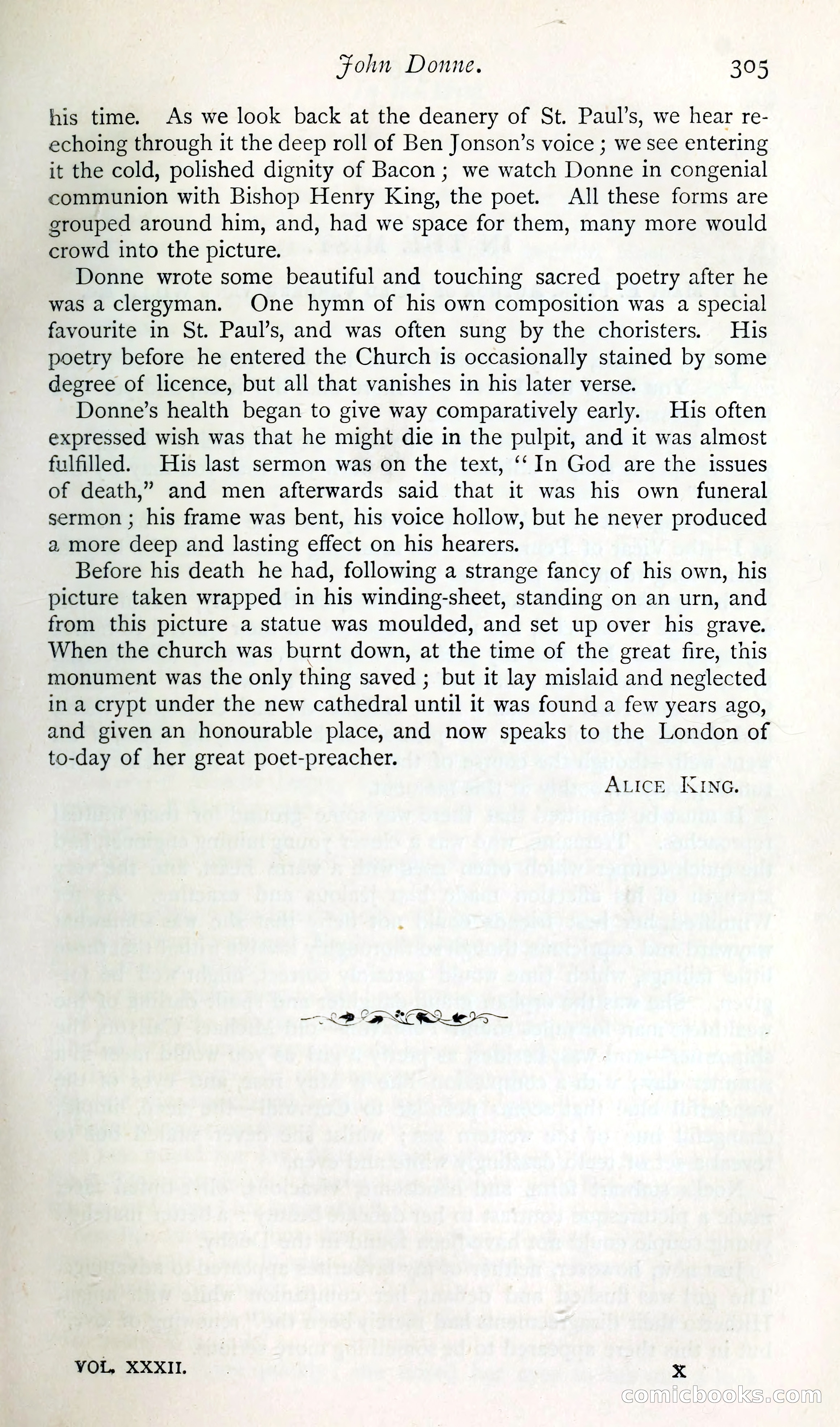
A restored page from Pulp Fiction, 1865. Page through the whole issue in the reader above.
📄 Transcribed text from this page (OCR, searchable)
Machine-transcribed from the original scan — historical spelling and the odd misread are preserved.
Fohn Donne. 305 his time. As we look back at the deanery of St. Paul’s, we hear re- echoing through it the deep roll of Ben Jonson’s voice ; we see entering it the cold, polished dignity of Bacon; we watch Donne in congenial communion with Bishop Henry King, the poet. All these forms are grouped around him, and, had we space for them, many more would crowd into the picture. Donne wrote some beautiful and touching sacred poetry after he was aclergyman. One hymn of his own composition was a special favourite in St. Paul’s, and was often sung by the choristers. His poetry before he entered the Church is occasionally stained by some degree of licence, but all that vanishes in his later verse. Donne’s health began to give way comparatively early. His often expressed wish was that he might die in the pulpit, and it was almost fulfilled. His last sermon was on the text, ‘‘ In God are the issues of death,” and men afterwards said that it was his own funeral sermon ; his frame was bent, his voice hollow, but he neyer produced a more deep and lasting effect on his hearers. Before his death he had, following a strange fancy of his own, his picture taken wrapped in his winding-sheet, standing on an urn, and from this picture a statue was moulded, and set up over his grave. When the church was burnt down, at the time of the great fire, this monument was the only thing saved ; but it lay mislaid and neglected in a crypt under the new cathedral until it was found a few years ago, and given an honourable place, and now speaks to the London of to-day of her great poet-preacher. ALICE KING. ou, XXxl1._—s | X GOMGdoOoks (CO)