
Pulp Fiction, 1865 · page 295 of 400
The Argosy — page 295: what you’re looking at
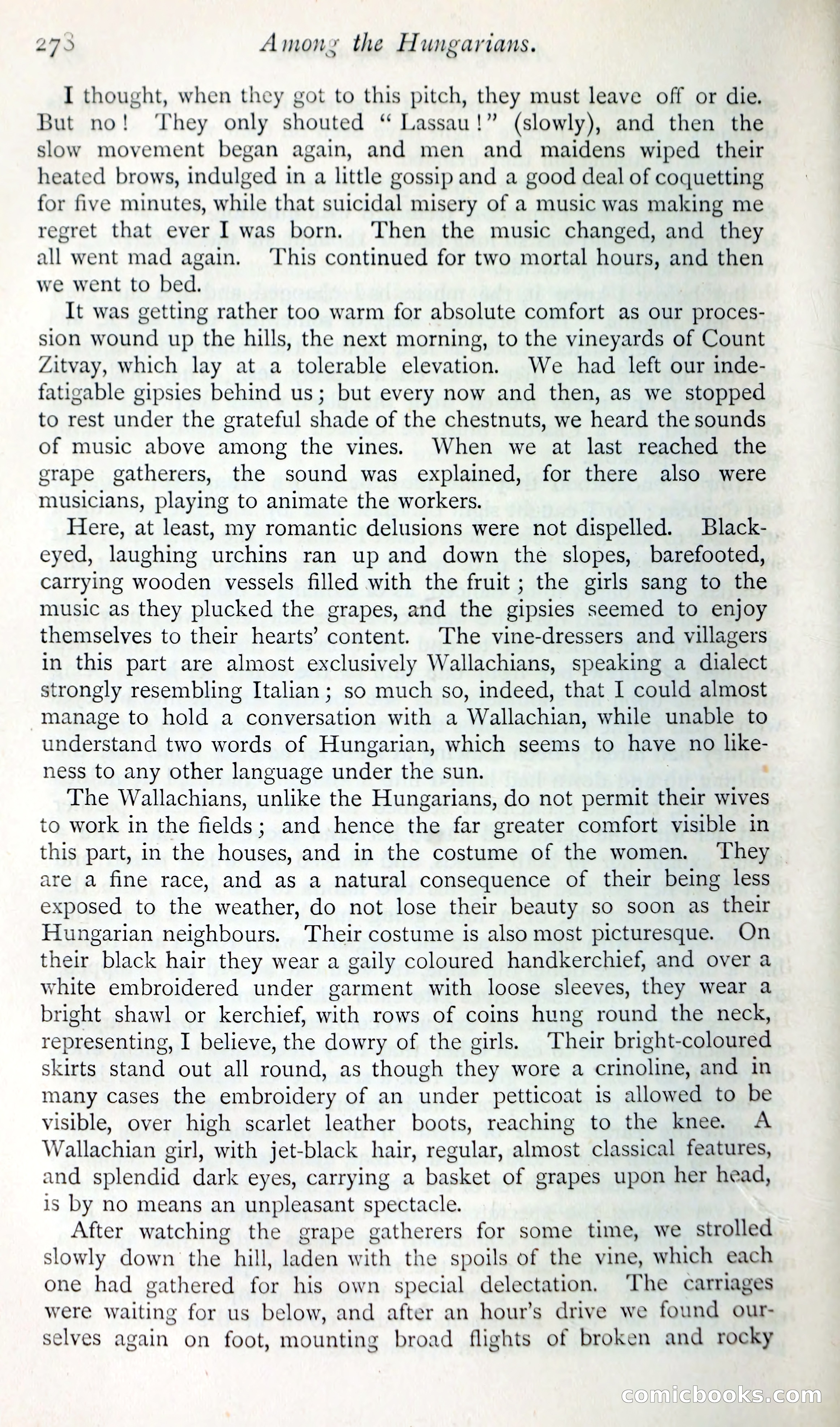
A restored page from Pulp Fiction, 1865. Page through the whole issue in the reader above.
📄 Transcribed text from this page (OCR, searchable)
Machine-transcribed from the original scan — historical spelling and the odd misread are preserved.
273 Among the Hungarians. I thought, when they got to this pitch, they must leave off or die. But no! ‘They only shouted “ Lassau!” (slowly), and then the slow movement began again, and men and maidens wiped their heated brows, indulged in a little gossip and a good deal of coquetting for five minutes, while that suicidal misery of a music was making me regret that ever I was born. ‘Then the music changed, and they all went mad again. ‘This continued for two mortal hours, and then we went to bed. It was getting rather too warm for absolute comfort as our proces- sion wound up the hills, the next morning, to the vineyards of Count Zitvay, which lay at a tolerable elevation. We had left our inde- fatigable gipsies behind us; but every now and then, as we stopped to rest under the grateful shade of the chestnuts, we heard the sounds of music above among the vines. When we at last reached the grape gatherers, the sound was explained, for there also were musicians, playing to animate the workers. Here, at least, my romantic delusions were not dispelled. Black- eyed, laughing urchins ran up and down the slopes, barefooted, carrying wooden vessels filled with the fruit; the girls sang to the music as they plucked the grapes, and the gipsies seemed to enjoy themselves to their hearts’ content. The vine-dressers and villagers in this part are almost exclusively Wallachians, speaking a dialect strongly resembling Italian; so much so, indeed, that I could almost manage to hold a conversation with a Wallachian, while unable to understand two words of Hungarian, which seems to have no like- ness to any other language under the sun. . The Wallachians, unlike the Hungarians, do not permit their wives to work in the fields; and hence the far greater comfort visible in this part, in the houses, and in the costume of the women. They — are a fine race, and as a natural consequence of their being less exposed to the weather, do not lose their beauty so soon as their Hungarian neighbours. Their costume is also most picturesque. On their black hair they wear a gaily coloured handkerchief, and over a white embroidered under garment with loose sleeves, they wear a bright shawl or kerchief, with rows of coins hung round the neck, representing, I believe, the dowry of the girls. Their bright-coloured skirts stand out all round, as though they wore a crinoline, and in many cases the embroidery of an under petticoat is allowed to be visible, over high scarlet leather boots, reaching to the knee. A Wallachian girl, with jet-black hair, regular, almost classical features, and splendid dark eyes, carrying a basket of grapes upon her head, is by no means an unpleasant spectacle. After watching the grape gatherers for some time, we strolled slowly down the hill, laden with the spoils of the vine, which each one had gathered for his own special delectation, ‘The carriages were waiting for us below, and after an hour’s drive we found our- selves again on foot, mounting broad flights of broken and rocky EOLMICLNOVO| KS, (E00)