
Pulp Fiction, 1865 · page 286 of 400
The Argosy — page 286: what you’re looking at
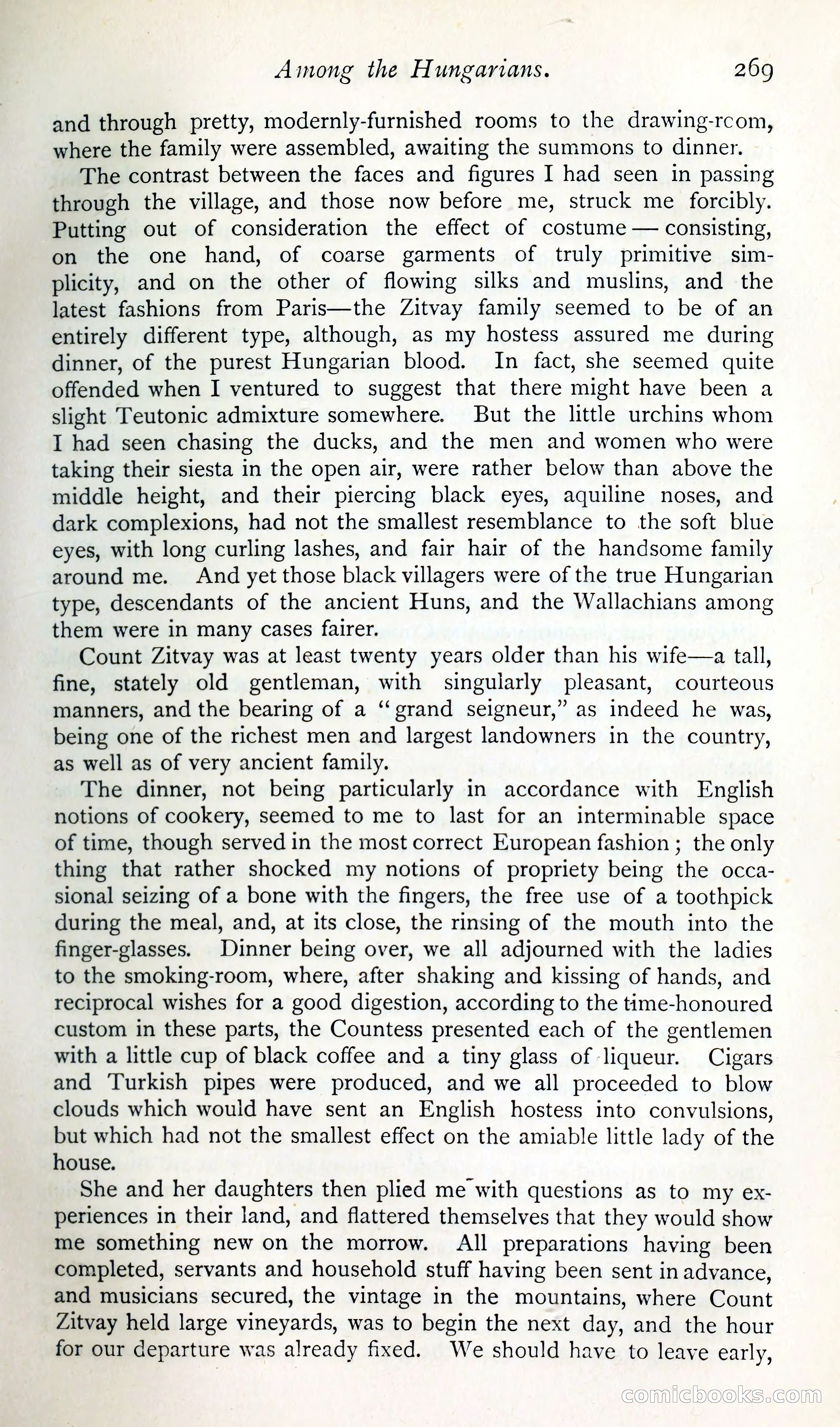
A restored page from Pulp Fiction, 1865. Page through the whole issue in the reader above.
📄 Transcribed text from this page (OCR, searchable)
Machine-transcribed from the original scan — historical spelling and the odd misread are preserved.
Among the Hungarians. 269 and through pretty, modernly-furnished rooms to the drawing-rcom, where the family were assembled, awaiting the summons to dinner. The contrast between the faces and figures I had seen in passing through the village, and those now before me, struck me forcibly. Putting out of consideration the effect of costume — consisting, on the one hand, of coarse garments of truly primitive sim- plicity, and on the other of flowing silks and muslins, and the latest fashions from Paris—the Zitvay family seemed to be of an entirely different type, although, as my hostess assured me during dinner, of the purest Hungarian blood. In fact, she seemed quite offended when I ventured to suggest that there might have been a slight Teutonic admixture somewhere. But the little urchins whom I had seen chasing the ducks, and the men and women who were taking their siesta in the open air, were rather below than above the middle height, and their piercing black eyes, aquiline noses, and dark complexions, had not the smallest resemblance to the soft blue eyes, with long curling lashes, and fair hair of the handsome family around me. And yet those black villagers were of the true Hungarian type, descendants of the ancient Huns, and the Wallachians among them were in many cases fairer. Count Zitvay was at least twenty years older than his wife—a tall, fine, stately old gentleman, with singularly pleasant, courteous manners, and the bearing of a “‘grand seigneur,” as indeed he was, being one of the richest men and largest landowners in the country, as well as of very ancient family. The dinner, not being particularly in accordance with English notions of cookery, seemed to me to last for an interminable space of time, though served in the most correct European fashion ; the only thing that rather shocked my notions of propriety being the occa- sional seizing of a bone with the fingers, the free use of a toothpick during the meal, and, at its close, the rinsing of the mouth into the finger-glasses. Dinner being over, we all adjourned with the ladies to the smoking-room, where, after shaking and kissing of hands, and reciprocal wishes for a good digestion, according to the time-honoured custom in these parts, the Countess presented each of the gentlemen with a little cup of black coffee and a tiny glass of liqueur. Cigars and Turkish pipes were produced, and we all proceeded to blow clouds which would have sent an English hostess into convulsions, but which had not the smallest effect on the amiable little lady of the house. She and her daughters then plied me with questions as to my ex- periences in their land, and flattered themselves that they would show me something new on the morrow. All preparations having been completed, servants and household stuff having been sent in advance, and musicians secured, the vintage in the mountains, where Count Zitvay held large vineyards, was to begin the next day, and the hour for our departure was already fixed. We should have to leave early, CONNICLOOKS.EO