
Pulp Fiction, 1865 · page 283 of 400
The Argosy — page 283: what you’re looking at
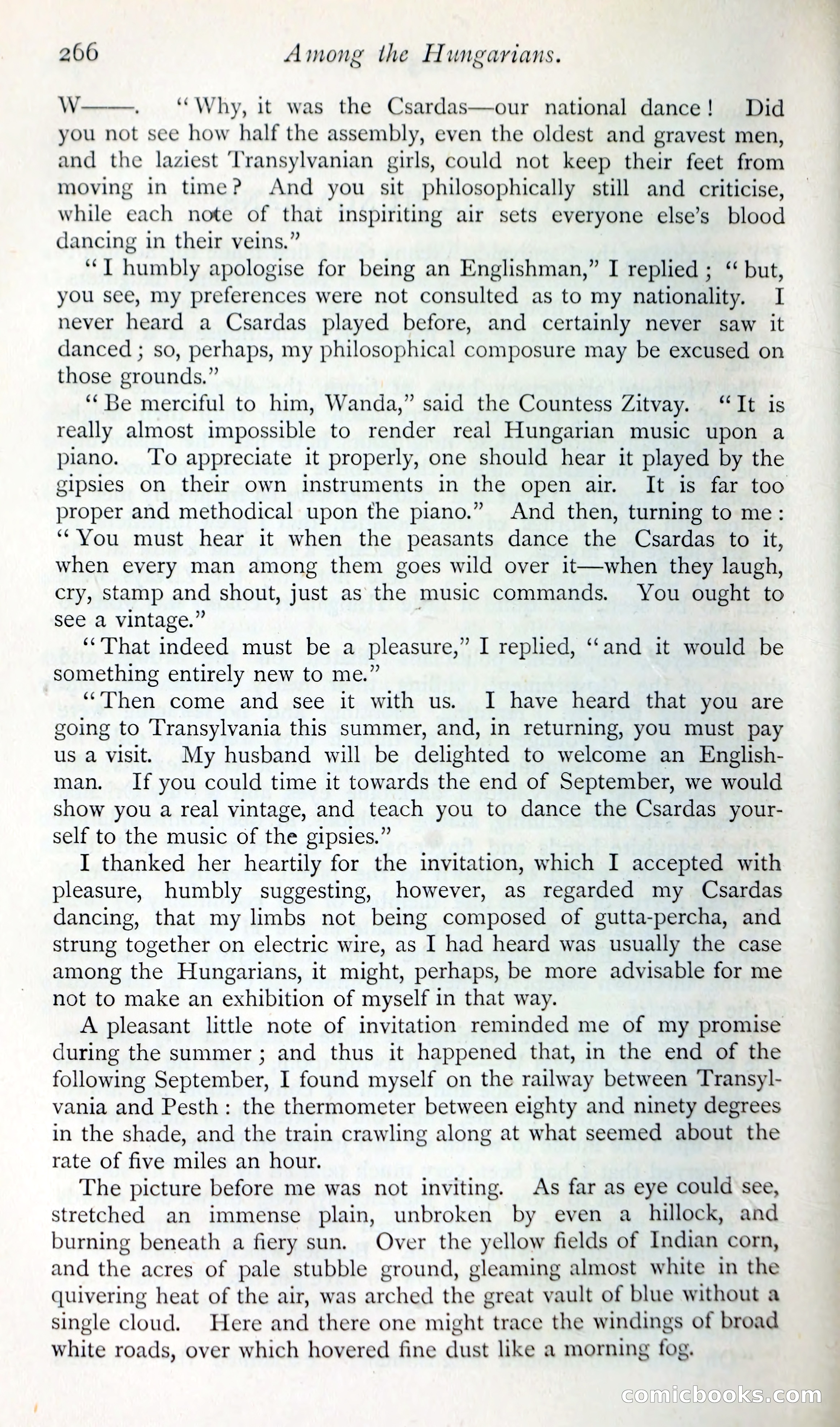
A restored page from Pulp Fiction, 1865. Page through the whole issue in the reader above.
📄 Transcribed text from this page (OCR, searchable)
Machine-transcribed from the original scan — historical spelling and the odd misread are preserved.
266 Among the Hungarians. W——. ‘Why, it was the Csardas—our national dance! Did you not see how half the assembly, even the oldest and gravest men, and the laziest ‘Transylvanian girls, could not keep their feet from moving in time? And you sit philosophically still and criticise, while each note of that inspiriting air sets everyone else’s blood dancing in their veins.” ‘“T humbly apologise for being an Englishman,” I replied; “ but, you see, my preferences were not consulted as to my nationality. I never heard a Csardas played before, and certainly never saw it danced ; so, perhaps, my philosophical composure may be excused on those grounds.” ‘Be merciful to him, Wanda,” said the Countess Zitvay. “It is really almost impossible to render real Hungarian music upon a plano. ‘To appreciate it properly, one should hear it played by the gipsies on their own instruments in the open air. It is far too proper and methodical upon the piano.” And then, turning to me: ‘You must hear it when the peasants dance the Csardas to it, when every man among them goes wild over it—when they laugh, cry, stamp and shout, just as the music commands. You ought to see a vintage.” : ‘That indeed must be a pleasure,” I replied, “‘and it would be something entirely new to me.” “Then come and see it with us. I have heard that you are going to Transylvania this summer, and, in returning, you must pay us a visit. My husband will be delighted to welcome an English- man. If you could time it towards the end of September, we would show you a real vintage, and teach you to dance the Csardas your- self to the music of the gipsies.” I thanked her heartily for the invitation, which I accepted with pleasure, humbly suggesting, however, as regarded my Csardas dancing, that my limbs not being composed of gutta-percha, and strung together on electric wire, as I had heard was usually the case among the Hungarians, it might, perhaps, be more advisable for me not to make an exhibition of myself in that way. A pleasant little note of invitation reminded me of my promise during the summer; and thus it happened that, in the end of the following September, I found myself on the railway between ‘Transyl- vania and Pesth: the thermometer between eighty and ninety degrees in the shade, and the train crawling along at what seemed about the rate of five miles an hour. The picture before me was not inviting. As far as eye could see, stretched an immense plain, unbroken by even a hillock, and burning beneath a fiery sun. Over the yellow fields of Indian corn, and the acres of pale stubble ground, gleaming almost white in the quivering heat of the air, was arched the great vault of blue without a single cloud. Here and there one might trace the windings of broad white roads, over which hovered fine dust like a morning fog. EOLMICLNCVO KS, (E00)