
Pulp Fiction, 1865 · page 282 of 400
The Argosy — page 282: what you’re looking at
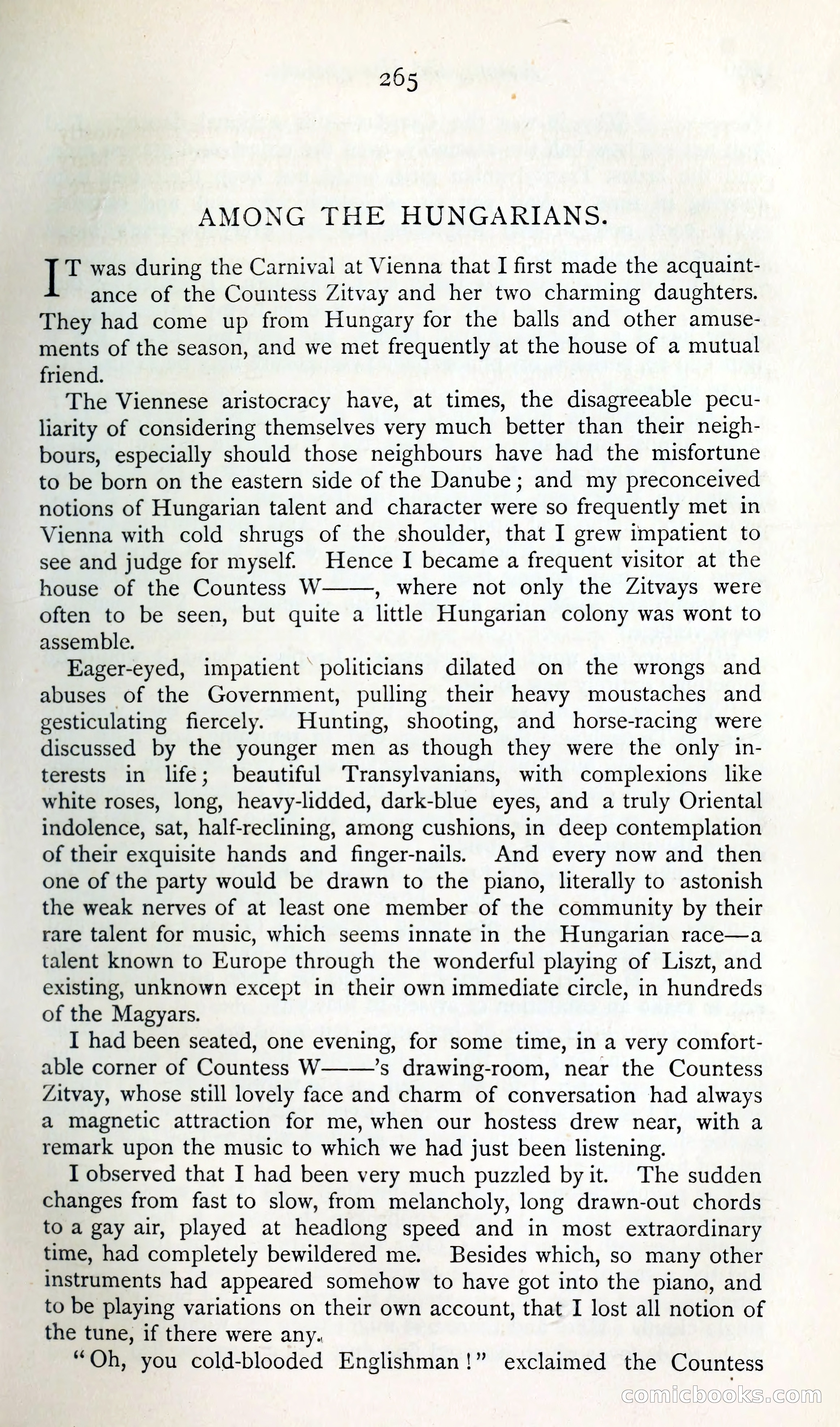
A restored page from Pulp Fiction, 1865. Page through the whole issue in the reader above.
📄 Transcribed text from this page (OCR, searchable)
Machine-transcribed from the original scan — historical spelling and the odd misread are preserved.
205 AMONG THE HUNGARIANS. T was during the Carnival at Vienna that I first made the acquaint- ance of the Countess Zitvay and her two charming daughters. They had come up from Hungary for the balls and other amuse- ments of the season, and we met frequently at the house of a mutual friend. The Viennese aristocracy have, at times, the disagreeable pecu- liarity of considering themselves very much better than their neigh- bours, especially should those neighbours have had the misfortune to be born on the eastern side of the Danube; and my preconceived notions of Hungarian talent and character were so frequently met in Vienna with cold shrugs of the shoulder, that I grew impatient to see and judge for myself. Hence I became a frequent visitor at the house of the Countess W , where not only the Zitvays were often to be seen, but quite a little Hungarian colony was wont to assemble. Eager-eyed, impatient politicians dilated on the wrongs and abuses of the Government, pulling their heavy moustaches and gesticulating fiercely. Hunting, shooting, and horse-racing were discussed by the younger men as though they were the only in- terests in life; beautiful Transylvanians, with complexions like white roses, long, heavy-lidded, dark-blue eyes, and a truly Oriental indolence, sat, half-reclining, among cushions, in deep contemplation of their exquisite hands and finger-nails. And every now and then one of the party would be drawn to the piano, literally to astonish the weak nerves of at least one member of the community by their rare talent for music, which seems innate in the Hungarian race—a talent known to Europe through the wonderful playing of Liszt, and existing, unknown except in their own immediate circle, in hundreds of the Magyars. I had been seated, one evening, for some time, in a very comfort- able corner of Countess W—-—’s drawing-room, near the Countess Zitvay, whose still lovely face and charm of conversation had always a magnetic attraction for me, when our hostess drew near, with a remark upon the music to which we had just been listening. I observed that I had been very much puzzled by it. The sudden changes from fast to slow, from melancholy, long drawn-out chords to a gay air, played at headlong speed and in most extraordinary time, had completely bewildered me. Besides which, so many other instruments had appeared somehow to have got into the piano, and to be playing variations on their own account, that I lost all notion of the tune, if there were any. “Oh, you cold-blooded Englishman!” exclaimed the Countess GOnlGaooks mn